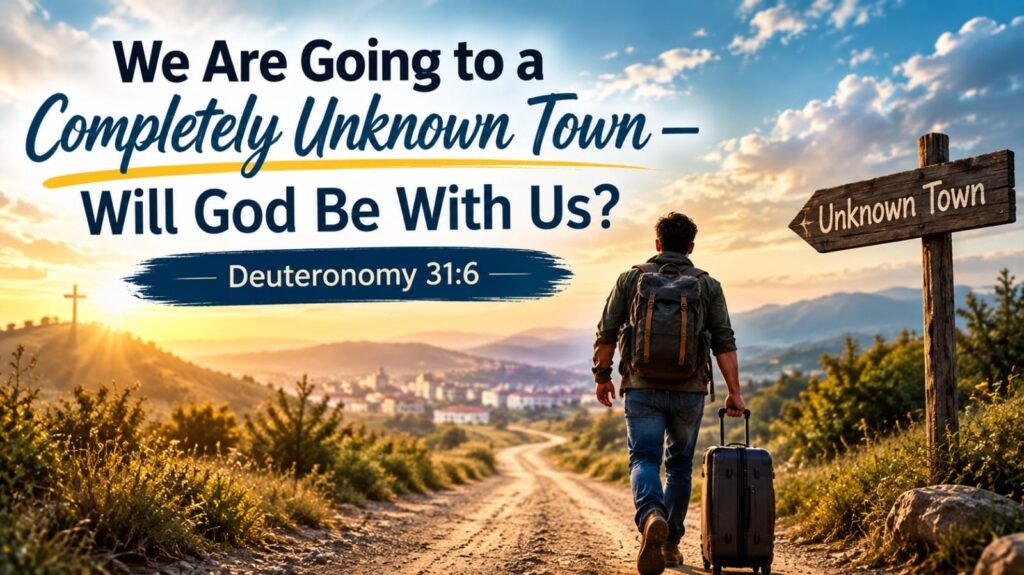
It takes years to build a home. It takes just as long to build a life in a town — the neighbors you borrow tools from, the friends your kids run to at the bus stop, the coffee shop where the barista starts making your order before you reach the counter, the Sunday church where you’re known by name, the streets you navigate without even thinking.
Then, suddenly, you are asked to leave it all behind and move to a place you have never seen.
You don’t know what the new house will look like. You don’t know if your kids will adjust to the new school. You don’t know how the new job will play out. You don’t know a single soul.
That one word — unknown — can shake your heart to its core.
This fear isn’t just a feeling. It shows up physically. Some people get a knot in their stomach. Some lie awake at 2 a.m., staring at the ceiling. Some snap at their family over the smallest things. Inside, a silent battle rages — a question that keeps circling: “Is this the right move? What if it all falls apart?”
We humans are naturally afraid of change. A familiar struggle can feel safer than an unfamiliar blessing. Familiar faces, familiar roads, familiar routines — they anchor us. When those anchors are suddenly pulled up, it feels like the ground has disappeared. That’s why, on the night before a big move, so many people lie in bed with their eyes wide open.
Inside, one question keeps churning: “Will we really be okay there? Will God be with us there too — or does His presence somehow stay behind in the place we’re leaving?”
We are not the first people to ask this. In the Bible, an entire nation asked the very same thing. They too were about to leave the familiar and step into something completely unknown. Their story gives us a clear answer.
Key Verse
“Be strong and of a good courage, fear not, nor be afraid of them: for the LORD thy God, he it is that doth go with thee; he will not fail thee, nor forsake thee.”
— Deuteronomy 31:6 (KJV)
In plain words: Moses told the people to be strong and not to be afraid of their enemies, because the LORD their God was going with them himself. He would not let them down, and He would not leave them.
Historical Background
The Israelites had wandered in the wilderness for forty years. That was the only life they knew — the same tents, the same daily manna, the same dusty path.
Now a new chapter stood before them: the land of Canaan. It was the land God had promised them, but it was also full of fortified cities, powerful armies, and battles they would have to fight. They didn’t know that land. They had no clue how to live there.
And on top of everything else, Moses — the man who had led them for four decades — wouldn’t be going with them. Moses was a hundred and twenty years old, and the LORD had told him that he would not cross the Jordan River (Deuteronomy 31:2). That made their fear double: an unknown land, and the absence of the leader who had walked with them through everything.
Years earlier, they had sent twelve spies to scout the land (Numbers 13). Ten of them came back with terrifying reports about giant walls and fierce warriors, and the whole nation was paralyzed by fear. That fear was the very reason they had spent forty years in the wilderness (Numbers 14:33-34). Now, here they were again, standing at the edge of the same land. The same challenge had returned. But this time, there was no turning back. They had to move forward.
It was in this moment that Moses stood before all Israel and spoke his farewell words (Deuteronomy 31:1-6). The promise above was not only for Joshua, their new leader. It was for everyone. Then Moses turned to Joshua and said, in front of all the people: “And the LORD, he it is that doth go before thee; he will be with thee, he will not fail thee, neither forsake thee: fear not, neither be dismayed.” (Deuteronomy 31:8, KJV) In plain words: the LORD himself would walk ahead of Joshua and stay with him, so Joshua had no reason to be afraid or discouraged.
And later, they did step into that land. There were struggles and battles, yes. But history proves one thing — they were never left alone. The same God who led them through the wilderness was with them in every new field they set foot in.
The Story of David and Sarah
David and Sarah had lived in the same town in Ohio for twelve years with their two kids, Emma and Jack. That town had become their whole world. They knew the neighbors who hosted the block party every summer. They knew which pediatrician to call. The kids had grown up in that house, with those friends, in that school district.
One Tuesday afternoon, David got a call from his boss. The company was restructuring, and his role was being relocated to a regional office in Texas. It was a promotion — more responsibility, better pay. They had about two months to make the move.
At first, David took the news with a mix of excitement and adrenaline. But that evening, when he told Sarah, her face showed less excitement and much more anxiety.
“What about Emma’s dance team? Jack finally has a solid group of friends. My parents are only two hours away. We don’t know anyone in Texas.”
The same questions echoed in David’s mind. They would have to find a new house in a crazy market, new schools, new doctors, a new church. If a crisis hit, there would be no family nearby to help with the kids.
When the kids heard the news, both of them cried. Emma, their middle-schooler, said she absolutely couldn’t leave her best friend. Jack, their youngest, was afraid he’d eat lunch alone every day at a new school.
The next morning, David went to work, but his mind was somewhere else. During lunch, a colleague said, “I heard about the promotion. Congrats! But you don’t look very excited.” David smiled and replied, “On the outside, I’m trying to be positive. On the inside, I’m honestly terrified.” His colleague nodded and said, “I moved my family across three states five years ago. The first three months were brutal. But looking back now, it was the best thing for us.” Those words gave David some courage, but the knot in his stomach didn’t go away.
That evening at home, the kids were still upset. Emma shut herself in her room. David and Sarah tried to talk to her, but she just sat on her bed with tears rolling down her cheeks. Sarah put her arm around her and said, “I’m scared too, sweetheart. It’s not just you.” That one honest sentence calmed something in Emma — knowing she wasn’t the only one feeling this way.
After the kids were asleep, David sat on the back porch. One thought kept spinning in his head: “Are we making a massive mistake? What if we can’t settle in? What if the kids never forgive us?” Sarah came out and sat beside him. For a while, neither of them spoke.
Then Sarah said quietly, “We haven’t really prayed about this together, have we?”
They prayed. Simply. Honestly. Afterward, Sarah opened her Bible. She flipped a few pages, searching for something, and stopped at Deuteronomy 31. She read the verse out loud:
“Be strong and of a good courage, fear not, nor be afraid of them: for the LORD thy God, he it is that doth go with thee; he will not fail thee, nor forsake thee.”
Something shifted in David. He thought to himself: “The Israelites were heading into a land they knew nothing about. They were scared to death. But God’s word to them wasn’t ‘stay where it’s safe.’ It was ‘he it is that doth go with thee.’”
That night, David and Sarah understood something deep: God’s presence isn’t zip-code specific. It isn’t tied to a particular house, a particular school district, or a particular circle of friends. His presence travels.
In the weeks that followed, they began to prepare. They researched churches online. They joined a local parents’ Facebook group in the new city and asked about schools. They made a list of what they could control and tried to release what they couldn’t.
The fear didn’t magically vanish. The first month in Texas was honestly rough — boxes everywhere, the kids crying after their first day at the new school, David feeling the pressure to prove himself in a new office. For the first two weeks, Sarah fought intense loneliness. Every day, David went to work, and she was left in a house full of unpacked boxes with no one to talk to. One night she called her mom, crying, and said, “Mom, I think we made a terrible mistake.”
But slowly, week by week, small signs of hope appeared. One evening, a neighbor knocked on the door with a plate of cookies and a warm welcome. At the kids’ school, a teacher made a special effort to pair Jack with a buddy for lunch. A coworker invited David to grab coffee and mentioned his church, which led to the first Sunday visit where someone actually remembered their names the second week.
One by one, connections formed. Emma made the volleyball team and found her people. Jack got invited to a birthday party and came home beaming. Sarah joined a small group at church, and the loneliness began to lift.
Six months later, Sarah said on the phone to her mom, “You know, when we moved here, I thought we’d lost everything familiar. But now I can honestly see — God didn’t stay in Ohio. He came with us to Texas too.”
Here’s the crucial part: God didn’t erase their struggles. They still had to hunt for a house, help their kids adjust, and navigate the stress of a new job. God didn’t airlift them out of the hardship. But He didn’t leave them alone in the middle of it. In His way and in His timing, He opened doors — connections, friendships, small mercies. God may not instantly remove our difficulties, but He walks with us through them and provides what we need, exactly when we need it.
Biblical Explanation
This verse teaches us four deep truths.
First, fear is normal, but it doesn’t get the final say. Moses didn’t tell them, “You won’t feel fear.” He commanded them, “fear not, nor be afraid of them.” He knew fear would come — but he also knew it was not meant to be the loudest voice in the room.
Second, God’s presence is connected to a person, not a place. God didn’t say, “I’ll stay in this wilderness and wait for you.” Through Moses He said, “the LORD thy God, he it is that doth go with thee.” His companionship moves wherever you move.
Third, the words “fail thee” and “forsake thee” are placed side by side. Together they promise that God will neither let you down nor walk away from you.
Fourth, this promise was given to an entire community, not just one superhero leader. It belongs to families, to households, to everyone facing the unknown together.
Application for Today
Today, many people face similar turning points.
A family relocating for a new job across the country.
A college freshman moving to a campus where they know no one.
A retired couple downsizing and moving closer to their adult children.
A single mom starting over in a new city after a divorce.
A family displaced by a hurricane, rebuilding in a different state.
In every one of these hearts, the same question beats: “We don’t know anyone here. Are we going to make it?”
And God gives the same answer: “he it is that doth go with thee; he will not fail thee, nor forsake thee.”
A Gentle Caution
But we need to understand something clearly: the promise “God is with me” is never a free pass to be reckless.
Some people hear this and think, “Well, God’s with me, so I don’t really need to plan, budget, or think ahead.” That’s not faith; that’s foolishness.
David and Sarah trusted God’s promise, but they didn’t sit on the couch waiting for a house to fall from heaven. They researched, planned, asked questions, and did the hard work of preparing. Trusting God’s presence doesn’t replace our responsibility — it empowers us to fulfill our responsibility without being consumed by fear.
Even the Israelites, though assured of God’s presence, still had to prepare for battle, make strategic plans, and move forward with wisdom. God’s presence didn’t replace their effort — it strengthened it. Prayer and preparation, trust and practical action — these must walk hand in hand.
Practical Steps
When you’re facing a new and unknown situation, these steps can help ground you:
1. Be brutally honest with God about your fear. Don’t sanitize your prayers. Tell Him, “I’m genuinely terrified right now. Help me.” That’s real faith.
2. Put this verse where you’ll see it daily. On your bathroom mirror, your phone lock screen, a sticky note on the dashboard. When fear hits, read it out loud.
3. Do what’s in your control to prepare. Research neighborhoods, schools, churches. Ask for recommendations. Make checklists. Preparation is a form of stewardship.
4. Pray together as a family. Instead of everyone carrying their fears alone, bring them into the open before God. Let your kids voice their fears too — don’t make them carry it silently.
5. Notice the small mercies. A friendly neighbor, a kind coworker, a teacher who goes the extra mile — these aren’t coincidences. They’re quiet evidence that God is already there, going ahead of you.
6. Find someone who’s walked this road before. Their story will give you perspective. One person saying, “We were terrified too, but God was faithful,” can be a lifeline.
7. Give yourself time to adjust. Settling in doesn’t happen in a weekend. It takes months. Don’t panic when you don’t feel at home right away. God’s faithfulness often reveals itself gradually
Conclusion
So, to the question “We have to move to a place we’ve never even seen — is God really going with us?” the answer is clear.
Yes. He is.
That doesn’t mean the fear will instantly vanish. It doesn’t mean the new place won’t bring hard days. The first weeks, maybe even the first months, may feel lonely and disorienting.
But God’s presence is not confined to one street, one church building, one familiar zip code. His presence travels with you. And here’s the beautiful truth: He is already there, ahead of you, preparing the way.
David and Sarah’s family still sometimes misses their old town in Ohio. Some memories still tug at their hearts. But they have learned a truth that outlasts any move: houses change, cities change, seasons change, but God’s presence never changes. He is their true stability.
If you are standing on the edge of a major transition today, take this one truth with you: on every new ground you step onto, God is already there. You are not walking into the unknown alone.
“for the LORD thy God, he it is that doth go with thee; he will not fail thee, nor forsake thee.” — Deuteronomy 31:6 (KJV)
Related Articles
- Scared of What’s Next? What to Do When the Road Ahead Is Unclear
- Abraham Biography: His Life, Faith, Family, and God’s Promises
- Waking Up Every Morning with Fear and Anxiety?
- Browse all English Bible articles
Disclaimer
Verses: All Bible verses in this article are quoted from the King James Version (KJV). Under each verse, we explain in plain words the situation in which it was written. To understand a verse fully, we encourage you to read the whole chapter in your own Bible.
Language: We wrote this article in simple, everyday English for readers who may not know the Bible well. It is meant for personal reflection and encouragement, not as an official Bible commentary.
Story: The story in this article (the names and events) is made up as an illustration. It is not from the Bible, and it is only here to help you understand the verse. When we mention history that is not in the Bible, we say so right there.
Written by Team HolyBibleWithYou.com