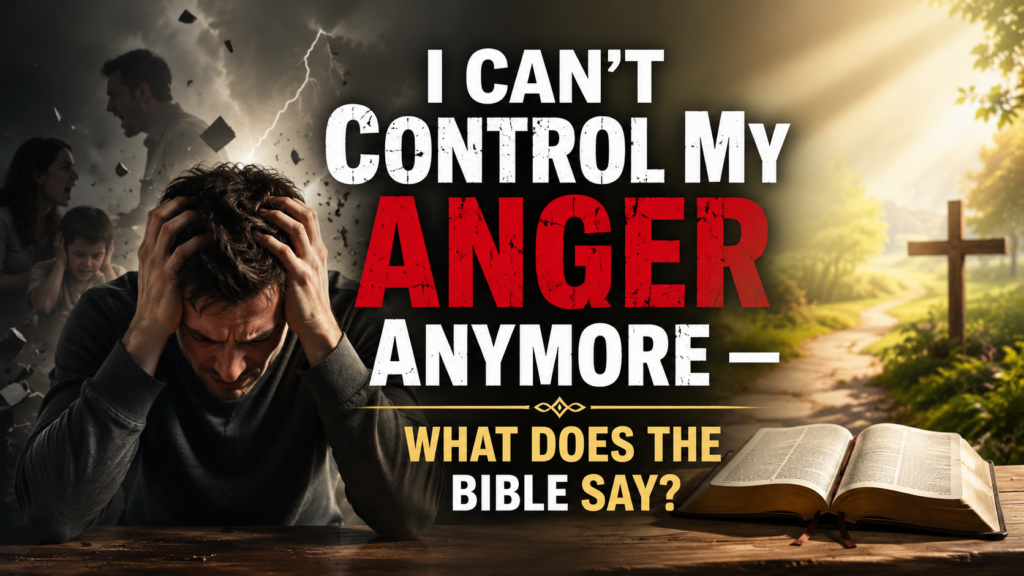
What Do You Do When Anger Takes Over?
Have you ever snapped over something ridiculously small — a spilled drink, a broken dish, someone cutting you off on the highway — and then immediately felt that wave of regret? “What was I thinking? I just hurt the people I care about most over something so stupid.”
In that moment, it sure feels like anyone in your shoes would’ve reacted the same way. You’re running on empty. You’re stressed out. And honestly, you just don’t have the energy to fake a smile anymore.
And it’s true — we’re all carrying a lot these days. Between the pressure at work, the bills that never seem to stop, and the constant comparison game on social media, there’s not much left in the tank. You try to be real with people, but some folks are just fake, and even the ones you love misunderstand you. It’s hard not to get angry.
But here’s the thing. When you blow up, people label you. You’re the angry one. The unstable one. But if you stuff it all down inside, it eats at you. Maybe you end up anxious or depressed. Or maybe you hold it together for weeks, months, even years — and then one day you explode like a pressure cooker. And that one moment can destroy relationships you’ve spent a lifetime building.
And it usually doesn’t stop with anger, does it? Jealousy and resentment creep in. You see a friend getting ahead. Someone else gets the recognition you deserved. And a quiet bitterness starts to grow. You don’t let it out, so it just sits there, turning into something ugly. Eventually, it comes out sideways — harsh words, a cold shoulder, or worse.
So how do you break the cycle? The Bible actually has some pretty practical things to say about this exact struggle.
The Story of Mike (A Fictional Example)
Mike runs a small auto repair shop. It’s honest work. But the pressure never lets up. The rent keeps climbing. The cost of parts is through the roof. And customers are always trying to talk him down on price. The money stress is always there, eating at him.
Mike’s biggest weakness — and maybe his biggest strength — is that he’s a straight shooter. He doesn’t know how to play the game, how to cut corners or upsell people on stuff they don’t need. He just does the work and tells the truth. But in a world that rewards slick marketing and half-truths, his honesty sometimes feels like a curse. His buddies tell him, “Dude, you’ve got to get more aggressive. You can’t survive being this nice all the time.” Every time he hears that, a little piece of him just sinks.
One evening, after a long, brutal day, Mike is heading home when he runs into an old friend from college, Derek. Derek always seems to land on his feet. New boat. Vacations every other month. Rental properties. Derek grins and says, “Mike, man, you’re still turning wrenches in that same old shop? You’ve got to get in on this crypto stuff. That’s where the real money is. Working hard is for suckers.”
Those words hit Mike right in the gut. “I’m busting my back doing honest work, and this guy just falls into money?” The jealousy and hurt pride start to build. But Mike doesn’t say anything. He forces a smile, clenches his jaw, and pushes it all down. He heads home with a storm brewing inside him.
By the time he walks through the front door, Mike is ready to blow.
First trigger: His ten-year-old son, Ethan, is supposed to be studying for a big test tomorrow. Instead, he’s zoned out on his tablet playing video games. Mike feels the annoyance flare up.
Second trigger: His wife, Sarah, comes in from the kitchen looking worn out. “Hey, the school sent a reminder — Ethan’s field trip payment is due tomorrow. Can we swing that?” Mike is already drowning in bills. That question just adds another brick to the pile.
Final straw: Ethan, reaching for a glass of water, accidentally knocks his juice off the counter. The glass shatters on the tile floor.
And just like that, Mike loses it. He yells at his son. He turns on his wife — “Do you have any idea how hard I work? You’re bleeding me dry!” Ethan runs to his room and slams the door. He’s scared. Sarah just stands there, trying not to cry.
Half an hour later, the anger has drained away. Mike is left staring at the broken glass on the floor. And it hits him — the people he loves most, the ones who would do anything for him, are the ones he just tore apart. He puts his head in his hands and breaks down.
What the Bible Says About It
Mike’s story isn’t unique. The Bible is full of people who let their anger and jealousy get the best of them. Let’s look at a few of those stories.
1. Moses Lost His Cool (Numbers 20:7-12, KJV)
Moses was one of the greatest leaders in history. He led the nation of Israel out of slavery in Egypt toward the Promised Land. What should have been a short trip turned into forty long years of wandering in the desert, mostly because the people wouldn’t stop complaining and rebelling.
During those forty years, the people griped about everything — no water, no food, “Wherefore is this that thou hast brought us up out of Egypt, to kill us and our children and our cattle with thirst?” (Exodus 17:3, KJV) And through it all, God kept showing up. Parted the Red Sea. Sent food from heaven. Made water come out of a rock.
Then they came to a place called Meribah. The name literally means “quarreling.” The people were thirsty, and they turned on Moses and his brother Aaron. “Would God that we had died when our brethren died before the LORD! And why have ye brought up the congregation of the LORD into this wilderness, that we and our cattle should die there?” (Numbers 20:3-4, KJV)
Moses and Aaron went to God. And God gave Moses a specific instruction: “Take the rod, and gather thou the assembly together, thou, and Aaron thy brother, and speak ye unto the rock before their eyes; and it shall give forth his water, and thou shalt bring forth to them water out of the rock: so thou shalt give the congregation and their beasts drink.” (Numbers 20:8, KJV) In plain words: God told Moses to take his rod, gather the people, and speak to the rock, and the rock would give water.
But Moses was done. After all those years of whining and complaining, he’d had it. He turned to the people and said, “Hear now, ye rebels; must we fetch you water out of this rock?” (Numbers 20:10, KJV) Then he struck the rock twice with his staff. Water gushed out. Everyone drank.
But God said to Moses and Aaron, “Because ye believed me not, to sanctify me in the eyes of the children of Israel, therefore ye shall not bring this congregation into the land which I have given them.” (Numbers 20:12, KJV) In plain words: God said that because Moses and Aaron did not trust Him enough to honor Him as holy before the people, they would not lead Israel into the Promised Land.
The Bible doesn’t tell us exactly what was going on inside Moses’s heart at that moment. We know the people had been pushing his buttons for years. But the lesson is clear: when God gives you instructions, follow them His way — not yours. No matter how frustrated you are.
2. King Saul’s Jealousy (1 Samuel 18:8-9)
Saul was the first king of Israel. He looked the part — tall, handsome, strong. The people were thrilled to have him.
Then along came a young man named David. The son of a man named Jesse. David started out as a shepherd, then became a musician in Saul’s court. God had big plans for him.
At the time, Israel was at war with the Philistines. Their champion was a giant named Goliath — huge, terrifying, and he challenged the Israelite army every single day. Everyone was scared of him. Even King Saul.
But David — this young guy with just a sling and a stone — stepped up and took Goliath down with one shot. It was a massive victory for Israel.
After the battle, the women were singing and dancing. But their song cut Saul deep:
“Saul hath slain his thousands, and David his ten thousands.” (1 Samuel 18:7, KJV)
Saul was furious. He said, “They have ascribed unto David ten thousands, and to me they have ascribed but thousands: and what can he have more but the kingdom?” (1 Samuel 18:8, KJV) And the Bible says, “And Saul eyed David from that day and forward.” (1 Samuel 18:9, KJV) In plain words: Saul was angry that the women gave David more credit than him, and from then on he watched David with jealousy.
Saul tried to kill David multiple times. Even though David married Saul’s daughter and was best friends with Saul’s son Jonathan, Saul kept hunting him. Eventually, Saul was wounded in battle and took his own life (1 Samuel 31). His kingdom passed to David.
The Bible doesn’t say jealousy was the single cause of Saul’s death. But it clearly shows that jealousy drove him toward suspicion and hatred. Jealousy left unchecked will wreck everything.
3. God’s Warning to Cain (Genesis 4:6-7)
The first book of the Bible, Genesis, tells the story of the first humans, Adam and Eve, and their two sons: Cain, a farmer, and Abel, a shepherd.
Both brothers brought offerings to God. Cain brought some of his crops. Abel brought the best of his flock. God accepted Abel’s offering, but not Cain’s. Cain was furious. You could see it all over his face.
God said to Cain: “Why art thou wroth? and why is thy countenance fallen? If thou doest well, shalt thou not be accepted? and if thou doest not well, sin lieth at the door. And unto thee shall be his desire, and thou shalt rule over him.” (Genesis 4:6-7, KJV) In plain words: God asked Cain why he was angry, and warned him that sin was lying at his door.
Later, Cain lured his brother Abel out into the field and killed him. The first murder in human history.
The book of Hebrews (11:4) tells us that Abel gave his offering in faith. Genesis 4 doesn’t tell us exactly what was in Cain’s heart. But God warned him clearly: sin was waiting at his door, and he needed to get control of it. It’s a warning: if you don’t deal with your anger, it will deal with you.
4. Peter’s Fall (Matthew 26:33-35, 75)
Peter was one of Jesus’s closest disciples. Three years he spent with Jesus. He was all in — or so he thought.
Jesus told his disciples that He was going to be arrested and killed, and that they would all abandon Him. Peter immediately spoke up: “Though all men shall be offended because of thee, yet will I never be offended.” (Matthew 26:33, KJV)
Jesus replied: “Verily I say unto thee, That this night, before the cock crow, thou shalt deny me thrice.” (Matthew 26:34, KJV)
Peter doubled down: “Though I should die with thee, yet will I not deny thee.” (Matthew 26:35, KJV)
That same night, Jesus was arrested. Peter followed at a distance. When people recognized him and asked if he was one of Jesus’s followers, Peter denied it three times. Immediately, a rooster crowed. And Peter went outside and cried his eyes out.
Peter’s story isn’t exactly about anger. It’s about overconfidence, relying on yourself, and giving in to fear. Trusting too much in your own strength — and ignoring warnings — can lead to a painful fall.
5. A Handful of Peace (Ecclesiastes 4:6)
Ecclesiastes is part of the Bible’s wisdom literature. It grapples with what really matters in life.
“Better is an handful with quietness, than both the hands full with travail and vexation of spirit.” (Ecclesiastes 4:6, KJV) In plain words: it is better to have a little with peace than to have a lot with hard work and stress.
This verse isn’t directly about anger, but it speaks to the pressure and dissatisfaction that often fuel it. We push ourselves to the breaking point, always wanting more. And we sacrifice our peace in the process. Always chasing more will steal your peace.
6. Don’t Let the Sun Go Down on Your Anger (Ephesians 4:26)
Ephesians is a letter written by the apostle Paul to a church in the city of Ephesus. Paul had once persecuted Christians, but after a life-changing encounter with Jesus, he became one of the most influential voices in the early church.
In this letter, Paul gets practical about everyday life:
“Be ye angry, and sin not: let not the sun go down upon your wrath: Neither give place to the devil.” (Ephesians 4:26-27, KJV)
Paul isn’t saying that anger itself is always a sin. Sometimes anger is a natural response to injustice or pain. But he warns that anger needs to be kept in check. And it shouldn’t be allowed to fester. “let not the sun go down upon your wrath” means don’t hold onto anger for days on end. It’s not saying every conflict has to be resolved by bedtime, but it’s a clear call not to let anger set up camp in your heart.
7. A Gentle Answer Defuses Anger (Proverbs 15:1)
Proverbs is a collection of short, practical wisdom sayings.
“A soft answer turneth away wrath: but grievous words stir up anger.” (Proverbs 15:1, KJV) In plain words: a gentle answer calms anger, but harsh words make it grow.
It’s simple and true. When someone is angry with you, harsh words will only make it worse. A calm, gentle response can actually calm the situation down. And it works the other way too — when you’re the one who’s angry, choosing to speak gently can help you settle down.
A Deeper Look at What’s Going On
Note: These are personal reflections, not direct biblical teachings.
We’re Carrying More Than We Can Handle
Think of it like a backpack that can comfortably carry 20 pounds. Pack exactly 20 pounds, and you’re good to go all day.
But what if you look around and see everyone else carrying 40-pound packs? What if you feel like you have to keep up? You stuff your pack with 40 pounds of expectations, comparisons, and “I should be able to handle this.” Sooner or later, the straps are going to break.
Mike’s capacity was 20 pounds, but he loaded up 40. His wife had warned him — “Let’s just live within our means.” But he didn’t listen. If he had admitted his limits earlier, he could have avoided the explosion.
Anger Rarely Comes Out of Nowhere
We often say, “I just snapped.” But in most cases, it’s not that sudden. We collect small annoyances, frustrations, and stresses all day long. We shove them down and try to ignore them. Then, one tiny thing — a spilled drink, a forgotten chore — becomes the trigger. And everything we’ve been holding in comes flooding out at once.
This doesn’t happen the same way for everyone. But here’s the thing: even when anger feels sudden, there’s often a lot of unresolved pressure behind it.
What to Do in the Moment
When You Feel the Anger Rising
Hit pause. When you feel that surge of anger, just stop. Count backward from 10 in your head before you say a word. That tiny pause is worth a lot.
Step away. If you’re in the middle of an argument or a stressful situation, physically leave the room. Go outside, walk around the block, or just stand on the porch for a few minutes.
Drink some cold water. Sip a glass of cold water slowly. Splash some on your face. It can help you feel a little calmer.
Breathe slowly. Try this: breathe in slowly through your nose for 4 seconds, hold for 7 seconds, then exhale slowly through your mouth for 8 seconds. Do that 3 or 4 times. It can help settle you down.
After You’ve Cooled Down
Ask yourself what’s really going on. “Am I actually this angry about a spilled drink? Or am I bringing my work stress home and taking it out on the people I love?” Figuring out the real source of the anger can help you stop taking it out on the wrong people.
Don’t have hard conversations when you’re exhausted. It’s okay to say, “I’m really drained right now. Can we talk about this in an hour?” and then step away.
Admit your limits. It’s humbling, but there’s real power in saying, “I can’t handle this much. This is my limit.” When you let go of your ego, a lot of the pressure just goes away.
Conclusion: Make Time for What Matters
So many of us wake up and immediately start running on the world’s treadmill, never stopping to think about what we actually need. By the evening, we’re burnt out and ready to snap.
One of the most practical things you can do is to carve out a little time for yourself every single day.
Start your day with a few quiet minutes. Sit alone for 15 minutes. Pray. Ask yourself honestly: “How heavy is my load today? Is there any bitterness or jealousy I’m holding onto? Am I living for the approval of others, or am I focused on what really matters?”
Own your limitations. Don’t let pride keep you from saying, “This is all I can do.” When you do, a lot of unnecessary stress just goes away.
Let go of today’s anger today. As Ephesians 4:26 says, don’t let the sun go down on your anger. Give it to God and leave it there. Hold onto it, and it’ll turn into bitterness.
Choose gentle words. When something goes wrong at home, try saying, “I’m feeling overwhelmed right now. Can we talk about this in a little while?” That’s strength, not weakness.
When you learn to know your limits and live within them, you can let go of so much unnecessary stress. Stop worrying about what everyone else thinks. Make time for what matters. Live at peace, and hold close the people who love you.
Related Articles
- It’s My Fault, So Why Do I Keep Blaming Everyone Else?
- I Made a Mistake: Will God Forgive Me?
- What Does God Say When You Reach a Dead End in Life?
- Browse all English Bible articles
Disclaimer
Verses: All Bible verses in this article are quoted from the King James Version (KJV). Under each verse, we explain in plain words the situation in which it was written. To understand a verse fully, we encourage you to read the whole chapter in your own Bible.
Language: We wrote this article in simple, everyday English for readers who may not know the Bible well. It is meant for personal study and understanding, not as an official Bible commentary.
History: Where this article adds extra detail beyond what the Bible states directly, that detail is a reasonable illustration meant to aid understanding, not a claimed historical fact.
Written by Team HolyBibleWithYou.com
If anger, stress, or depression is becoming overwhelming and affecting your relationships or your health, please reach out to a qualified mental health professional or counselor. This article is not a substitute for professional care.