Author: holybiblewithyou team
The life of Jacob stands as one of the most complex and instructive accounts in all of Holy Scripture. Before the twins were born, God had already declared His purpose concerning them—yet being chosen by God did not exempt Jacob from a life filled with intense struggles, family conflict, and personal failure. He secured the birthright from his hungry brother Esau through bargaining, and later, at his mother’s urging, he deceived his aged, blind father Isaac to receive the patriarchal blessing that Isaac had intended to give Esau. The consequence was swift and terrifying: Esau’s threat to kill Jacob forced Jacob into exile, sending him on a journey toward distant Haran. Even there, peace eluded him. He fell deeply in love with Rachel and labored seven years for her, only to be deceived by his uncle Laban, who substituted Leah in her place on the wedding night. Jacob then served another seven years for Rachel, serving under Laban for twenty years in total. Yet through it all, the Lord remained faithful to His covenant promises. Eventually, God commanded Jacob to return to the land of his fathers, but waiting for him was his greatest fear: Esau, the brother he had wronged. Unsure whether he would face a sword or an embrace, Jacob prayed, sent substantial gifts, and, in the night, found himself in a desperate struggle with a man at the ford of Jabbok—a struggle that left him limping and with a new name, Israel. Yet even after this defining encounter, heartbreak continued: the defilement of his daughter Dinah, the death of his beloved Rachel in childbirth, the grievous sin of his firstborn Reuben, and the deep grief of believing his favored son Joseph had been devoured by a wild beast, only to discover later that Joseph had actually been sold into Egypt by his own brothers. In the end, God raised Joseph to a position of great authority in Egypt, and Joseph became the means through which Jacob’s household was preserved during the severe famine. Jacob is no flawless hero; his life is a story of shrewdness, fear, deception, determination, desperate prayer, painful human failure, and transformation. Yet throughout his journey, God’s covenant purposes continued to unfold through Jacob’s life.
Throughout this narrative, the term “Canaan” appears repeatedly. In the biblical context, Canaan was the ancient land associated with the promises God gave to Abraham, Isaac, and Jacob—the land that would become the inheritance of their descendants. Geographically, the biblical land of Canaan covered a region corresponding broadly to areas of the modern Levant, including much of present-day Israel and the West Bank, as well as areas that may correspond to parts of modern Jordan, Lebanon, and Syria. However, ancient Canaanite boundaries should not be treated as identical to modern political borders. When Scripture speaks of the “Land of Canaan,” it refers to a historical and covenantal region, not a modern nation-state. With that in mind, let us walk through Jacob’s life, from the divine prophecy before his birth to his final days in Egypt.
The Prologue: Purpose, Birth, and the Seeds of Conflict
Jacob’s story begins with a barren womb and a husband’s earnest prayer. Isaac entreated the Lord for his wife Rebekah because she was barren, and the Lord answered. She conceived, but the children struggled within her. Troubled, Rebekah went to inquire of the Lord, and God gave her a prophecy: “Two nations are in thy womb, and two manner of people shall be separated from thy bowels; and the one people shall be stronger than the other people; and the elder shall serve the younger” (Genesis 25:19-23). This declaration was made before Jacob was born. When the twins were born, the first came out red and hairy like a garment, so they named him Esau. Then his brother came out with his hand holding Esau’s heel, and his name was called Jacob. Isaac was sixty years old when Rebekah bore them. As they grew, their personalities diverged sharply: Esau became a skillful hunter, a man of the field, while Jacob was a plain man, dwelling in tents. Tragically, parental favoritism created deep division within the household from the start—Isaac loved Esau because he ate of his venison, but Rebekah loved Jacob (Genesis 25:24-28).
One day, Jacob was cooking pottage when Esau came from the field and was faint. Esau asked for the red pottage, and Jacob seized the opportunity: “Sell me this day thy birthright.” Esau, focused on his immediate hunger, replied, “Behold, I am at the point to die: and what profit shall this birthright do to me?” Jacob required Esau to swear to him, and Esau sold his birthright to Jacob. Jacob then gave him bread and lentil stew. The text concludes, “thus Esau despised his birthright” (Genesis 25:29-34). The episode shows the seriousness of Esau’s attitude toward his birthright and Jacob’s determination to obtain it.
Years passed, and Isaac grew old and blind. He summoned Esau and instructed him to hunt game and prepare a savory meal so that he might bless him before he died (Genesis 27:1-4). Rebekah overheard the conversation and devised a plan. She instructed Jacob to bring her two young goats from the flock so she could prepare the food. Jacob was afraid that his father would recognize him because his skin was smooth while Esau’s was hairy. He said, “My father perhaps will feel me, and I shall seem to him as a deceiver; and I shall bring a curse upon me, and not a blessing.” Rebekah replied, “Upon me be thy curse, my son: only obey my voice” (Genesis 27:5-13). Jacob followed her instructions, covered his hands and neck with goat skins, put on Esau’s garments, and went before Isaac, answering falsely when Isaac asked who he was (Genesis 27:14-24).
Isaac ate and blessed Jacob with the dew of heaven, the fatness of the earth, and dominion over his brothers, declaring, “Cursed be every one that curseth thee, and blessed be he that blesseth thee” (Genesis 27:25-29). Soon afterward, Esau returned from the hunt. When the deception became known, Isaac trembled greatly, and Esau cried, “Bless me, even me also, O my father!” Esau said that Jacob had supplanted him twice—first taking his birthright and now taking his blessing. Isaac later pronounced a separate word concerning Esau, including the fatness of the earth and life by the sword. Esau then hated Jacob and said in his heart that he would kill him after the days of mourning for Isaac were completed (Genesis 27:30-41).
Exile to Haran: Bethel, Laban, and Twenty Years of Toil
When Rebekah learned of Esau’s intention, she urged Jacob to flee to her brother Laban in Haran until Esau’s anger subsided (Genesis 27:42-46). Before Jacob left, Isaac blessed him again and instructed him not to take a wife from the daughters of Canaan but to go to Padan-aram and take a wife from the family of Laban, reaffirming the blessing given to Abraham (Genesis 28:1-9). Haran is commonly identified with the ancient site of Harran in modern-day Türkiye.
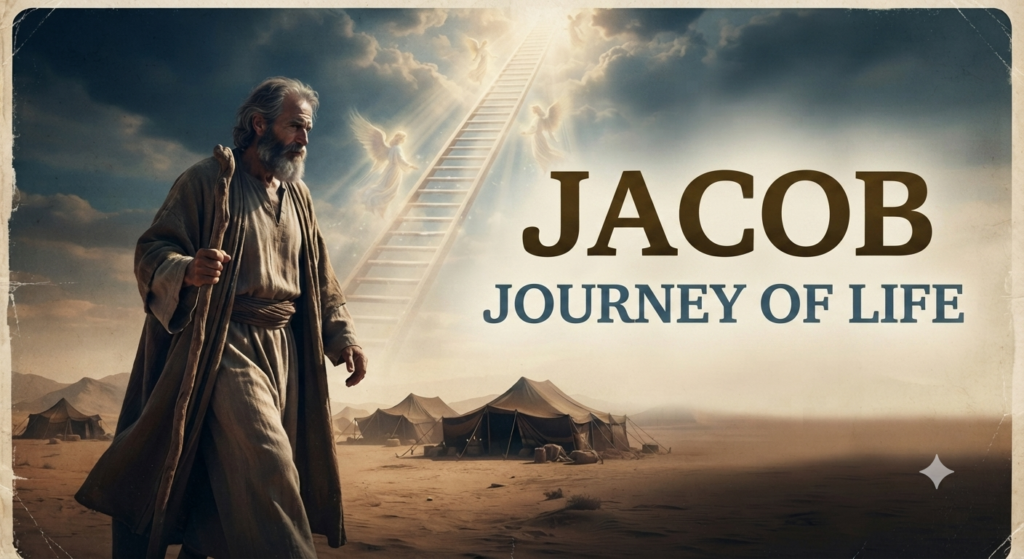
Journeying from Beersheba toward Haran, Jacob stopped for the night and used a stone for his pillow. There, God gave him a vision of a ladder set up on the earth, with its top reaching heaven, and angels ascending and descending on it. The Lord reaffirmed the covenant, promising Jacob the land, descendants, His presence, and His protection: “I will not leave thee, until I have done that which I have spoken to thee of” (Genesis 28:10-15). Jacob awoke in awe and declared, “Surely the Lord is in this place; and I knew it not… This is none other but the house of God, and this is the gate of heaven.” He set up the stone as a pillar, poured oil upon it, and named the place Bethel, which had previously been called Luz. Jacob then made a vow concerning God’s protection, provision, his safe return, and giving a tenth of all that God would give him (Genesis 28:16-22). Bethel is commonly associated with the area of modern Beitin in the West Bank.
Arriving in Haran, Jacob encountered shepherds gathered around a well. There he met Rachel, Laban’s daughter, who was coming with her father’s sheep. Jacob rolled the stone from the well’s mouth and watered Laban’s flock. He kissed Rachel and wept aloud, telling her that he was related to her father (Genesis 29:1-12). Laban came out to meet him and acknowledged their family relationship (Genesis 29:13-14). Jacob fell in love with Rachel and offered to serve Laban seven years for her. Laban agreed, and the seven years seemed to Jacob like only a few days because of his love for her (Genesis 29:15-20).
When the wedding night came, Laban gave Leah to Jacob instead of Rachel. In the morning, Jacob confronted Laban and asked why he had deceived him. Laban explained that it was not customary in his place to give the younger daughter before the firstborn. He then allowed Jacob to marry Rachel after completing Leah’s week, on the condition that Jacob serve another seven years. Jacob did so, and Scripture says that he loved Rachel more than Leah (Genesis 29:21-30).
The following years were marked by conflict and competition between Leah and Rachel concerning Jacob’s affection and children. The Lord saw that Leah was hated and opened her womb, while Rachel was barren. Leah bore Reuben, Simeon, Levi, and Judah (Genesis 29:31-35). Rachel, distressed because she had no children, gave her handmaid Bilhah to Jacob, and Bilhah bore Dan and Naphtali. Leah then gave her handmaid Zilpah to Jacob, and Zilpah bore Gad and Asher. The rivalry continued, including the incident involving mandrakes. Leah later bore Issachar, Zebulun, and Dinah. Finally, God remembered Rachel, and she bore Joseph (Genesis 30:1-24).
After Joseph’s birth, Jacob wanted to return home. He asked Laban to release him, but Laban recognized that the Lord had blessed him because of Jacob and asked him to name his wages. Jacob proposed an arrangement involving speckled, spotted, and brown livestock. Laban agreed, but then separated the animals that were to become Jacob’s wages and placed them under the care of his sons. Jacob continued tending the remaining flock. Genesis describes Jacob using rods during the breeding process and selectively placing them before the stronger animals. Jacob’s flocks increased greatly. Later, Jacob explained that Laban had changed his wages ten times, but God had seen Laban’s treatment of him and had caused Jacob to prosper (Genesis 30:25-43; 31:7-12).
The Flight Home: Confrontation, Mizpah, and Angels
As Jacob’s wealth grew, Laban’s sons became hostile toward him. Then the Lord commanded Jacob, “Return unto the land of thy fathers, and to thy kindred; and I will be with thee” (Genesis 31:1-13). Jacob gathered his wives, children, and livestock and left without telling Laban. Rachel took her father’s household idols with her. Laban pursued Jacob and caught up with him in the mountains of Gilead. But God appeared to Laban in a dream and warned him, “Take heed that thou speak not to Jacob either good or bad” (Genesis 31:22-24). Laban confronted Jacob about leaving secretly and about the missing household gods. Jacob did not know that Rachel had taken them and declared that whoever had them would not live. Rachel hid the idols under the camel’s furniture and sat upon it while Laban searched (Genesis 31:25-35).
Jacob then spoke strongly to Laban, recounting his twenty years of service, the hardship he had endured, and Laban’s repeated changes to his wages. Jacob testified that the God of his fathers had been with him and had protected him (Genesis 31:36-42). Finally, Jacob and Laban made a covenant. They set up a heap of stones as a witness, and the place was called Mizpah. Laban said, “The Lord watch between me and thee, when we are absent one from another” (Genesis 31:43-55).
As Jacob continued his journey, the angels of God met him at Mahanaim. Jacob named the place Mahanaim, meaning “two camps” (Genesis 32:1-2). He then sent messengers to Esau in Seir. The messengers returned saying that Esau was coming with 400 men. Jacob was greatly afraid and distressed. He divided his household and possessions into two groups, hoping that at least one group might escape. Then he prayed to God, reminding Him of His promises and asking for deliverance (Genesis 32:3-12). Jacob also prepared a large gift for Esau: 200 female goats, 20 male goats, 200 ewes, 20 rams, 30 female camels with their colts, 40 cows, 10 bulls, 20 female donkeys, and 10 foals. He sent the animals ahead in separate groups (Genesis 32:13-21).
The Turning Point: Wrestling at Peniel and Reconciliation
That night, Jacob crossed the ford of Jabbok and was left alone. Then a man wrestled with him until the breaking of the day. The man touched the hollow of Jacob’s thigh, and Jacob’s thigh was put out of joint. Jacob continued to hold on and said that he would not let the man go unless he blessed him. The man asked his name and then declared, “Thy name shall be called no more Jacob, but Israel: for as a prince hast thou power with God and with men, and hast prevailed” (Genesis 32:22-29). Jacob walked away with a limp and a new name—Israel. Jacob called the place Peniel, saying, “I have seen God face to face, and my life is preserved” (Genesis 32:30). The passage also records the custom concerning the sinew that shrank (Genesis 32:31-32). The Jabbok is commonly identified with the modern Zarqa River in Jordan, while the precise location of Peniel is uncertain.
When Jacob saw Esau approaching, he bowed to the ground seven times. Instead of attacking him, Esau ran to meet Jacob, embraced him, fell on his neck, kissed him, and they wept together. Esau accepted Jacob’s gifts, and Jacob said, “I have seen thy face, as though I had seen the face of God” (Genesis 33:1-11). Esau offered to travel with Jacob, but Jacob explained that the children and livestock could not travel at the same pace. Jacob therefore continued separately and came to Succoth, where he built a house and made shelters for his cattle (Genesis 33:12-17). He later came to Shechem, purchased a parcel of land, and built an altar, calling it El-Elohe-Israel, meaning “God, the God of Israel” (Genesis 33:18-20). Shechem is commonly associated with the area of modern Nablus in the West Bank.
Sorrow in Canaan: Dinah’s Tragedy and Bethel’s Cleansing
Peace was short-lived. Dinah, Jacob’s daughter, was defiled by Shechem, the son of Hamor the Hivite. Shechem then sought to marry Dinah. Jacob’s sons responded with deception. They required the men of the city to be circumcised as a condition for intermarriage. While the men were still suffering from the procedure, Simeon and Levi entered the city and killed the males. Jacob’s other sons then plundered the city, taking the flocks, herds, donkeys, wealth, women, and children. Jacob was deeply distressed because he feared that the surrounding inhabitants would gather against his family and destroy them (Genesis 34:1-31).
God then commanded Jacob to go up to Bethel, dwell there, and build an altar. Jacob instructed his household to put away the strange gods among them, purify themselves, and change their garments. They gave Jacob their strange gods and earrings, and he hid them under the oak near Shechem. As they journeyed, a terror from God fell upon the surrounding cities, so they did not pursue Jacob’s family (Genesis 35:1-5). At Bethel, God appeared to Jacob again, reaffirmed the name Israel, and repeated the covenant concerning fruitfulness and the land. Jacob set up a stone pillar and poured a drink offering upon it (Genesis 35:6-14).
The Loss of Rachel and the Defilement of the Home
As they traveled from Bethel, Rachel went into hard labor. The midwife told her that she had another son. As Rachel died, she named the child Benoni, but Jacob called him Benjamin. Rachel was buried on the way to Ephrath, which is Bethlehem, and Jacob set a pillar upon her grave (Genesis 35:16-20). The death of Rachel became one of the great losses in Jacob’s life.
After this, Reuben, Jacob’s firstborn, went and lay with Bilhah, his father’s concubine, and Israel heard of it (Genesis 35:21-22). The consequences of Reuben’s act later became clear when Jacob addressed his sons near the end of his life. Shortly afterward, Isaac died at the age of 180. Esau and Jacob came together to bury him in the cave of Machpelah (Genesis 35:27-29).
Joseph’s Betrayal, Judah’s Shame, and the Famine
Jacob’s favoritism now contributed to another painful family conflict. He loved Joseph more than all his other children because Joseph was the son of his old age, and he made him a coat of many colours. Joseph’s dreams, in which his brothers’ sheaves bowed to his sheaf and the sun, moon, and eleven stars bowed to him, increased their jealousy (Genesis 37:1-11). When Joseph came to his brothers in the field, they conspired against him. Reuben persuaded them to put Joseph into a pit rather than kill him. While Reuben was absent, Judah suggested that they sell Joseph. The narrative describes the traders as Ishmeelites and also refers to Midianites in connection with the transaction. Joseph was sold for twenty pieces of silver and carried into Egypt, where he was sold to Potiphar, an officer of Pharaoh and captain of the guard (Genesis 37:23-28, 36; 39:1). The brothers dipped Joseph’s coat in goat’s blood and brought it to Jacob. Jacob believed that Joseph had been killed by a wild beast and mourned deeply, saying, “I will go down into the grave unto my son mourning” (Genesis 37:29-35).
In the midst of this family crisis, the narrative turns briefly to Judah and Tamar. Their story includes serious moral and family difficulties and ends with the birth of twins, Perez and Zerah (Genesis 38:1-30). These events form part of the wider account of Jacob’s deeply troubled family.
Years later, a severe famine came upon Canaan, following the years of plenty and famine that God had revealed to Joseph in Egypt. Jacob heard that there was grain in Egypt and sent his ten older sons to buy food, keeping Benjamin with him because he feared losing him. The brothers appeared before Joseph, who was governor over the land, but they did not recognize him. Joseph tested them, accused them of being spies, kept Simeon, and required them to bring Benjamin when they returned (Genesis 42:1-24). The brothers remembered their guilt concerning Joseph and spoke among themselves about what they had done.
When the brothers returned to Canaan, Jacob was distressed by the demand to bring Benjamin to Egypt, saying, “Me have ye bereaved of my children: Joseph is not, and Simeon is not, and ye will take Benjamin away: all these things are against me” (Genesis 42:36). As the famine continued, Judah offered himself as surety for Benjamin, and Jacob eventually agreed to send him. When the brothers returned to Egypt, Joseph tested them again. Judah then pleaded for Benjamin’s release, offering himself in his place (Genesis 44:1-34). Joseph could no longer control his emotions and revealed himself to his brothers in Genesis 45:1-15. His weeping was heard by the Egyptians and by Pharaoh’s household. Joseph comforted his brothers, declaring, “God sent me before you to preserve you a posterity in the earth, and to save your lives by a great deliverance” (Genesis 45:7).
The Final Chapter: Reunion, Egypt, and the Prophetic Blessing
When Jacob was told that Joseph was alive and was ruler over all Egypt, his spirit revived. When he saw the wagons Joseph had sent, he declared, “It is enough; Joseph my son is yet alive: I will go and see him before I die” (Genesis 45:21-28). On the journey to Egypt, Jacob stopped at Beersheba and offered sacrifices to the God of his father Isaac. God spoke to him in a vision at night and said, “Fear not to go down into Egypt; for I will there make of thee a great nation: I will go down with thee into Egypt; and I will also surely bring thee up again” (Genesis 46:1-4). Jacob then went into Egypt with his household. Joseph met him in Goshen, and when Jacob saw his son, he fell upon Joseph’s neck and wept for a long time, saying, “Now let me die, since I have seen thy face, because thou art yet alive” (Genesis 46:5-30).
Jacob was presented before Pharaoh when he was 130 years old. He described his years as “few and evil”, meaning difficult and troubled, and he blessed Pharaoh (Genesis 47:7-10). As his death approached, Jacob adopted Joseph’s sons, Ephraim and Manasseh, as his own and blessed them. He intentionally placed Ephraim, the younger, before Manasseh, the older, saying, “let my name be named on them, and the name of my fathers Abraham and Isaac” (Genesis 48:16). Jacob then gathered his twelve sons and spoke concerning their future. Genesis 49 contains a mixture of blessings, rebukes, descriptions, and prophetic words concerning the tribes. Concerning Judah, Jacob said, “The sceptre shall not depart from Judah, nor a lawgiver from between his feet, until Shiloh come” (Genesis 49:1-33). The exact interpretation of “Shiloh” remains debated.
Jacob died at the age of 147. Joseph commanded his servants, the physicians, to embalm his father. Forty days were fulfilled for the embalming, and the Egyptians mourned for him seventy days (Genesis 50:1-3). Joseph received Pharaoh’s permission to carry Jacob’s body to Canaan. A large company accompanied him, including Pharaoh’s servants, elders, Joseph’s household, Jacob’s sons, chariots, and horsemen. They mourned at the threshing floor of Atad, and Jacob was buried in the cave of Machpelah in Canaan, according to his command (Genesis 50:4-14). After Jacob’s death, Joseph’s brothers feared that Joseph might take revenge against them. Joseph wept and reassured them, saying, “Fear not: for am I in the place of God? But as for you, ye thought evil against me; but God meant it unto good, to bring to pass, as it is this day, to save much people alive” (Genesis 50:15-21).
Conclusion — The Enduring Legacy of Jacob
Looking back over Jacob’s long, turbulent, and complex life, we see a man who practiced deception at important moments, yet whose life was also marked by a persistent desire for God’s blessing and covenant promises. He was a planner, a bargainer, and at times a deceiver—but he was also a man who loved deeply, endured difficult years of labor, prayed in fear, and continued his journey despite repeated losses. He made serious mistakes that brought suffering to himself and those around him. Yet God continued to work through Jacob and remained faithful to the covenant promises He had made to Abraham, Isaac, and Jacob. Jacob’s encounter at the Jabbok became a defining moment in his life, when his name was changed to Israel. His story demonstrates that God’s covenant purposes continued despite the weaknesses and failures of the people through whom those purposes unfolded. When Jacob finally died, his body was carried back to Canaan and buried in the Cave of Machpelah, in accordance with his wishes. His life remains one of the Bible’s most detailed portraits of a flawed man whose story was continually shaped by God’s promises, discipline, protection, and faithfulness.
Related Articles
Disclaimer
Verses: All Bible verses in this article are quoted from the King James Version (KJV). Under each verse, we explain in plain words the situation in which it was written. To understand a verse fully, we encourage you to read the whole chapter in your own Bible.
Language: We wrote this article in simple, everyday English for readers who may not know the Bible well. It is meant for personal study and understanding, not as an official Bible commentary.
History: Where this article adds extra detail beyond what the Bible states directly, that detail is a reasonable illustration meant to aid understanding, not a claimed historical fact.
Written by Team HolyBibleWithYou.com
To read more articles like this in English…