Introduction
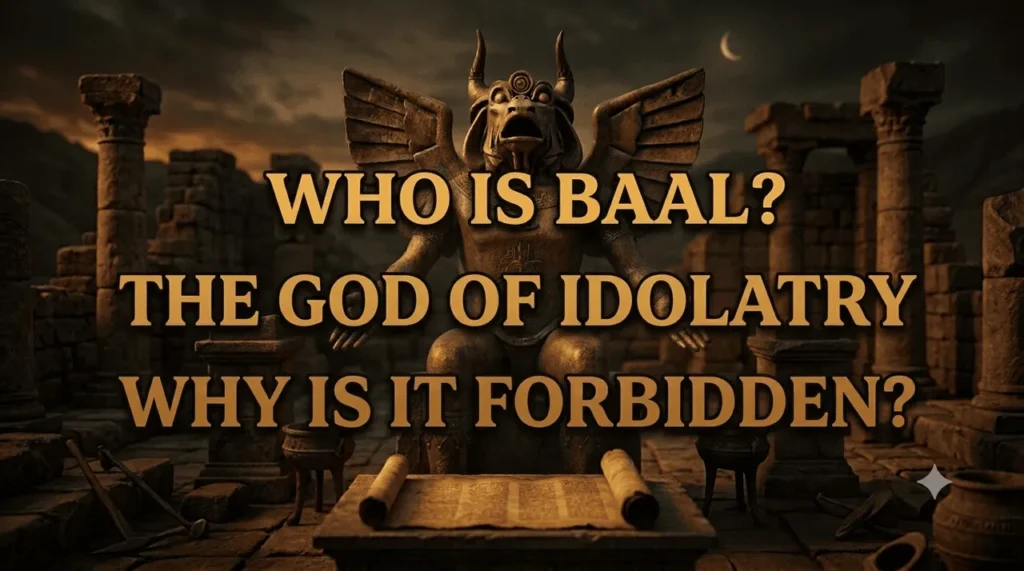
At different points in Israel’s history, Baal worship became so influential that kings supported it, priests served it, prophets opposed it, and ordinary people were drawn into it. The conflict between the LORD and Baal became especially visible during the reign of Ahab and Jezebel and in the confrontation between Elijah and the prophets of Baal on Mount Carmel.
This article examines what the Bible actually says about Baal worship, how it entered Israel, why God opposed it, and how different biblical leaders responded to it.
Note: In this article, biblical passages and their explanations are distinguished from historical background. Information that the Bible does not explicitly state is clearly identified as Historical Background.
Also, after each Bible quotation you will find a short “In Simple Terms” explanation, written in everyday English for readers who are not familiar with the Bible. These explanations are paraphrases in ordinary language — they are not Scripture itself. They are an attempt to restate the meaning of the verse, not a replacement for it. Readers are encouraged to read the actual Bible verses in their full context.
1. Who Was Baal?
A. The Name and Its Meaning
The Hebrew word Baal (בַּעַל, Ba’al) can carry the meanings “owner,” “lord,” “master,” or “husband.” The word also appears as part of personal names in the Old Testament, including names recorded in 1 Chronicles 5:5, 8:30, and 9:36.
However, in many biblical passages, Baal refers to a deity associated with the idolatrous worship practiced among the peoples surrounding Israel.
The Bible also uses different forms of the name in connection with particular places or contexts. These include:
- Baal of Peor — Numbers 25:3
- Baal-gad — Joshua 11:17
- Baal-hermon — Judges 3:3
- Baal-berith — Judges 8:33
- Baal-zebub — 2 Kings 1:2
These names suggest different local expressions or associations connected with Baal worship.
B. The Role Associated With Baal
Historical Background: The Bible does not provide a single direct definition of Baal’s religious role. Ancient Canaanite evidence outside the Bible associates Baal with rain, storms, and fertility. Baal and Asherah are also mentioned together in biblical passages dealing with idolatry, such as Judges 3:7 and 1 Kings 18:19.
However, later historical descriptions should not be presented as though they are direct biblical teaching. For this reason, it is important to distinguish what the Bible explicitly says from information obtained from historical and archaeological sources.
2. How Was Baal Worship Practiced?
The Bible does not merely say that Baal worship was wrong. It also describes, in many places, how people practiced it. Some of these practices are stated directly in Scripture. Others are known from historical and archaeological sources outside the Bible. This section distinguishes between the two.
A. Sacrifices and Offerings
Biblical: Baal worship involved sacrifices and offerings. People offered incense and burnt offerings to Baal.
Jeremiah 19:5 — KJV
“They have built also the high places of Baal, to burn their sons with fire for burnt offerings unto Baal, which I commanded not, nor spake it, neither came it into my mind.”
In Simple Terms (a paraphrase, not Scripture): The people built special worship sites for Baal and even burned their own children there as offerings. God says clearly that He never asked for this and never even imagined such a thing. This shows that child sacrifice was sometimes part of Baal worship.
Second Kings 10:19 also mentions “a great sacrifice” for Baal.
Historical Background: Ancient sources describe animal sacrifices, grain offerings, and drink offerings (libations) in Baal worship. The Bible mentions sacrifices but does not give every detail of the ritual.
B. Self-Mutilation and Ecstatic Prayer
Biblical: First Kings 18 gives a vivid description.
1 Kings 18:26 — KJV
“And they took the bullock which was given them, and they dressed it, and called on the name of Baal from morning even until noon, saying, O Baal, hear us. But there was no voice, nor any that answered. And they leaped upon the altar which was made.”
In Simple Terms (a paraphrase, not Scripture): The prophets of Baal prepared an animal sacrifice and then shouted prayers to Baal all morning long, begging him to answer. Nothing happened. No voice, no reply. They even jumped around on the altar in desperation.
1 Kings 18:28 — KJV
“And they cried aloud, and cut themselves after their manner with knives and lancets, till the blood gushed out upon them.”
In Simple Terms (a paraphrase, not Scripture): When Baal still did not answer, his prophets started screaming and cutting themselves with knives and sharp tools until blood poured out. They believed that hurting themselves would force their god to respond.
Elijah mocked them, saying Baal might be talking, pursuing, on a journey, or sleeping (1 Kings 18:27).
In Simple Terms (a paraphrase, not Scripture): Elijah made fun of them. He suggested that maybe Baal was busy chatting, out hunting, traveling somewhere, or simply asleep and needed to be woken up. Of course, Elijah knew the real reason: Baal was not a real god at all.
Historical Background: Ecstatic frenzy, loud crying, dancing, and self-cutting were common in ancient Near Eastern fertility religions. Worshipers believed they could force their god to respond by working themselves into a frenzy.
C. Sexual Rituals and Sacred Prostitution
Biblical: The Bible forbids sacred prostitution.
Deuteronomy 23:17–18 — KJV
“There shall be no whore of the daughters of Israel, nor a sodomite of the sons of Israel.”
In Simple Terms (a paraphrase, not Scripture): God commanded that no Israelite woman or man should work as a temple prostitute. In the religions around Israel, sexual acts were part of worship, but God said this must never happen among His people.
First Kings 14:24 and 15:12 mention “sodomites” (male cult prostitutes) in the land.
Hosea 4:13–14 — KJV
“They sacrifice upon the tops of the mountains, and burn incense upon the hills… therefore your daughters shall commit whoredom, and your spouses shall commit adultery.”
In Simple Terms (a paraphrase, not Scripture): The people were worshiping on hilltops and burning incense under trees. Because they mixed worship with sexual sin, that same sin spread into their families. The prophet Hosea is saying that their false worship was destroying their homes.
Historical Background: Baal and Asherah worship often included sexual acts performed at temples or high places. These were meant to ensure fertility of the land, animals, and people. This practice is often called “sacred prostitution” or “fertility cult prostitution.”
D. Child Sacrifice
Biblical: Child sacrifice is explicitly condemned.
Psalm 106:37–38 — KJV
“Yea, they sacrificed their sons and their daughters unto devils, And shed innocent blood, even the blood of their sons and of their daughters, whom they sacrificed unto the idols of Canaan.”
In Simple Terms (a paraphrase, not Scripture): The psalm says the people killed their own sons and daughters as sacrifices to demons and to the idols of Canaan. They poured out the blood of innocent children. This is one of the darkest things the Bible records about Israel’s rebellion.
Second Kings 23:10 also mentions burning children in the fire to Molech.
Historical Background: Later historical sources describe a horrific method: a bronze statue of Baal or Molech was heated, and a living infant was placed in its heated arms. The Bible does not describe this method directly. It simply says the children were “burned” or “passed through the fire.” The method comes from outside the Bible and should be labeled as historical background.
E. Other Practices
Biblical:
- Kissing idols: First Kings 19:18 says, “Yet I have left me seven thousand in Israel, all the knees which have not bowed unto Baal, and every mouth which hath not kissed him.” Hosea 13:2 also mentions those who “kiss the calves.”
- Incense and drink offerings: Jeremiah 7:9 and 44:17–19 mention burning incense and pouring out drink offerings to other gods.
- High places and groves: First Kings 14:23 and Second Kings 17:10 speak of high places and Asherah poles (groves) where false worship took place.
- Special garments: Second Kings 10:22 says, “Bring forth vestments for all the worshippers of Baal. And he brought them forth vestments.”
In Simple Terms (a paraphrase, not Scripture): Baal worship had its own customs. People bowed to idols and kissed them. They burned incense and poured out drinks as offerings. They built worship sites on hills and set up wooden poles for the goddess Asherah. They even wore special clothes during their rituals. All of this was part of a whole religious system that God had forbidden.
Historical Background: Ancient texts describe temples, altars, and sacred groves dedicated to Baal. Worship often took place on hills, under trees, or on rooftops.
F. Priests and Prophets
Biblical: First Kings 18:19 says there were 450 prophets of Baal and 400 prophets of Asherah. Second Kings 10:19 mentions “all the prophets of Baal, all his servants, and all his priests.” These leaders organized and led the sacrifices, prayers, and rituals.
In Simple Terms (a paraphrase, not Scripture): Baal worship was not a small private thing. It had hundreds of official prophets and priests who led the ceremonies. This was a large, organized religious system, and at times the king himself paid for it.
Historical Background: Baal worship had a structured priesthood. Priests and prophets were supported by the state, especially during the reign of Ahab and Jezebel.
Conclusion to This Section
The Bible clearly condemns Baal worship. It describes sacrifices, self-mutilation, sexual immorality, and child sacrifice. Some details—such as the exact method of child sacrifice or the full nature of fertility rituals—come from historical sources outside the Bible. When writing about these details, it is important to label them as Historical Background so readers know what Scripture explicitly says and what it does not.
The core issue remains the same: Baal worship was a rejection of the LORD. It led Israel into moral corruption and spiritual adultery. That is why God opposed it and called His people to return to Him alone.
3. Why Did God Oppose Baal Worship?
A. God Alone Is Worthy of Worship
The foundation of the biblical opposition to Baal worship is God’s command that His people must not worship other gods.
Exodus 20:3–5 — KJV
“Thou shalt have no other gods before me. Thou shalt not make unto thee any graven image, or any likeness of any thing that is in heaven above, or that is in the earth beneath, or that is in the water under the earth: Thou shalt not bow down thyself to them, nor serve them: for I the LORD thy God am a jealous God…”
In Simple Terms (a paraphrase, not Scripture): This is one of the Ten Commandments. God says, “Do not put any other god ahead of Me. Do not make statues or images to worship. Do not bow down to them or serve them.” God is not one option among many—He is the only true God.
The issue was therefore not merely the name Baal. The central issue was that God’s people were turning away from the LORD and giving worship to another deity.
B. Idols Cannot Do What God Can Do
Psalm 115:4–8 — KJV
“Their idols are silver and gold, the work of men’s hands. They have mouths, but they speak not: eyes have they, but they see not: They have ears, but they hear not: noses have they, but they smell not: They have hands, but they handle not: feet have they, but they walk not: neither speak they through their throat. They that make them are like unto them; so is every one that trusteth in them.”
In Simple Terms (a paraphrase, not Scripture): Idols are just metal and wood shaped by human hands. They have a mouth but can’t speak, eyes but can’t see, ears but can’t hear, hands but can’t hold, feet but can’t walk. They are lifeless. The psalm warns that people who trust in them become just as lifeless and empty. Baal could never do what the living God does.
C. Israel Repeatedly Turned Away From the LORD
Judges 2:11–13 — KJV
“And the children of Israel did evil in the sight of the LORD, and served Baalim: And they forsook the LORD God of their fathers, which brought them out of the land of Egypt, and followed other gods, of the gods of the people that were round about them, and bowed themselves unto them, and provoked the LORD to anger. And they forsook the LORD, and served Baal and Ashtaroth.”
In Simple Terms (a paraphrase, not Scripture): Israel did what God called evil. They served the Baals. They left the LORD—the God who had rescued their ancestors from slavery in Egypt—and started following the gods of the neighboring nations. They bowed down to those gods and made the LORD angry. This verse shows the basic pattern: they left God and served Baal and Asherah instead.
D. God Warned Israel Not to Follow Other Gods
Deuteronomy 6:14–15 — KJV
“Ye shall not go after other gods, of the gods of the people which are round about you; (For the LORD thy God is a jealous God among you) lest the anger of the LORD thy God be kindled against thee, and destroy thee from off the face of the earth.”
In Simple Terms (a paraphrase, not Scripture): God warned Israel plainly: do not chase after the gods of the surrounding nations. God describes Himself as “jealous”—not in a petty way, but because He alone deserves His people’s love and loyalty. If they turned to other gods, they would face serious consequences.
E. Idolatry Was Connected With Serious Moral Corruption
Leviticus 18:24–30 — KJV
“Defile not ye yourselves in any of these things: for in all these the nations are defiled which I cast out before you: And the land is defiled: therefore I do visit the iniquity thereof upon it; and the land itself vomiteth out her inhabitants. Ye shall therefore keep my statutes and my judgments, and shall not commit any of these abominations; neither any of your own nation, nor any stranger that sojourneth among you… For whosoever shall commit any of these abominations, even the souls that commit them shall be cut off from among their people. Therefore shall ye keep mine ordinance, that ye commit not any one of these abominable customs, which were committed before you, and that ye defile not yourselves therein: I am the LORD your God.”
In Simple Terms (a paraphrase, not Scripture): God told Israel not to copy the immoral practices of the nations living in Canaan. Those nations had polluted the land with their sins, and the land itself “vomited them out.” God warned that if Israel did the same things, they would be removed too. Idolatry was never just a religious preference—it came packaged with practices God had clearly forbidden.
F. Some Forms of Baal Worship Included Child Sacrifice
Jeremiah 19:5 — KJV
“They have built also the high places of Baal, to burn their sons with fire for burnt offerings unto Baal, which I commanded not, nor spake it, neither came it into my mind.”
In Simple Terms (a paraphrase, not Scripture): God says the people built worship sites for Baal and burned their own sons there as offerings. God makes it very clear: He never commanded this, never spoke of it, and it never even entered His mind. This was completely against His will.
G. God Called His People Away From Their Idols
Ezekiel 20:39 — KJV
“As for you, O house of Israel, thus saith the Lord GOD; Go ye, serve ye every one his idols, and hereafter also, if ye will not hearken unto me: but pollute my holy name no more with your gifts, and with your idols.”
In Simple Terms (a paraphrase, not Scripture): God speaks in strong, almost sarcastic language: if you refuse to listen to Me, then go ahead and serve your idols. But stop pretending to worship Me at the same time. Do not drag My holy name into your idol worship. The message is consistent: Israel was called to come back to the LORD, not to mix Him with idols.
4. How Did Baal Worship Enter Israel?
A. Israel Adopted the Religious Practices Around Them
Judges 3:7 — KJV
“And the children of Israel did evil in the sight of the LORD, and forgat the LORD their God, and served Baalim and the groves.”
In Simple Terms (a paraphrase, not Scripture): Israel did what was evil in God’s eyes. They forgot the LORD their God and started serving the Baals and the Asherah poles. Baal worship entered Israel gradually—not through one big decision, but through forgetting God and copying the people around them.
B. The Repeated Cycle in the Book of Judges
The Book of Judges repeatedly describes a cycle in Israel’s history. The people would turn away from God, experience oppression, cry out to the LORD, and then receive deliverance through a judge.
Judges 2:11–19 describes this pattern. Israel would turn to other gods, experience the consequences of that rebellion, and later cry out to God. God would raise up a deliverer, but after the judge died, the people would again return to their former ways.
In Simple Terms (a paraphrase, not Scripture): The book of Judges shows a repeating cycle: (1) the people sin and turn to idols, (2) God allows an enemy to oppress them, (3) the people cry out for help, (4) God sends a leader to rescue them, (5) the people stay faithful for a while, then (6) they fall back into idol worship. This cycle helps explain why Baal worship kept coming back again and again.
C. Gideon and the Altar of Baal
Judges 6:31 — KJV
“And Joash said unto all that stood against him, Will ye plead for Baal? will ye save him? he that will plead for him, let him be put to death whilst it is yet morning: if he be a god, let him plead for himself, because one hath thrown down his altar.”
In Simple Terms (a paraphrase, not Scripture): Gideon had torn down his father’s altar to Baal and built an altar to the LORD instead. The people were furious and wanted to kill Gideon. But his father Joash said, “Are you going to fight Baal’s battles for him? If Baal is really a god, let him defend himself!” It was a sarcastic challenge showing that Baal was powerless.
D. Solomon and the Influence of Foreign Worship
1 Kings 11:4–8 — KJV
“For it came to pass, when Solomon was old, that his wives turned away his heart after other gods: and his heart was not perfect with the LORD his God, as was the heart of David his father. For Solomon went after Ashtoreth the goddess of the Zidonians, and after Milcom the abomination of the Ammonites. And Solomon did evil in the sight of the LORD, and went not fully after the LORD, as did David his father. Then did Solomon build an high place for Chemosh, the abomination of Moab, in the hill that is before Jerusalem, and for Molech, the abomination of the children of Ammon. And likewise did he for all his strange wives, which burnt incense and sacrificed unto their gods.”
In Simple Terms (a paraphrase, not Scripture): Solomon was the wisest king Israel ever had, but in his old age his many foreign wives led his heart away from God. He started worshiping Ashtoreth, Milcom, Chemosh, and Molech—the gods of the nations around him. He even built places of worship for these false gods near Jerusalem. The Bible calls this evil. It opened the door for idolatry to grow stronger in Israel later on.
5. Ahab, Jezebel, and the Expansion of Baal Worship
A. Ahab Officially Supported Baal Worship
1 Kings 16:31–33 — KJV
“And it came to pass, as if it had been a light thing for him to walk in the sins of Jeroboam the son of Nebat, that he took to wife Jezebel the daughter of Ethbaal king of the Zidonians, and went and served Baal, and worshipped him. And he reared up an altar for Baal in the house of Baal, which he had built in Samaria. And Ahab made a grove; and Ahab did more to provoke the LORD God of Israel to anger than all the kings of Israel that were before him.”
In Simple Terms (a paraphrase, not Scripture): King Ahab married Jezebel, a princess from Sidon who worshiped Baal. Ahab himself began serving and worshiping Baal. He built a temple for Baal in Samaria and set up an altar inside it. He also made an Asherah pole. The Bible says Ahab made God angrier than any king of Israel before him. This was the time when Baal worship became an official, state-supported religion.
B. Jezebel and the Prophets of the LORD
1 Kings 18:4 — KJV
“For it was so, when Jezebel cut off the prophets of the LORD, that Obadiah took an hundred prophets, and hid them by fifty in a cave, and fed them with bread and water.”
In Simple Terms (a paraphrase, not Scripture): Queen Jezebel was actively killing the prophets of the LORD. A man named Obadiah secretly rescued one hundred of them, hiding them fifty at a time in caves and bringing them bread and water. This shows how dangerous it had become to worship the LORD at that time.
C. God Had Not Abandoned Everyone in Israel
1 Kings 19:18 — KJV
“Yet I have left me seven thousand in Israel, all the knees which have not bowed unto Baal, and every mouth which hath not kissed him.”
In Simple Terms (a paraphrase, not Scripture): Even though it looked like everyone in Israel had turned to Baal, God told Elijah that 7,000 people were still faithful—people who had never bowed to Baal or kissed his image. God always keeps a faithful remnant.
6. Elijah and the Confrontation on Mount Carmel
A. Elijah Challenged the People
1 Kings 18:21 — KJV
“And Elijah came unto all the people, and said, How long halt ye between two opinions? if the LORD be God, follow him: but if Baal, then follow him.”
In Simple Terms (a paraphrase, not Scripture): Elijah asked the people a direct question: “How long will you keep wavering between two sides? If the LORD is God, follow Him. If Baal is god, follow him.” He was forcing them to make a choice. They could not keep one foot in each camp.
B. The Prophets of Baal Called on Baal
1 Kings 18:26 — KJV
“And they took the bullock which was given them, and they dressed it, and called on the name of Baal from morning even until noon, saying, O Baal, hear us. But there was no voice, nor any that answered. And they leaped upon the altar which was made.”
In Simple Terms (a paraphrase, not Scripture): The prophets of Baal prepared a sacrifice and shouted to Baal from morning until noon, crying out, “Baal, hear us!” But there was no voice and no answer. They even jumped on the altar. Nothing happened. The Bible is showing that Baal could not respond because he was not real.
C. Elijah Mocked Them
1 Kings 18:27 — KJV
“And it came to pass at noon, that Elijah mocked them, and said, Cry aloud: for he is a god; either he is talking, or he is pursuing, or he is in a journey, or peradventure he sleepeth, and must be awaked.”
In Simple Terms (a paraphrase, not Scripture): At noon, Elijah started making fun of them. He said, “Shout louder! Maybe Baal is deep in conversation, maybe he is busy hunting, maybe he is traveling, or maybe he is asleep and needs to be woken up.” Elijah knew the real reason for the silence: Baal was not a real god at all.
D. Elijah Prayed to the LORD
1 Kings 18:36–37 — KJV
“And it came to pass at the time of the offering of the evening sacrifice, that Elijah the prophet came near, and said, LORD God of Abraham, Isaac, and of Israel, let it be known this day that thou art God in Israel, and that I am thy servant, and that I have done all these things at thy word. Hear me, O LORD, hear me, that this people may know that thou art the LORD God, and that thou hast turned their heart back again.”
In Simple Terms (a paraphrase, not Scripture): When it was time for the evening sacrifice, Elijah prayed a short and simple prayer. He asked God to show everyone that He alone is God in Israel, that Elijah was His servant, and that everything Elijah had done was by God’s command. He also prayed that the people’s hearts would turn back to God.
E. The People Recognized the LORD
1 Kings 18:39 — KJV
“And when all the people saw it, they fell on their faces: and they said, The LORD, he is the God; the LORD, he is the God.”
In Simple Terms (a paraphrase, not Scripture): When the people saw what God did, they fell face down on the ground and shouted, “The LORD—He is God! The LORD—He is God!” Their eyes were opened, and they recognized the true God.
F. The Prophets of Baal Were Executed
1 Kings 18:40 — KJV
“And Elijah said unto them, Take the prophets of Baal; let not one of them escape. And they took them: and Elijah brought them down to the brook Kishon, and slew them there.”
In Simple Terms (a paraphrase, not Scripture): Elijah ordered the people to seize the prophets of Baal. None escaped. They were taken down to the Kishon Valley and executed there. This happened under the laws and covenant of ancient Israel, where leading people into idolatry was a capital offense. It should not be separated from that context or treated as a general instruction for today.
7. Jehu and the Destruction of Baal Worship
A. Jehu Gathered the Prophets and Servants of Baal
2 Kings 10:19 — KJV
“Now therefore call unto me all the prophets of Baal, all his servants, and all his priests; let none be wanting: for I have a great sacrifice to do to Baal; whosoever shall be wanting, he shall not live.”
In Simple Terms (a paraphrase, not Scripture): Jehu pretended to be a great follower of Baal. He announced a huge sacrifice to Baal and ordered every prophet, servant, and priest of Baal to come. He said anyone who did not show up would be killed. It was a trap—he was gathering them all in one place.
B. Jehu Destroyed the House of Baal
2 Kings 10:25–28 — KJV
“And it came to pass, as soon as he had made an end of offering the burnt offering, that Jehu said to the guard and to the captains, Go in, and slay them; let none come forth. And they smote them with the edge of the sword; and the guard and the captains cast them out, and went into the city of the house of Baal. And they brought forth the images out of the house of Baal, and burned them. And they brake down the image of Baal, and brake down the house of Baal, and made it a draught house unto this day. Thus Jehu destroyed Baal out of Israel.”
In Simple Terms (a paraphrase, not Scripture): After the sacrifice, Jehu ordered his soldiers to kill everyone inside. Then they went into the temple of Baal, dragged out the sacred images, and burned them. They smashed the image of Baal, tore down the temple, and turned the site into a public toilet. The Bible says plainly: “Thus Jehu destroyed Baal out of Israel.”
C. Jehu Did Not Remove Every Form of Idolatry
2 Kings 10:29 — KJV
“Howbeit from the sins of Jeroboam the son of Nebat, who made Israel to sin, Jehu departed not from after them, to wit, the golden calves that were in Bethel, and that were in Dan.”
In Simple Terms (a paraphrase, not Scripture): Jehu destroyed Baal worship, but he did not remove every kind of idolatry. He kept the golden calves that King Jeroboam had set up at Bethel and Dan. So even after Baal’s temple was gone, Israel still had false worship in the land. This detail matters because it shows that Jehu’s reform was partial, not complete.
8. Hosea and the Spiritual Meaning of Turning Away From Baal
A. God Wanted Israel to Return to Him
Hosea 2:16–17 — KJV
“And it shall be at that day, saith the LORD, that thou shalt call me Ishi; and shalt call me no more Baali. For I will take away the names of Baalim out of her mouth, and they shall no more be remembered by their name.”
In Simple Terms (a paraphrase, not Scripture): God promised a future day when Israel would no longer call Him “Baali” (which sounds like “my Baal” or “my master”) but “Ishi” (which means “my husband”). God was saying that He wanted a close, loving relationship with His people—not a distant, idol-like one. He would remove the very names of Baal from their lips.
B. Idolatry Corrupted Israel’s Relationship With God
Hosea 4:12–13 — KJV
“My people ask counsel at their stocks, and their staff declareth unto them: for the spirit of whoredoms hath caused them to err, and they have gone a whoring from under their God. They sacrifice upon the tops of the mountains, and burn incense upon the hills, under oaks and poplars and elms, because the shadow thereof is good…”
In Simple Terms (a paraphrase, not Scripture): God’s people were asking wooden idols for advice instead of asking Him. Hosea calls this “spiritual unfaithfulness”—like a wife cheating on her husband. They sacrificed on mountain tops and burned incense under shady trees. They were looking for guidance everywhere except from the God who loved them.
C. Religious Leaders Also Became Involved
Jeremiah 2:8 — KJV
“The priests said not, Where is the LORD? and they that handle the law knew me not: the pastors also transgressed against me, and the prophets prophesied by Baal, and walked after things that do not profit.”
In Simple Terms (a paraphrase, not Scripture): The problem was not only among ordinary people. The priests never asked, “Where is the LORD?” The teachers of the law did not know God. The leaders rebelled against Him. The prophets gave their messages in Baal’s name and chased after worthless things. Even Israel’s spiritual leaders had turned away.
D. God’s Name Was Forgotten Through Idolatry
Jeremiah 23:27 — KJV
“Which think to cause my people to forget my name by their dreams which they tell every man to his neighbour, as their fathers have forgotten my name for Baal.”
In Simple Terms (a paraphrase, not Scripture): False prophets were telling made-up dreams to each other and using them to make people forget God’s name—just as their ancestors had already forgotten God’s name because of Baal. Idolatry makes people slowly forget the true God and replace Him with something else.
9. King Josiah and the Removal of Baal Worship
A. Josiah Cleansed the Temple
2 Kings 23:4–5 — KJV
“And the king commanded Hilkiah the high priest, and the priests of the second order, and the keepers of the door, to bring forth out of the temple of the LORD all the vessels that were made for Baal, and for the grove, and for all the host of heaven: and he burned them without Jerusalem in the fields of Kidron, and carried the ashes of them unto Bethel. And he put down the idolatrous priests, whom the kings of Judah had ordained to burn incense in the high places in the cities of Judah, and in the places round about Jerusalem; them also that burned incense unto Baal, to the sun, and to the moon, and to the planets, and to all the host of heaven.”
In Simple Terms (a paraphrase, not Scripture): King Josiah ordered the high priest and other priests to bring out every object in the LORD’s temple that was made for Baal, for Asherah, and for the stars. He burned them outside Jerusalem and took the ashes away. He also removed the priests who had been burning incense to Baal, the sun, the moon, the planets, and the stars.
His reforms described throughout 2 Kings 23 included:
- Removing and burning vessels connected with Baal worship.
- Removing idolatrous priests.
- Destroying high places associated with false worship.
- Removing and destroying Asherah-related objects.
- Destroying the altar at Bethel.
- Defiling certain idolatrous altars by removing and burning human bones upon them.
In Simple Terms (a paraphrase, not Scripture): Josiah’s reform was thorough. He cleared out the temple, removed the false priests, tore down the hilltop shrines, destroyed Asherah objects, demolished the altar at Bethel, and even desecrated old idol altars by burning bones on them. He was doing everything he could to remove idolatry from the land.
B. Josiah’s Commitment to the LORD
2 Kings 23:25 — KJV
“And like unto him was there no king before him, that turned to the LORD with all his heart, and with all his soul, and with all his might, according to all the law of Moses; neither after him arose there any like him.”
In Simple Terms (a paraphrase, not Scripture): The Bible says no king before or after Josiah turned to the LORD with his whole heart, soul, and strength the way Josiah did. He followed the Law of Moses completely. He is remembered as one of the most faithful kings in Israel’s history.
10. What Was the Deeper Problem Behind Baal Worship?
Baal worship was not merely a disagreement over religious names. The deeper issue was whether Israel would remain faithful to the LORD or turn to other gods.
A. God’s Name Was to Be Treated With Reverence
Exodus 20:7 — KJV
“Thou shalt not take the name of the LORD thy God in vain; for the LORD will not hold him guiltless that taketh his name in vain.”
In Simple Terms (a paraphrase, not Scripture): This is another of the Ten Commandments. God’s name is holy. We must not use it carelessly or in a false way. God will not treat it as a small thing when someone uses His name lightly. Israel was called to honor God in both worship and daily life.
B. Idolatry Was a Spiritual Departure
Ezekiel 20:39 — KJV
“As for you, O house of Israel, thus saith the Lord GOD; Go ye, serve ye every one his idols, and hereafter also, if ye will not hearken unto me: but pollute my holy name no more with your gifts, and with your idols.”
In Simple Terms (a paraphrase, not Scripture): God says through Ezekiel: if you refuse to listen to Me, then go and serve your idols—but stop dragging My holy name into it. Do not pretend to worship Me while worshiping idols at the same time. The warning is clear: Israel was not allowed to divide its worship between the LORD and other gods.
Baal worship represented a turning away from the God who had brought Israel out of Egypt and established His covenant with them.
11. Conclusion: What Does the Bible Ultimately Say About Baal Worship?
The Bible presents Baal worship as a recurring form of idolatry that repeatedly pulled Israel away from the LORD.
Israel encountered Baal worship through the surrounding nations and gradually adopted practices that God had forbidden. During some periods, kings and political leaders actively supported it. During the reign of Ahab and Jezebel, Baal worship became especially prominent in the northern kingdom.
But the Bible also records repeated efforts to confront and remove it.
Gideon destroyed an altar of Baal. Elijah confronted the prophets of Baal on Mount Carmel. Jehu destroyed the house and images of Baal. Josiah removed objects associated with Baal and other forms of idolatry.
Through all these accounts, the central biblical issue remains the same: Who will Israel worship and follow?
Elijah expressed that question clearly:
1 Kings 18:21 — KJV
“How long halt ye between two opinions? if the LORD be God, follow him: but if Baal, then follow him.”
In Simple Terms (a paraphrase, not Scripture): Elijah asked the people how long they would keep wavering between two choices. If the LORD is God, follow Him. If Baal is god, follow him. There is no middle ground. This question is the heart of the whole article.
The Bible’s consistent message is that the LORD alone is God and that His people were called to worship Him rather than follow the gods of the nations around them.
Related Articles
- Who Was Molech?
- Who Are the Sons of God?
- Who Were the Nephilim in the Bible?
- Browse all English Bible articles
Disclaimer
Verses: All Bible verses in this article are quoted from the King James Version (KJV). Under each verse, we explain in plain words the situation in which it was written. To understand a verse fully, we encourage you to read the whole chapter in your own Bible.
Language: We wrote this article in simple, everyday English for readers who may not know the Bible well. It is meant for personal study and understanding, not as an official Bible commentary.
History: Where this article adds extra detail beyond what the Bible states directly, that detail is a reasonable illustration meant to aid understanding, not a claimed historical fact.
Written by Team HolyBibleWithYou.com
Keep Reading
📖 Open your own Bible and read the verses for yourself.
Take time to understand the full context.