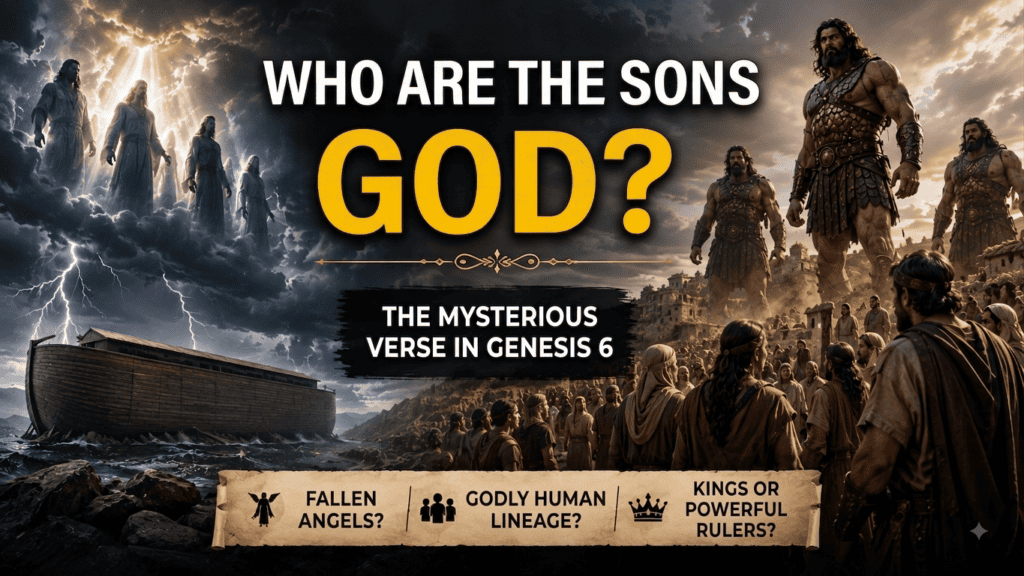
Introduction: Who Are the “Sons of God”?
Some phrases in the Bible are very short, yet the context behind them raises very large questions. The phrase “sons of God” is one of them.
In Genesis 6, the Bible describes a time before the Flood when human wickedness had spread across the earth. In that same context, it says that the “sons of God” saw that the daughters of men were beautiful and took whichever women they chose. After that, the Nephilim are mentioned, along with the mighty men of old, men of renown.
From here, many questions begin:
- Who were the “sons of God”?
- Were they angels?
- Were they ordinary human beings?
- Did they belong to a human lineage that feared God?
- Were they kings or powerful rulers?
- Were the Nephilim born because of them?
- What connection did the events of Genesis 6 have with the Flood?
- Do some passages in the New Testament explain this event?
When answering these questions, one important principle must be remembered:
We should not treat what the Bible clearly says, an interpretation proposed from the Bible, and our own speculation as though they are all the same thing.
To understand who the “sons of God” were, we should examine not only Genesis 6 but also other passages in the Bible where this phrase or a similar concept appears.
1. Where Does the Phrase “Sons of God” Appear?
The phrase “sons of God” appears prominently in Genesis 6:2:
“That the sons of God saw the daughters of men that they were fair; and they took them wives of all which they chose.” — Genesis 6:2
Then Genesis 6:4 says:
“There were giants in the earth in those days; and also after that, when the sons of God came in unto the daughters of men, and they bare children to them, the same became mighty men which were of old, men of renown.”
When these two verses are considered together, one thing is clear: the writer presents a distinction between the “sons of God” and the “daughters of men.”
But Genesis 6 does not directly explain exactly what kind of distinction this was.
This is where the different interpretations begin.
2. Were the “Sons of God” Angels?
This is one of the oldest and most widely known interpretations of this passage.
According to this view, the “sons of God” in Genesis 6 were not ordinary human beings. They were spiritual beings or angels associated with the presence of God.
One of the main reasons for this interpretation is that in other passages of the Old Testament, the expression “sons of God” appears to refer to heavenly beings.
For example, in the Book of Job, the “sons of God” appear before the LORD.
Job 1:6 says:
“Now there was a day when the sons of God came to present themselves before the LORD…”
A similar scene appears in Job 2:1.
Likewise, Job 38:7 speaks of the “sons of God” shouting for joy when describing creation.
Based on these passages, some interpreters believe that the “sons of God” in Genesis 6 also refer to spiritual or heavenly beings.
However, an important caution is necessary here.
We cannot automatically conclude that the usage in Job and the usage in Genesis 6 have exactly the same meaning.
Even when the phrase is the same, its meaning must be determined by the context of each passage.
3. If the “Sons of God” Were Angels, How Did They Marry Human Women?
When the angel interpretation is accepted, another question immediately arises:
Did angels enter into marriage relationships with human women?
This is a difficult question.
In the New Testament, Jesus said:
“For in the resurrection they neither marry, nor are given in marriage, but are as the angels of God in heaven.” — Matthew 22:30
This verse does not present angels as beings who ordinarily enter into marriage.
Therefore, when someone interprets the “sons of God” in Genesis 6 as angels, this passage also needs to be considered.
However, in Matthew 22:30, Jesus was speaking about human beings in the resurrection and about the nature of marriage in that context. Therefore, that single verse cannot completely resolve the question of Genesis 6.
As a result, this remains an issue of interpretation.
4. Another View: Were the “Sons of God” a Human Lineage Belonging to God?
Another well-known interpretation is that the “sons of God” referred to the descendants of Seth or to a human lineage associated with the worship of God.
After Genesis 4 describes the line of Cain, Genesis 5 gives the genealogy from Adam through Seth.
At the end of Genesis 4, after Seth was born, we read:
“Then began men to call upon the name of the LORD.” — Genesis 4:26
Therefore, some interpreters believe that the “sons of God” in Genesis 6 referred to a lineage associated with God—specifically, men from the line of Seth.
At the same time, they understand the “daughters of men” as referring to a human group that had turned away from God.
According to this interpretation, the main problem in Genesis 6 was not a relationship between angels and human beings.
Instead, it was the breaking down of moral boundaries between people who belonged to God and a wicked human society.
Those who favor this interpretation read the broader context of Genesis 6 as being centered on human sin, moral corruption, and God’s judgment.
5. Another View: Were the “Sons of God” Powerful Rulers?
A third major interpretation is that the “sons of God” referred to powerful kings, rulers, or lords.
In the ancient world, it was not unusual for kings or rulers to present themselves as being connected with gods or divine authority.
From this perspective, the words in Genesis 6:2 are especially important:
“They took them wives of all which they chose.”
Some interpreters understand this to mean that these powerful men used their authority to take whatever women they wanted.
In this interpretation, the central issue is power, violence, injustice, and the uncontrolled pursuit of human desires.
However, this interpretation also does not rest on a verse in Genesis 6 that directly says, “They were kings.” It is a contextual interpretation.
6. So Which Interpretation Is Correct?
Here is the most honest thing we can say:
Genesis 6 does not provide a complete, detailed definition explaining exactly who the “sons of God” were.
Therefore, there are three major interpretations:
- Spiritual beings or angels
- A human lineage belonging to God, especially the line of Seth
- Powerful rulers or lords
We can choose one of these interpretations and examine the explanations and other biblical passages that support it.
But one thing must always be remembered:
We should not turn the interpretation we prefer into something the Bible explicitly says.
7. What Is the Connection Between the “Sons of God” and the Nephilim?
This is a very important question.
Genesis 6:4 says:
“There were giants in the earth in those days; and also after that, when the sons of God came in unto the daughters of men, and they bare children to them, the same became mighty men which were of old, men of renown.”
Because of this verse, some people understand it this way:
Sons of God + daughters of men = Nephilim.
But the verse does not present that equation quite that simply.
First, the verse says that the Nephilim were on the earth in those days. Then it speaks about the sons of God coming in to the daughters of men. After that, it describes the children born from this union as mighty men of old and men of renown.
Therefore, there are differences in interpretation concerning who exactly the Nephilim were, who exactly the children of the sons of God were, and whether the two groups were completely identical.
This is something we should clearly recognize.
8. Did the Flood Come Because of the “Sons of God”?
This is another view that is often heard.
But Genesis 6 clearly explains why God brought the Flood as a judgment.
Genesis 6:5 says:
“And GOD saw that the wickedness of man was great in the earth, and that every imagination of the thoughts of his heart was only evil continually.”
Then Genesis 6:11 says:
“The earth also was corrupt before God, and the earth was filled with violence.”
Therefore, the main reasons the Bible gives for the Flood include:
- Human wickedness
- Evil thoughts of the heart
- The corruption of the earth
- The earth being filled with violence
Therefore, saying that “God sent the Flood only because of what the sons of God did” would narrow the biblical explanation for the judgment too much.
9. 1 Peter 3:19–20 and the Days of Noah
When discussing the “sons of God,” some people also mention 1 Peter 3:19–20 in the New Testament.
There, Peter speaks about God’s patience in the days of Noah while the ark was being prepared.
“When once the longsuffering of God waited in the days of Noah, while the ark was a preparing…” — 1 Peter 3:20
Although this passage speaks about the time of Noah, it does not directly define who the “sons of God” in Genesis 6 were.
Therefore, we should be careful about using this passage to declare one particular interpretation to be an established fact.
10. Who Are the Angels That Sinned in 2 Peter 2:4?
There is another interesting passage.
2 Peter 2:4 says:
“For if God spared not the angels that sinned, but cast them down to hell, and delivered them into chains of darkness, to be reserved unto judgment…”
Some biblical interpreters connect this passage with Genesis 6.
According to their view, if the “sons of God” in Genesis 6 were angels, the angels who sinned in 2 Peter 2:4 may have been connected with the same event.
However, 2 Peter 2:4 does not directly say, “These angels were the sons of God in Genesis 6.”
Therefore, this is an interpretive connection rather than something the passage explicitly states.
11. The Angels in Jude 6–7 and Genesis 6
Jude 6 says:
“And the angels which kept not their first estate, but left their own habitation, he hath reserved in everlasting chains under darkness unto the judgment of the great day.”
Jude 7 then speaks about Sodom, Gomorrah, and the surrounding cities.
Some interpreters connect these verses with Genesis 6.
However, there is an important limitation here as well:
Jude 6 does not explicitly say that the angels mentioned there were the “sons of God” in Genesis 6.
Therefore, this connection can be examined as an interpretation, but it should not be presented as an established fact.
12. Why Is the Phrase “Sons of God” in Job Important?
The Book of Job is very useful when trying to understand this subject.
Job 1:6 says:
“Now there was a day when the sons of God came to present themselves before the LORD…”
In that context, the expression “sons of God” appears in a setting involving spiritual beings who come before God’s presence.
Job 38:7 also says:
“When the morning stars sang together, and all the sons of God shouted for joy…”
Because of these passages, we can see that the expression “sons of God” can refer to spiritual beings in certain biblical contexts.
However, we still need to examine the context of Genesis 6 before concluding that the phrase must have exactly the same meaning there.
13. Why Does the Bible Use the Expression “Daughters of Men”?
Genesis 6:2 uses the expression “daughters of men” in contrast with the “sons of God.”
This appears to be an intentional distinction.
However, the Bible does not say that the “daughters of men” necessarily belonged to one particular human lineage.
Likewise, the same verse does not say that the “sons of God” must necessarily have been angels.
Therefore, it is good to recognize the distinction between these two expressions. But we should not construct additional details that the Bible itself does not provide.
14. Why Did They Take “All Which They Chose”?
This part of Genesis 6:2 is very important:
“They took them wives of all which they chose.”
There is a moral problem visible here.
They took whichever women they wanted.
Some interpreters believe that this can point to human desires, abuse of authority, and the crossing of moral boundaries.
Whatever interpretation is accepted, the overall story of Genesis 6 does not present a healthy spiritual environment.
Immediately afterward, the text says:
“And GOD saw that the wickedness of man was great in the earth…”
In other words, the direction of the story ultimately moves toward the moral corruption of human society and God’s judgment.
15. What Can We Say with Certainty About the “Sons of God”?
If we separate only the things that the Bible clearly states, we know these things:
- Genesis 6:2 contains the phrase “sons of God.”
- They saw the daughters of men.
- They took the women they chose as wives.
- Genesis 6:4 mentions the Nephilim in connection with this context.
- The same verse speaks about mighty men of old and men of renown.
- Human wickedness was spreading across the earth in this context.
- God then determined to judge the world through the Flood.
- Noah found grace in the eyes of God.
- The Bible does not provide a complete explanation of the identity of the “sons of God” in Genesis 6.
16. So Which Interpretation Should We Believe?
Rather than rushing to a conclusion, it is better to keep the three major interpretations in mind.
The Angel Interpretation
The “sons of God” were spiritual beings or angels.
Strength: There is some similarity with the expression “sons of God” in the Book of Job.
Question: How should we understand such a relationship between angels and human beings?
The Sethite Interpretation
The “sons of God” were people belonging to a human lineage associated with God.
Strength: This can be connected with the context of the human genealogies and the worship of God in Genesis 4–6.
Question: Why did Genesis 6 specifically use the expression “sons of God”?
The Ruler Interpretation
The “sons of God” were powerful kings or rulers.
Strength: This can be connected with the abuse of authority implied by taking the women they wanted.
Question: How strong is the direct textual evidence for this meaning in Genesis 6?
Each of these interpretations has arguments in its favor. That is why it is better to place the clear information from the text first rather than declaring only one interpretation to be the Bible’s definitive explanation.
17. Why Is the Story of Noah More Important Than the “Sons of God”?
After Genesis 6 discusses the “sons of God,” the story turns toward Noah.
Genesis 6:9 says:
“Noah was a just man and perfect in his generations, and Noah walked with God.”
This is where the central message of the story becomes visible.
The earth was filled with wickedness.
Human hearts had become corrupt.
Violence had increased.
God’s judgment was coming.
But Noah walked with God during that time.
Therefore, although the question “Who were the sons of God?” is an interesting subject for biblical study, the main purpose of Genesis 6 is not simply to give information about a mysterious group.
It also speaks about human sin, God’s justice, God’s grace, and what it means to walk with God in faith.
18. The Main Lesson Noah Gives Us
Hebrews 11:7 describes Noah’s faith:
“By faith Noah, being warned of God of things not seen as yet, moved with fear, prepared an ark to the saving of his house…”
Noah did not reject God’s word because of the circumstances around him.
He believed God’s warning.
He obeyed God’s command.
He trusted what he could not yet see.
This is the central lesson of faith in the story of Noah.
Therefore, no matter how much we learn about the “sons of God,” our attention should ultimately return to Noah, who walked with God.
Conclusion: Does the Bible Completely Explain Who the “Sons of God” Were?
The “sons of God” in Genesis 6 are one of the most debated phrases in the Bible.
There is a major interpretation that understands them as angels or spiritual beings. Another interpretation understands them as a human lineage belonging to God. Another explanation understands them as powerful kings or rulers.
When other biblical passages are examined, we can find points that appear to support some of these interpretations. Nevertheless, Genesis 6 does not provide a complete definition identifying exactly who the “sons of God” were.
Therefore, we should distinguish between three things:
- What does the Bible clearly say?
- What is an interpretation based on the Bible?
- What is our own speculation?
When these three become mixed together, Bible study can turn into speculation.
It is natural to be curious about who the “sons of God” were. But Genesis 6 ultimately leads our attention toward a more important question:
Just as Noah walked with God in a time filled with wickedness, how are we walking with God today?
No matter how mysterious the Nephilim may be, and no matter how debated the “sons of God” may be, one thing is clear in Genesis 6—God sees sin, God can judge sin, God can show grace, and He provides a way of salvation for those who trust His word and walk with Him.
Related Articles
- Who Were the Nephilim in the Bible? What Does the Bible Say About the Mysterious People in Genesis 6?
- Why Did the Flood Come? Why Did God Bring Judgment Upon the Earth?
- The Story of Noah: The Righteous Man Who Was Saved from the Flood
- Why Was the Earth So Full of Wickedness in the Days of Noah?
- How Many Years Did Noah Build the Ark? What Is the Mystery of the 120 Years?
➜ Read More English Bible Articles
Bible Verses Related to the “Sons of God”
- The sons of God and the daughters of men — Genesis 6:1–4
- The Nephilim — Genesis 6:4
- Human wickedness — Genesis 6:5–7
- Noah was righteous — Genesis 6:9
- The sons of God — Job 1:6
- The sons of God — Job 2:1
- The sons of God — Job 38:7
- The state of angels — Matthew 22:30
- Angels who sinned — 2 Peter 2:4
- Angels who left their own habitation — Jude 6
- God’s patience in the days of Noah — 1 Peter 3:20
- Noah’s faith — Hebrews 11:7
- Noah, a preacher of righteousness — 2 Peter 2:5
Related Articles
- Who Were the Nephilim in the Bible? What Genesis 6 Really Says
- Noah: The Righteous Man Who Was Saved from the Flood
- Adam and Eve: Their Story, Sin, and Life After Eden
- Browse all English Bible articles
Disclaimer
Verses: All Bible verses in this article are quoted from the King James Version (KJV). Under each verse, we explain in plain words the situation in which it was written. To understand a verse fully, we encourage you to read the whole chapter in your own Bible.
Language: We wrote this article in simple, everyday English for readers who may not know the Bible well. It is meant for personal study and understanding, not as an official Bible commentary.
History: Where this article adds extra detail beyond what the Bible states directly, that detail is a reasonable illustration meant to aid understanding, not a claimed historical fact.
Written by Team HolyBibleWithYou.com