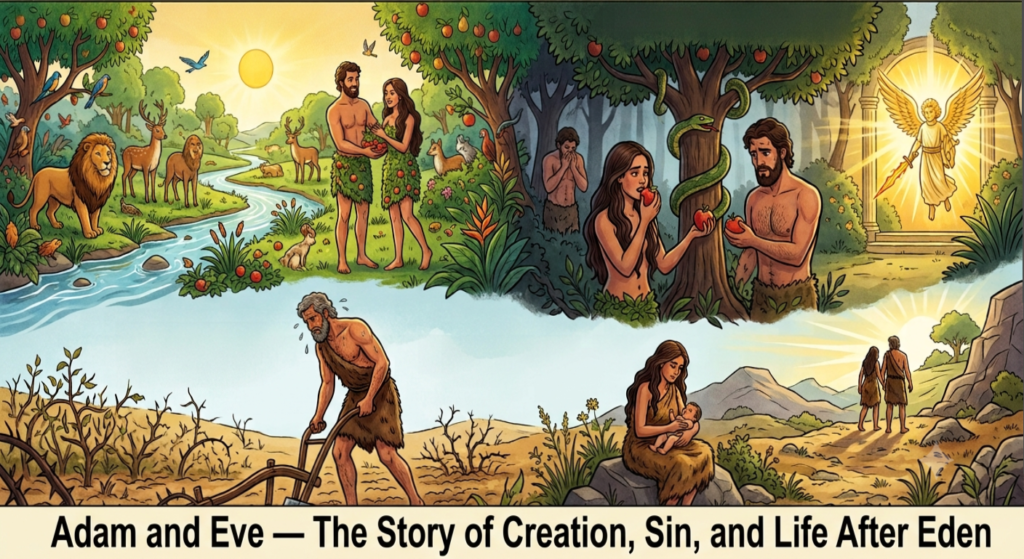
The Life of Adam and Eve — A Complete Bible-Based Story
If you want to understand how the Bible explains the beginning of humanity, the first few chapters of Genesis are where the story begins. There we meet a man, a woman, a garden, a choice, a fall, and a promise. This is not simply an ancient story. It introduces the Bible’s explanation of why humanity became separated from God, why suffering entered human life, why death became part of our experience, and why the story of redemption became necessary.
1. Creation — From an Empty World to an Ordered Creation
To understand the story of Adam and Eve, we first need to look at the world in which they were going to live.
The very first verse of the Bible says, “In the beginning God created the heaven and the earth” (Genesis 1:1, KJV). The earth was initially without form and empty, with darkness over the deep waters (1:2). God then brought His creation into order over six days.
On the first day, God brought forth light (1:3-5). On the second day, He made the firmament, separating the waters (1:6-8). On the third day, the waters were gathered together so that dry land appeared. God called the dry land Earth and the gathered waters Seas (1:9-10). On that same day, the earth brought forth plants, herbs, and trees (1:11-13).
On the fourth day, God made the sun, moon, and stars to give light and to mark seasons, days, and years (1:14-19). On the fifth day, He created the creatures of the sea and the birds of the air (1:20-23). On the sixth day came the animals of the earth, and finally humanity was created in the image of God (1:24-27).
When God looked upon everything He had made, He saw that it was “very good” (1:31). On the seventh day, God finished His work, rested from His work of creation, blessed the seventh day, and made it holy (2:2-3). This is why the seventh day receives a special place in the biblical creation account.
Before the story of humanity begins, Genesis places us in a world created by God and described by Him as “very good.”
2. Humanity — Created in the Image of God
Into this newly created world comes a very special creation: humanity.
When God created the animals, the account repeatedly speaks of them being made according to their kinds. But when God speaks about humanity, the language changes: “Let us make man in our image, after our likeness” (Genesis 1:26). The Bible does not explain here exactly why the word “our” is used. It simply records the words. What is clear is that humanity is uniquely described as being made in God’s image.
God blessed them and told them to be fruitful, multiply, fill the earth, and have dominion over it (1:28). At this stage, the plants, seeds, and fruit-bearing trees were given as food for humanity and the animals (1:29-30). The account does not describe animals being given as food at this point.
Human beings, therefore, were not presented as merely another part of creation. They were given God’s image, responsibility, and a distinctive role within God’s creation.
But Genesis does not stop there. The story now becomes more personal. We are about to see how the first man was formed and given life.
3. Adam — Formed From the Dust and Given Life by God
Genesis chapter 2 gives us a more detailed picture of the creation of humanity. “And the LORD God formed man of the dust of the ground, and breathed into his nostrils the breath of life; and man became a living soul” (2:7).
This is where the Bible brings the first man into focus. God formed him from the dust of the ground and then gave him life by breathing into him. His physical body came from the ground, but his life came from God.
The man would eventually be called Adam. Now he needed a place to live, and God prepared a special place for him.
4. The Garden of Eden — Adam’s First Home
God planted a garden eastward in Eden. It was filled with trees that were beautiful to look at and good for food. In the middle of the garden were two trees of particular importance: the tree of life and the tree of the knowledge of good and evil (2:9).
God placed the man in the garden to dress it and keep it (2:15). A river flowed out of Eden and divided into four branches: Pison, Gihon, Hiddekel, and Euphrates (2:10-14).
This was Adam’s first home. There was food, meaningful work, and fellowship with God. Yet even in the middle of that freedom, God established one clear boundary.
5. One Clear Command
Adam had enormous freedom in the garden. God told him that he could freely eat from every tree in the garden. But there was one exception: “But of the tree of the knowledge of good and evil, thou shalt not eat of it” (Genesis 2:17, KJV). God warned that in the day he ate of it, he would surely die.
The command was simple. Adam could eat from every other tree. Only one tree was forbidden. By obeying this single command, Adam could demonstrate his trust and obedience toward God.
But another problem soon became clear. Even though Adam lived in a beautiful garden surrounded by God’s creation, he was alone.
6. A Companion — The Animals Receive Names
God said, “It is not good that the man should be alone; I will make him an help meet for him” (2:18).
God brought the animals of the field and the birds of the air to Adam to see what he would call them. Adam gave names to the animals and birds (2:19-20). Yet among them there was no companion comparable to him.
Adam was surrounded by living creatures, but none was his equal or suitable companion. So God was about to do something uniquely for Adam.
7. Eve — Created From Adam’s Side
God caused Adam to fall into a deep sleep. He took one of Adam’s ribs, closed up the flesh, and made a woman from what He had taken from the man. Then He brought her to Adam (2:21-22).
When Adam saw her, he responded with joy: “This is now bone of my bones, and flesh of my flesh” (2:23).
Adam had finally found a companion corresponding to him. Genesis immediately connects this event with marriage: “Therefore shall a man leave his father and his mother, and shall cleave unto his wife: and they shall be one flesh” (2:24).
At that time, Adam and Eve were both naked, yet they were not ashamed because sin had not yet entered their experience (2:25).
Everything appeared complete. A man and a woman, a beautiful garden, God’s presence, food, meaningful work, and a relationship between them—nothing seemed to be missing.
But that peace would not last.
8. The Serpent — A Subtle Temptation
This is where the story takes a dramatic turn.
The serpent was more subtle than any beast of the field that the LORD God had made (3:1). It approached the woman and asked, “Yea, hath God said, Ye shall not eat of every tree of the garden?”
The deception began with a question. The serpent did not immediately deny God’s command. Instead, it first questioned whether God had really said what He had said.
The woman’s response was slightly different from God’s original command. God had said they could freely eat from the trees except for one, but Eve added that they should not touch the forbidden tree (3:2-3).
The temptation began with a seemingly simple question, but behind it was an attempt to create doubt about God’s word.
9. The Serpent’s Lie — The First Deception
The serpent then directly contradicted God’s warning: “Ye shall not surely die” (3:4). It went on to tell the woman that their eyes would be opened and that they would be like gods, knowing good and evil (3:5).
This is the first clear lie recorded in the biblical story. The serpent rejected God’s warning and presented God’s command as though God were keeping something good from them.
The serpent made the forbidden fruit appear desirable because it promised greater knowledge and a status like God’s. But God had already established a clear boundary for their good.
Now Eve was faced with two voices—the word of God and the word of the serpent.
Which one would she believe?
10. Sin — Eating the Forbidden Fruit
The woman looked at the tree again. The fruit appeared good for food, beautiful to look at, and desirable because it seemed to offer wisdom (3:6).
In that moment, the tree looked different to her. The command that had once defined the boundary was now overshadowed by the attractiveness of the fruit.
She took the fruit and ate it. Then she gave some to her husband, who was with her, and he ate it as well.
The New Testament later explains that Adam was not deceived in the same way Eve was (1 Timothy 2:14). Eve was deceived, but Adam also knowingly participated in disobedience. Both violated God’s command.
This was not merely about eating a piece of fruit. It was an act of choosing another voice over God’s word and rejecting the boundary He had established.
From that one decision forward, their world changed.
11. Their Eyes Were Opened — Shame and Hiding
Immediately after eating, their eyes were opened. They realized that they were naked and made coverings for themselves from fig leaves (3:7).
Only moments earlier, they had felt no shame. Now they were trying to hide themselves. The physical world around them had not suddenly disappeared, but something inside them had changed.
Later, when they heard the sound of the LORD God walking in the garden, they hid themselves from His presence.
God’s presence had previously been part of their life. Now that same presence produced fear.
God called to Adam and asked, “Where art thou?” (3:9).
God was not asking because He did not know where Adam was. The question confronted Adam with his condition and gave him an opportunity to respond.
The issue was no longer simply about the fruit. Adam now had to face what he had done.
12. Blame — Passing Responsibility to Someone Else
Adam did not fully accept responsibility. He said, “The woman whom thou gavest to be with me, she gave me of the tree, and I did eat” (3:12).
He admitted that he had eaten, but he immediately pointed to Eve. His words also indirectly pointed toward God when he referred to “the woman whom thou gavest me.”
When God questioned the woman, Eve answered, “The serpent beguiled me, and I did eat” (3:13).
Neither of them simply stood before God and accepted responsibility without explanation. The story shows something that remains familiar in human behavior: after doing wrong, people often try to justify themselves or shift responsibility onto someone else.
Now God would pronounce judgment.
13. The Judgments — God’s Justice
God pronounced different consequences for the serpent, the woman, and the man.
The Serpent
God declared that the serpent would crawl upon its belly and eat dust all the days of its life. God also placed enmity between the serpent and the woman, and between their offspring. The woman’s offspring would bruise the serpent’s head, while the serpent would bruise his heel (3:14-15).
This final part is especially important. In Christian tradition, Genesis 3:15 has been understood as the first promise of redemption. Christians have traditionally understood the woman’s offspring who would ultimately defeat the serpent as pointing forward to Christ. The New Testament identifies the serpent with Satan in Revelation 12:9 and 20:2.
The Woman
God told the woman that He would greatly multiply her sorrow and conception, and that she would bring forth children in pain. The passage also speaks about her relationship with her husband and his rule over her (3:16). The exact wording and interpretation of the phrase concerning her desire toward her husband varies somewhat among Bible translations and interpretive traditions.
Adam
God told Adam that the ground was cursed because of him. He would work and struggle for food throughout his life. The ground would produce thorns and thistles, and eventually Adam would return to the dust from which he had been formed (3:17-19).
Death is clearly introduced into the judgment. Adam came from the dust, and ultimately he would return to the dust.
Yet even after judgment, God’s actions toward them would show an element of mercy.
14. Eve’s Name and the Garments God Provided
Adam called his wife’s name Eve, because she would become the mother of all living (3:20).
Even after the announcement of sin, judgment, and death, the name Eve points toward the continuation of human life.
God also made coats of skins for Adam and Eve and clothed them (3:21). Christians have often viewed God’s act of clothing them as another picture of His care even after their disobedience. However, Genesis does not specifically say that their fig-leaf coverings were inadequate.
But another serious decision now had to be made. Adam and Eve could no longer remain permanently in Eden.
15. Expelled From Eden
God said that humanity had now come to know good and evil and that Adam should not take from the tree of life, eat, and live forever (3:22-23). Therefore, God sent Adam out of the Garden of Eden to work the ground from which he had been taken.
Adam and Eve’s life in Eden was over.
God placed cherubim and a flaming sword that turned every way to guard the way to the tree of life (3:24).
This represents one of the greatest losses resulting from sin: humanity was separated from Eden and from access to the tree of life.
Life outside the garden would be different. Food would require hard work. The ground would produce thorns and thistles. Eventually, they would return to the dust.
But their story did not end outside Eden.
16. Cain and Abel — The First Sons
After Adam and Eve left the garden, a new chapter began for their family.
They had two sons. Their first son was Cain, and later came Abel (4:1-2).
Abel was a keeper of sheep, while Cain worked the ground. Both brought offerings to God. Cain brought an offering from the fruit of the ground, while Abel brought the firstborn of his flock and the fat thereof (4:3-4).
God respected Abel and his offering, but He did not respect Cain and his offering.
Another conflict was now beginning within the family itself.
17. Cain’s Anger and the Murder of Abel
Cain became angry.
God warned him: “If thou doest well, shalt thou not be accepted? and if thou doest not well, sin lieth at the door” (4:7). God told Cain that he needed to rule over it.
God gave Cain an opportunity to respond differently. He warned him to deal with the sin that was waiting at the door.
But Cain did not listen.
He took Abel into the field and killed him (4:8).
This became the first recorded murder in human history.
The sin that began in Eden had now grown into violence within the first family, reaching the point where one brother took the life of another.
18. God’s Question and Cain’s Judgment
Once again, God’s question came.
God asked Cain, “Where is Abel thy brother?”
Cain answered, “I know not: Am I my brother’s keeper?” (4:9).
His response echoes Adam’s earlier reaction. Adam pointed toward Eve when confronted with his sin. Cain refused to accept responsibility for his brother.
God then declared, “The voice of thy brother’s blood crieth unto me from the ground” (4:10). Cain was judged, and the ground would no longer yield its strength to him. He would become a fugitive and a wanderer (4:10-12).
Cain became afraid that someone would kill him. God placed a mark on him and did not allow him to be killed (4:13-15).
Again, the story contains both judgment and mercy. Cain was not excused for what he had done, but God did not allow him to be immediately killed.
Cain went out from the presence of the LORD and lived in the land of Nod.
19. Cain’s Descendants and Lamech’s Song
Cain’s family continued to grow. Cain’s wife gave birth to Enoch, and Cain built a city and named it after his son Enoch (4:17).
Several people from Cain’s line are mentioned:
- Jabal — described as the father of those who dwell in tents and keep livestock.
- Jubal — described as the father of those who play the harp and organ.
- Tubal-cain — an instructor of craftsmen who worked with brass and iron.
- Naamah — the sister of Tubal-cain.
These details are recorded in Genesis 4:18-22.
Cain’s descendants therefore include people connected with city building, livestock, music, and metalworking. Human culture and technology were developing, yet the same family line also reveals an increasing pattern of violence.
Lamech, one of Cain’s descendants, spoke a song to his wives. He described killing a man who had wounded him and then declared that if Cain would be avenged sevenfold, Lamech would be avenged seventy and sevenfold (4:23-24).
This provides another picture of how violence and revenge were becoming increasingly severe in human society.
But Cain’s line is not the only line through which the biblical story continues. After Abel’s death, another son was born.
20. Seth — Another Son After Abel
Adam and Eve had another son.
Eve said that God had appointed her another seed instead of Abel, whom Cain had killed, and she named him Seth (4:25).
After Abel’s death at Cain’s hands, Seth became another important part of the family’s continuing story.
Seth had a son named Enos. “Then began men to call upon the name of the LORD” (4:26).
So within Adam’s family, the story contains not only sin, violence, and death, but also a growing pattern of people calling on the name of the LORD.
21. From Adam to Noah — The Genealogy
From this point, Genesis temporarily shifts its focus from individual events to a genealogy.
The Bible records the line of Adam in detail. God made man in His own likeness and called his name Adam. When Adam was 130 years old, Seth was born. Adam lived another 800 years and had sons and daughters. In total, Adam lived 930 years and then died (5:1-5).
The genealogy continues: Seth → Enos → Cainan → Mahalaleel → Jared → Enoch → Methuselah → Lamech → Noah (5:6-32).
The genealogy repeatedly gives ages, descendants, and the length of each person’s life.
One person in this list stands out in a unique way—Enoch.
“And Enoch walked with God: and he was not; for God took him” (5:24).
This is the distinctive statement the Bible gives about Enoch.
Adam lived 930 years and died. The Bible does not record when Eve died.
Adam’s story therefore becomes part of the larger family line that eventually leads to Noah. Yet the consequences of Adam’s sin do not disappear from the biblical story. The New Testament places Adam within a much larger story of sin, death, grace, and redemption.
22. Adam and Eve in the New Testament
The New Testament refers to Adam and Eve several times.
Paul explains that sin and death entered the world through one man, Adam, while grace, righteousness, and life are offered through Christ (Romans 5:12-19).
“For as in Adam all die, even so in Christ shall all be made alive” (1 Corinthians 15:22).
Paul also contrasts the first Adam with Christ, describing the first Adam as a living soul and the last Adam as a life-giving spirit (1 Corinthians 15:45).
Paul refers to the order of creation and the deception of Eve in 1 Timothy 2:13-14.
In 2 Corinthians 11:3, Paul uses the serpent’s deception of Eve as a warning that believers can also be led away from sincere devotion to Christ.
When Jesus taught about marriage, He referred back to the creation account, saying that the Creator made them male and female from the beginning (Matthew 19:4-6; Mark 10:6-8).
Luke’s genealogy eventually traces the human line back to Adam and describes Adam as the son of God (Luke 3:38).
The serpent is later identified as Satan in Revelation 12:9 and 20:2.
For this reason, Adam is not presented in the New Testament merely as a distant historical figure. Paul uses Adam in contrast with Christ, explaining the relationship between the first man’s disobedience and death and Christ’s work bringing grace, righteousness, and life.
23. Lessons From the Story of Adam and Eve
When we step back and look at the entire story, we can see many lessons that still speak to human life.
There is much to learn from this account. First, questioning and distrusting God’s word can become the beginning of disobedience. Second, refusing to accept responsibility and blaming others can make a situation worse. Third, sin has consequences—suffering, hardship, and death. Fourth, God is merciful; even after judgment, He provided clothing and gave a promise concerning future victory over the serpent. Fifth, Paul explains that sin and death came through Adam, while grace, righteousness, and life are found in Christ. This becomes one of the foundational themes of the larger biblical story.
The story of Adam and Eve reveals human weakness. The story of Cain and Abel shows sin taking an even more destructive form. Yet throughout these accounts, God’s judgment is accompanied by His actions, His mercy, and indications of His purpose to bring redemption.
24. Why Does This Story Matter?
The story of Adam and Eve is ultimately a story that helps explain our human condition.
It provides the opening biblical background for understanding why humanity is separated from God, why suffering and hardship exist, and why death became part of human life.
But the story does not end in hopelessness.
Even though humanity was driven out of Eden, God’s purpose of redemption did not end there. God spoke of the offspring of the woman who would ultimately overcome the serpent. Christians believe that this promise is fulfilled through Jesus Christ.
That is why the story of Adam and Eve is more than an account of how humanity began. It provides the opening background for the Bible’s larger story of sin, death, human weakness, God’s justice, God’s mercy, and ultimately redemption.
And that is why this ancient story can still give people hope today.
📖 Read More Bible Articles
Would you like to read more Bible-based articles in English?
Explore more articles about life, faith, suffering, God’s Word, and the spiritual questions people face in real life.