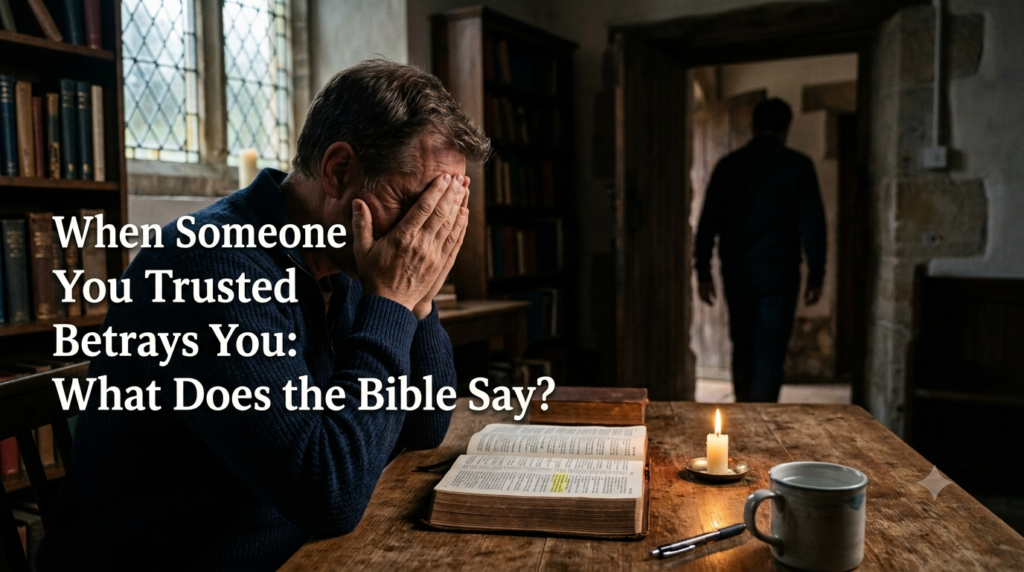
When a stranger hurts us, we may become angry or disappointed. But when the person who hurts us is someone we trusted with our friendship, our family, our finances, our secrets, or even our future, the pain can feel completely different.
Betrayal does not simply damage a relationship. It can make us question our own judgment.
How could I have trusted this person?
How did I not see it coming?
Was everything they told me a lie?
Can I ever trust anyone again?
Those questions can stay with a person for a long time.
A physical wound can often be treated. Emotional wounds caused by betrayal can be much harder to see and much harder to explain. You may continue going to work, taking care of your family, and talking to people normally while carrying a deep wound inside.
The Bible does not pretend that betrayal is a small problem. Scripture contains some of the most painful stories of betrayal ever recorded.
Joseph was betrayed by his own brothers.
David experienced betrayal from people close to him.
Jesus was betrayed by one of His own disciples.
Yet these stories do not end with betrayal.
They point to a greater truth:
Human betrayal cannot cancel God’s ability to accomplish His purposes.
That does not mean God approves of betrayal or excuses what people do. It means that even when people make sinful choices and cause terrible damage, God can still work through a broken situation and bring His purposes to completion.
If someone you trusted has betrayed you, the Bible offers both comfort and wisdom—comfort for the wound and wisdom for what you should do next.
Joseph: When Your Own Family Betrays You
One of the clearest examples of betrayal in the Bible is the story of Joseph.
Joseph was not betrayed by an enemy.
He was betrayed by his brothers.
Genesis 37 tells us that Jacob loved Joseph more than his other sons. His brothers saw this and became jealous of him.
Joseph also had dreams that suggested his family would one day bow before him. His brothers hated him even more because of those dreams.
Eventually, they saw Joseph coming from a distance.
Instead of welcoming their younger brother, they began plotting against him.
They wanted to kill him.
Reuben persuaded them not to murder Joseph and suggested putting him into a pit instead. Later, Judah suggested selling him to passing merchants.
Joseph was sold as a slave.
His own brothers took the special coat his father had given him, dipped it in goat’s blood, and brought it back to their father.
They allowed Jacob to believe that Joseph had been killed by a wild animal.
Think about what that meant.
Joseph lost his family.
He lost his freedom.
He lost his home.
And his father was left grieving because of a lie his own sons had created.
Yet Joseph’s story did not end in that pit.
God was still working.
Joseph eventually rose to a position of great authority in Egypt. Years later, famine forced his brothers to come to Egypt looking for food. They stood before the brother they had betrayed without realizing who he was.
When Joseph finally revealed his identity, he did not pretend that what they had done was acceptable.
Instead, he showed them a bigger picture:
“But as for you, ye thought evil against me; but God meant it unto good.”
— Genesis 50:20, KJV
Joseph did not say, “What you did was not evil.”
He acknowledged that they intended evil, but God was able to bring good out of what they had done.
That distinction matters.
God did not need Joseph’s brothers to do evil in order to accomplish His purpose. But their evil did not have the final word.
If someone has betrayed you, you may not understand why God allowed it.
You may not see any good coming from it right now.
But you are not necessarily seeing the whole story.
You may be standing in the middle of one painful chapter.
God sees the entire story.
A Modern Example: Daniel and Michael
Note: The following story is a fictional example created to help illustrate how betrayal can happen in modern life. It is not based on any specific person or company.
Daniel and Michael had been friends since childhood.
They grew up in the same neighborhood, went to the same schools, and remained close as adults.
Daniel eventually worked hard to build a small printing and marketing company.
When Michael was struggling financially and could not find stable work, Daniel did not hesitate to help him.
Daniel did not see Michael as merely a friend.
He considered him family.
So he brought Michael into the business as a partner, even though Michael had no money to invest.
Daniel trusted him with important responsibilities.
Michael had access to company accounts, client information, banking transactions, and day-to-day business operations.
For years, everything seemed fine.
Then things slowly began to change.
Michael became resentful.
He started thinking, “Why should Daniel receive more of the profits when I am doing so much of the work?”
At the same time, Michael had accumulated significant personal debt.
Instead of dealing with his financial problems honestly, he began taking money from the company without Daniel’s knowledge.
One lie required another.
He began redirecting payments from clients into his own account.
Eventually, he even used company equipment as collateral for a loan and used a forged version of Daniel’s signature without his permission.
Then the truth came out.
One day, bank officials arrived at the business with legal notices.
Daniel confronted Michael.
But instead of showing genuine remorse, Michael tried to turn the situation against him. He even told Daniel’s wife that Daniel himself had caused the financial problems.
Daniel felt as though his entire life had collapsed.
The person he had trusted like a brother had used that trust against him.
That night, Daniel could barely sleep.
He kept asking himself:
How could someone I trusted this much do this to me?
Eventually, he opened the Bible his mother had given him years earlier.
He came across Psalm 55, where David described the pain of being betrayed by someone who had once been close to him:
“For it was not an enemy that reproached me; then I could have borne it…”
— Psalm 55:12, KJV
Daniel realized something important.
His pain did not mean that God had abandoned him.
He prayed.
He told God everything—the anger, disappointment, fear, and confusion.
But he also took responsible action.
He gathered the financial records, sought appropriate legal advice, told his wife the truth, and began dealing with the consequences of what had happened.
Forgiveness did not mean ignoring the fraud.
Faith did not mean refusing to take legal action.
And trusting God did not mean trusting Michael again without boundaries.
Over time, Daniel rebuilt his life and eventually rebuilt his business.
His story illustrates an important biblical principle:
You can forgive someone without giving them the same access to your life again.
David and Ahithophel: Betrayed by a Trusted Counselor
Joseph was betrayed by family.
David experienced another kind of betrayal—from someone who had been close to him and whose advice he deeply valued.
Ahithophel was one of David’s trusted counselors.
The Bible describes his counsel as extraordinarily respected:
“And the counsel of Ahithophel, which he counselled in those days, was as if a man had enquired at the oracle of God.”
— 2 Samuel 16:23, KJV
That tells us how seriously David and others regarded his advice.
But when David’s son Absalom rebelled against him, Ahithophel joined Absalom.
This was not simply a disagreement.
Ahithophel advised Absalom on how to pursue David and kill him.
David learned what had happened and prayed:
“O LORD, I pray thee, turn the counsel of Ahithophel into foolishness.”
— 2 Samuel 15:31, KJV
Notice David’s response.
He did not try to solve everything through revenge.
He prayed.
God ultimately caused Absalom to reject Ahithophel’s advice.
The betrayal was real.
The danger was real.
But the betrayal did not determine the final outcome.
David had to flee.
He had to endure humiliation and fear.
But he continued looking to God.
That is one of the recurring lessons in Scripture:
When people fail you, do not let their failure become the foundation of your relationship with God.
Jesus and Judas: Betrayal With a Kiss
Perhaps the most painful example of betrayal in Scripture is Judas Iscariot.
Judas was not a stranger.
He was one of the twelve disciples.
He traveled with Jesus.
He heard Jesus teach.
He witnessed miracles.
He was present during moments that changed the lives of countless people.
Yet Judas eventually agreed to betray Jesus for thirty pieces of silver.
Matthew records:
“What will ye give me, and I will deliver him unto you? And they covenanted with him for thirty pieces of silver.”
— Matthew 26:15, KJV
Later, Judas identified Jesus to the authorities with a kiss.
A gesture normally associated with affection became the signal for an arrest.
That makes the scene particularly heartbreaking.
Jesus knew what Judas was doing.
The betrayal did not surprise Him.
Yet Jesus still allowed the events to unfold.
This does not mean Jesus approved of Judas’s actions.
It means something much deeper:
Human sin and betrayal could not stop God’s plan of redemption.
The betrayal was sinful.
The motives were sinful.
The consequences were terrible.
But God was not defeated by them.
Jesus went to the cross.
And through His death and resurrection, the cross became central to the Christian gospel.
This is one of the strongest truths for someone who has been betrayed:
What someone did to you may have changed your circumstances, but it does not have the authority to determine the final chapter of your life.
When Betrayal Feels Like Darkness
John records something striking when Judas left Jesus:
“And it was night.”
— John 13:30, KJV
At one level, John is simply telling us that it was nighttime.
But the moment can also serve as a powerful picture of what betrayal feels like.
Betrayal often feels like darkness.
You may not know who to trust.
You may question your own judgment.
You may lose your sense of security.
You may even begin wondering whether God sees what happened.
But darkness is not the same thing as abandonment.
The fact that you cannot see what God is doing does not mean He is doing nothing.
You may be unable to see the next chapter.
God is not.
Psalm 55: When the Betrayer Was a Friend
One reason the Psalms are so meaningful to people who have experienced betrayal is that David does not hide his emotions.
He tells God exactly how deeply he is hurting.
Psalm 55 says:
“For it was not an enemy that reproached me; then I could have borne it…”
— Psalm 55:12, KJV
David then describes the person as someone who had been his companion and friend.
This is an important biblical lesson:
You do not have to pretend that betrayal did not hurt.
You can tell God the truth.
You can tell Him that you are angry.
You can tell Him that you feel broken.
You can tell Him that you do not understand.
Prayer is not about using religious words to hide your emotions.
The Psalms show us that prayer can be the place where we bring those emotions into God’s presence.
David and Jonathan: Not Everyone Will Betray You
After reading stories of betrayal, it would be easy to become cynical.
You might start thinking:
“Nobody can be trusted.”
But the Bible does not teach that.
David’s friendship with Jonathan gives us a beautiful example of faithful friendship.
The Bible says:
“The soul of Jonathan was knit with the soul of David, and Jonathan loved him as his own soul.”
— 1 Samuel 18:1, KJV
Jonathan had every human reason to become jealous of David.
Jonathan was Saul’s son.
David was becoming the man God had chosen to lead Israel.
Yet Jonathan did not respond with jealousy.
He loved David.
He protected him.
He warned him when Saul wanted to kill him.
He was willing to sacrifice his own interests for the sake of his friend.
When Jonathan died, David mourned deeply.
His friendship with Jonathan reminds us of something important:
One person’s betrayal does not prove that every relationship is false.
There are still people who are loyal.
There are still people who keep their word.
There are still people who will stand beside you when life becomes difficult.
Betrayal should teach you discernment—not convince you that love and friendship are impossible.
What Should You Do When Someone You Trusted Betrays You?
The Bible gives us several principles that can guide us.
1. Take the Betrayal Seriously
Forgiveness does not require pretending that nothing happened.
If someone stole money, lied, abused your trust, committed fraud, or deliberately damaged your life, acknowledge what happened.
Truth matters.
2. Do Not Let Revenge Control You
Paul writes:
“Dearly beloved, avenge not yourselves, but rather give place unto wrath.”
— Romans 12:19, KJV
Giving the matter to God does not mean refusing to protect yourself.
It means refusing to allow revenge to become the thing that controls your life.
There is a difference between justice and revenge.
If a crime has been committed, appropriate legal action may be necessary.
Forgiveness does not cancel accountability.
3. Forgive Without Abandoning Wisdom
Jesus taught His followers to forgive.
But Jesus also taught His disciples to be discerning:
“Be ye therefore wise as serpents, and harmless as doves.”
— Matthew 10:16, KJV
That is a powerful combination.
Be loving.
Be forgiving.
But also be wise.
You can forgive someone while maintaining healthy boundaries.
You can wish someone well without giving them access to your finances.
You can release hatred without restoring the same level of trust.
Forgiveness and trust are not identical.
Trust may need to be rebuilt over time through consistent actions.
4. Do Not Place Ultimate Trust in People
Psalm 118 says:
“It is better to trust in the LORD than to put confidence in man.”
— Psalm 118:8, KJV
People can change.
People can fail.
People can make selfish choices.
Even people we love can disappoint us.
God is different.
His character does not change because another person has failed us.
5. Take Wise Practical Action
If the betrayal involves financial fraud, identity theft, stolen property, forged documents, business misconduct, or another crime, spiritual comfort should not replace practical responsibility.
Document what happened.
Protect your finances.
Secure important accounts and records.
Seek qualified legal advice when appropriate.
Report criminal conduct through the proper authorities when necessary.
You can pray and take responsible action.
Those two things are not opposites.
What Betrayal Cannot Take Away From You
Someone may take money.
Someone may damage a business.
Someone may destroy a friendship.
Someone may spread lies about you.
Someone may walk away from a relationship.
But there are things they cannot ultimately take away from you:
Your character.
Your faith.
Your ability to rebuild.
Your future.
Your relationship with God.
Joseph lost years of his life because of what his brothers did.
Yet his story did not end with what they did to him.
David was betrayed and hunted.
Yet God continued to lead him.
Jesus was betrayed and crucified.
Yet the cross became central to God’s redemptive work.
That does not make betrayal good.
It means betrayal does not have to be the end of the story.
The Comfort the Bible Gives to a Betrayed Heart
If someone you trusted has hurt you deeply, you may still be asking:
“Why did God allow this?”
Sometimes Scripture does not give us an immediate answer to that question.
But it gives us something else.
It reminds us that God sees.
God knows.
God is not confused by what happened.
And God is not limited by what another person did.
You may be looking at one broken chapter.
God sees the whole story.
You may not understand what He is doing today.
That does not mean He has abandoned you.
The Bible gives this promise:
“I will never leave thee, nor forsake thee.”
— Hebrews 13:5, KJV
People may leave.
Friends may change.
Partners may betray.
Business relationships may collapse.
But God’s faithfulness does not depend on another person’s loyalty.
Conclusion: Betrayal Is a Wound, Not Your Final Chapter
Being betrayed by someone you trusted can change you.
It can make you more cautious.
It can make you question people.
It can leave scars.
But a scar is not proof that the wound will always be open.
Joseph’s brothers betrayed him, but God was not finished with Joseph.
Ahithophel betrayed David, but God was not finished with David.
Judas betrayed Jesus, but the betrayal did not stop God’s plan of redemption.
And if you are walking through betrayal today, your story is not necessarily finished either.
You do not have to become bitter.
You do not have to pretend that nothing happened.
You do not have to trust the same person blindly again.
And you do not have to carry the burden of revenge.
Bring the pain to God.
Seek truth.
Use wisdom.
Set appropriate boundaries.
Take responsible action when necessary.
And leave the final judgment in God’s hands.
Human beings can break promises. God does not.
People can betray your trust. God remains faithful.
Someone may have damaged one chapter of your story. They do not get to write the entire story.
The Bible’s message is not that betrayal does not hurt.
It does.
The message is that betrayal does not have the final word.
A Note for Anyone Walking Through Betrayal
If you have been betrayed, do not feel ashamed because you trusted someone.
Trust itself is not foolishness.
But wisdom means learning from what happened.
Forgiveness does not mean ignoring wrongdoing.
Faith does not mean refusing to seek justice.
And loving someone does not require giving them unlimited access to your life.
Ask God for both healing and discernment.
Let Him heal the wound without allowing the wound to become your identity.
And remember:
You may only see a broken chapter right now. God sees the whole story.
Read More Bible-Based Articles
If you would like to read more Bible-based articles in English, explore our English Articles collection.
Related Articles
- Everyone Around Me Acts Nice but Hurts Me
- The Good God Does for Us Through Those Who Hurt Us
- I Can’t Control My Anger Anymore
- Browse all English Bible articles
Disclaimer
Verses: All Bible verses in this article are quoted from the King James Version (KJV). Under each verse, we explain in plain words the situation in which it was written. To understand a verse fully, we encourage you to read the whole chapter in your own Bible.
Language: We wrote this article in simple, everyday English for readers who may not know the Bible well. It is meant for personal reflection and encouragement, not as an official Bible commentary.
Story: The story in this article (the names and events) is made up as an illustration. It is not from the Bible, and it is only here to help you understand the verse. When we mention history that is not in the Bible, we say so right there.
Written by Team HolyBibleWithYou.com
If the betrayal in your own situation involves fraud, theft, abuse, forged documents, financial wrongdoing, or another legal matter, please seek appropriate professional legal assistance as well. Forgiveness does not remove another person’s legal responsibility or your right to protect yourself.