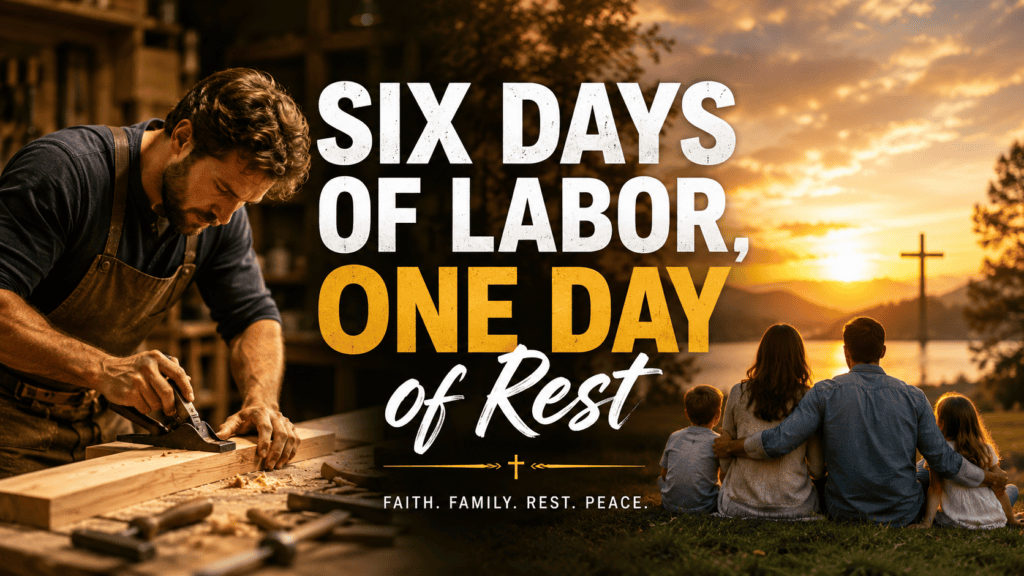
God’s Blueprint for Hard Work, Divine Sabbath, Family Connection, and Inner Peace
Scripture Foundation (Exodus 20:9–10, KJV)
“Six days shalt thou labour, and do all thy work: But the seventh day is the sabbath of the LORD thy God: in it thou shalt not do any work, thou, nor thy son, nor thy daughter, thy manservant, nor thy maidservant, nor thy cattle, nor thy stranger that is within thy gates.”
In plain words: God told His people to work for six days and to keep the seventh day as a day of rest for the LORD. This rest was for the whole household: children, servants, animals, and visitors.
When and why these words were spoken. God spoke these words to Israel at Mount Sinai, about three months after they had left Egypt (Exodus 19:1). They are part of the Ten Commandments. God began by saying, “I am the LORD thy God, which have brought thee out of the land of Egypt, out of the house of bondage” (Exodus 20:2, KJV). Just before the verse above, He said, “Remember the sabbath day, to keep it holy” (Exodus 20:8, KJV). So this is the Sabbath commandment: six days for work, and the seventh day set apart for the LORD.
1. Introduction: Losing Your Soul in the 24/7 Hustle
In today’s fast-paced world, life moves faster than the machines we operate. From the moment the morning alarm rings to the time we collapse into bed, we are caught in a relentless cycle of tasks, responsibilities, and endless notifications. With smartphones glued to our hands, laptops on our kitchen counters, and weekend emails demanding immediate attention, modern hustle culture pushes us to the brink. In the process, we find ourselves disconnected from God, distant from our families, and completely drained physically and emotionally.
Society preaches that non-stop work is the only road to success. Yet, ignoring the natural rhythm of labor and rest leaves us hollow, stressed, and burned out. The ancient wisdom of Exodus 20:9–10 offers a timeless antidote: a healthy balance between honest physical work, sacred rest, and meaningful human relationships.
2. Six Days of Honest Labor: The Dignity of Hard Work
God did not create humanity for apathy or idleness. “Six days shalt thou labour, and do all thy work,” Scripture commands. Honest physical and mental work is not a curse; it is a source of dignity, health, and purpose.
Crucially, we must remember: Rest is not laziness! Slothfulness—avoiding responsibility, wasting time in mindless distraction, or living without discipline—is not Sabbath rest. True rest is different from simply wasting time. When you spend six days putting your heart into your craft—whether building, farming, managing a business, or working with your hands—your labor has purpose, and genuine rest becomes meaningful.
Our bodies and minds also need recovery. That is one reason doctors commonly encourage people to get adequate rest and sleep. God’s design for work and rest recognizes something modern life often forgets: human beings were never designed to work endlessly without recovery.
When we work honestly and responsibly, the fruits of our labor can bring genuine satisfaction. Our profession may be anything—construction, woodworking, farming, running a business, operating machinery, or any other form of honest work. When it is done with integrity and faithfulness, our work can honor God.
3. Why Did God Institute Rest? The Biblical Perspective
Scripture provides clear, intentional reasons why God ordained Sabbath rest for human flourishing:
The Pattern of Creation (Genesis 2:2–3, Exodus 20:11)
God created the universe in six days and rested on the seventh, blessing and sanctifying it. God did not rest because He was exhausted, but to establish a holy rhythm for humanity so we would not turn into tireless, unfeeling machines.
Physical and Mental Renewal (Exodus 23:12)
“Six days thou shalt do thy work, and on the seventh day thou shalt rest: that thine ox and thine ass may rest, and the son of thy handmaid, and the stranger, may be refreshed.”
God designed our minds and bodies with limits. The Sabbath ensured that every worker, family member, and even working animals received necessary physical restoration and relief from continuous strain.
Rest Is Made for Human Good (Mark 2:27)
When some Pharisees objected that His disciples were picking grain on the Sabbath, Jesus clarified the true intent of the Sabbath: “The sabbath was made for man, and not man for the sabbath.” (Mark 2:23-27, KJV) Rest is not a rigid burden meant to crush us; it is a gift designed for our good and well-being.
A Memorial of Freedom (Deuteronomy 5:15)
When the Israelites were slaves in Egypt, they were forced into endless labor. After liberating them, God commanded them to remember their former slavery and keep the Sabbath. Resting was a reminder that they were no longer slaves defined only by endless productivity.
Sacred Connection and Identity (Ezekiel 20:12, Exodus 31:13)
“Moreover also I gave them my sabbaths, to be a sign between me and them, that they might know that I am the LORD that sanctify them.”
During six days of work, our focus is naturally consumed by earthly tasks. The seventh day invites us to pause, look up, worship, and realign our hearts with our Creator.
Renewed Energy and Perspective (Isaiah 58:13–14)
Stepping away from weekly stress and delighting in God’s presence can restore spiritual strength, sharpen perspective, and prepare our hearts for the week ahead.
4. The Seventh Day: Conversation with God and Spiritual Surrender
Sabbath rest is far more than sleeping in or lounging on the couch. It is an intentional act of spiritual alignment.
Rest is not slothful leisure; it is intentional renewal. It involves stepping away from the normal pressure of work, allowing the body to recover, quieting the mind, and turning our attention toward God.
Unfiltered Prayer
Prayer means pouring out your heart to God without pretense. It means placing the accumulated worries, hidden anxieties, and weekly exhaustion at His feet. When you surrender your burdens to God, inner peace can begin to replace panic.
Spiritual Renewal
Spending time in Scripture, worship, and quiet reflection can strengthen the soul and provide clarity for the upcoming week.
5. Family Connection: Being Present for Those You Love
Notice how Exodus 20:10 specifically mentions family: “thou, nor thy son, nor thy daughter…” The Sabbath was meant to include the household. Workaholism can starve relationships, leaving family members with only the leftover scraps of our energy and patience.
Dedicated rest allows us to cultivate deeper bonds.
Understanding Your Spouse
Take time to listen attentively to your spouse’s thoughts, fears, and dreams without the distraction of work and daily pressure.
Nurturing Your Children
Be fully present in your children’s lives. Listen to their school experiences, understand their challenges, play with them, and build joyful childhood memories.
Honoring Aging Parents
Sit with elderly parents, listen to their stories, and offer them heartfelt care and attention.
Love cannot be bought with money; it requires time, presence, and genuine attention.
6. A Fictional Illustrative Story: Ethan’s Journey of Transformation
Let us look at a fictional illustrative story to see how this Biblical principle plays out in everyday modern life.
A Craftsman Trapped in the Workaholic Grind
Ethan was a highly skilled woodworker who owned an artisan custom furniture studio in a bustling suburb. He was married to Sarah, and they had two children—ten-year-old Jack and eight-year-old Lily—along with Ethan’s aging parents who lived nearby.
Ethan was deeply devoted to his family, but he lived by a rigid mindset: “The more hours I work, the better future I can buy for my family.”
Driven by this belief, Ethan arrived at his workshop by 6:00 AM every morning and returned home late past 10:00 PM. The heavy physical labor—lifting lumber, precision cutting, sanding, and assembling custom pieces—left his body aching and exhausted. Driven by financial worries, he refused to take Sundays off, taking on weekend rush orders and spending seven days a week at his workbench.
Despite his earnings, his home life began to crumble. Ethan returned every evening exhausted, tense, and irritable. When Sarah tried to share her day or talk about household matters, Ethan snapped: “I’ve been doing manual labor all day! I’m exhausted, don’t overwhelm me.”
When Jack and Lily asked him to play catch or look at their school projects, he brushed them off: “Daddy’s working hard for you. Go watch TV.” Slowly, his presence vanished from his family’s emotional life.
The Drawing That Changed Everything
One Sunday evening, Ethan dragged himself home from the workshop. On the kitchen counter lay a drawing from Lily’s second-grade art folder. The assignment prompt read: “My Family’s Sunday.”
Lily had drawn a sunny backyard garden where Sarah, Jack, and their grandparents were sitting at a picnic table, smiling together. Off in the far corner of the page, separated by a heavy black line, was Ethan’s workshop. Inside stood a solitary stick figure holding a saw, surrounded by dust.
Below the drawing, Lily had written in messy crayon letters:
“Daddy works on Sundays too. He doesn’t play with us, and he is always tired and angry.”
The drawing hit Ethan like a physical blow. Tears welled in his eyes. In his quest to secure his family’s material future, he realized he was robbing them of his present. His children didn’t just need his paycheck; they needed him.
Turning to God and Finding True Sabbath Rest
Late that night, Ethan opened his dusty Bible and came across Exodus 20:9–10: “Six days shalt thou labour, and do all thy work: But the seventh day is the sabbath of the LORD thy God…”
The verse pierced his heart. He realized God had established a clear rhythm: six days of honest labor followed by a day of worship, rest, and renewed connection with God and family. He resolved to change.
The following Sunday morning, Ethan locked his workshop doors and drove his family to church. Afterward, he retreated to his study, knelt down, and prayed with complete vulnerability:
“Lord, in my pride, I relied entirely on my own strength and neglected You and my family. I lay down my financial anxieties, my exhaustion, and my short temper at Your feet. Give me the wisdom to prioritize what truly matters, and grant me Your peace.”
As he poured out his heart, a profound sense of calm settled over him.
A Restored Home and Balanced Life
Ethan walked out into the living room and sat beside Sarah. He took her hand and apologized for his long absence and irritability. Touched by his sincerity, Sarah embraced him.
He spent the afternoon outdoors playing soccer with Jack and Lily, reassuring them that Sundays were now reserved for family time. Later in the evening, they visited his parents, sharing a relaxed meal filled with laughter.
Ethan established a permanent weekly rhythm:
Monday through Saturday: He devoted himself to his woodworking with full dedication, giving his best effort to his craft.
Sunday—the seventh day: He shut down his workshop completely. He dedicated the day to worship, prayerful surrender, rest, and joyful connection with his family.
Ethan discovered firsthand that rest is not laziness—it is intentional renewal. By taking a day away from work, his mind cleared and his body recovered. When he returned to his workshop on Monday morning, his focus was sharper and his creativity improved. His furniture designs became more refined, and his home gradually transformed into a place of peace and love.
7. Self-Reflection Questions
As we consider this Biblical wisdom and Ethan’s fictional story, let us evaluate our own lives:
Are we engaging in honest, disciplined work, or are we allowing laziness to steal our productivity?
Are we setting aside meaningful time to pour out our hearts to God in prayer, or are we constantly carrying our stress alone?
Are we using work as an excuse to neglect our spouses, children, and parents, offering them only the leftover pieces of our energy?
Have we forgotten that our bodies and minds also need rest and renewal?
8. Conclusion
God’s commandment in Exodus 20:9–10 is not an arbitrary rule; it reveals a divine pattern of work and rest. Six days of honest labor give work its proper place and allow us to fulfill our responsibilities. A day of Sabbath rest gives us an opportunity to slow down, reconnect with God, recover from the pressures of the week, and strengthen our family relationships.
Remember: Rest is not laziness. It is different from wasting time or avoiding responsibility. Meaningful rest allows us to recover physically, quiet our minds, and prepare ourselves to serve faithfully in the days ahead.
Set aside your tools. Hand your worries over to God in prayer. Make time for the people you love. Listen to your spouse, talk with your children, and remember your parents.
Related Articles
- My Job Feels Like a Punishment — Did God Really Curse Us With Work?
- Waking Up Every Morning with Fear and Anxiety?
- What Does God Say About a Marriage on the Verge of Falling Apart?
- Browse all English Bible articles
When work and rest are placed in their proper order, life becomes more than a constant pursuit of productivity. It becomes a life of purpose, meaningful relationships, spiritual renewal, and the peace that comes from trusting God.
Disclaimer
Verses: All Bible verses in this article are quoted from the King James Version (KJV). Under each verse, we explain in plain words the situation in which it was written. To understand a verse fully, we encourage you to read the whole chapter in your own Bible.
Language: We wrote this article in simple, everyday English for readers who may not know the Bible well. It is meant for personal reflection and encouragement, not as an official Bible commentary.
Story: The story in this article (the names and events) is made up as an illustration. It is not from the Bible, and it is only here to help you understand the verse. When we mention history that is not in the Bible, we say so right there.
Written by Team HolyBibleWithYou.com