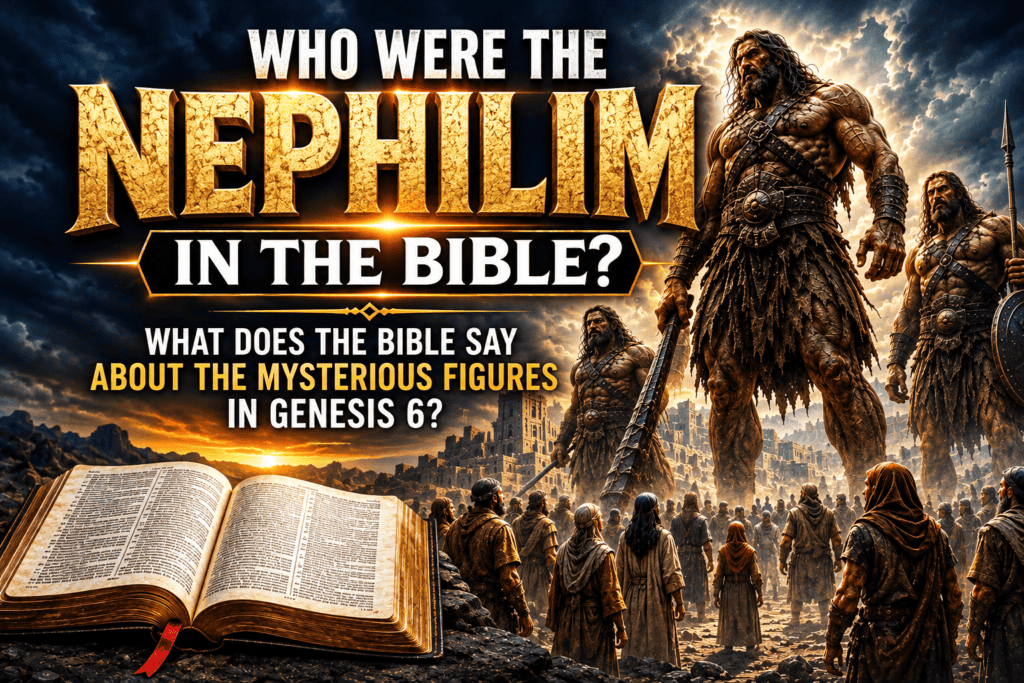
Introduction: Who Were the Nephilim in the Bible?
Some events in the Bible are explained to us clearly. Other subjects are mentioned in Scripture with only a few words. The Nephilim are one of those mysterious subjects.
In Genesis 6, we read that the Nephilim were on the earth before the Flood. In the same context, we are told that the “sons of God” saw the daughters of men and took wives for themselves from those they chose. After this event, the Nephilim are mentioned along with the mighty men and famous men of ancient times.
From here, many questions arise:
- Who exactly were the Nephilim?
- Were they really giants or monstrous beings?
- Were they the offspring of angels?
- Were they ordinary human beings?
- What connection did they have with the Flood?
- Were the Nephilim still present after the Flood?
When answering these questions, one important principle must be remembered: we should not mix what the Bible clearly says with later interpretations and speculation. This is especially important when studying the Nephilim.
1. Where Are the Nephilim First Mentioned?
The first mention of the Nephilim appears in Genesis 6:4:
“There were giants in the earth in those days; and also after that, when the sons of God came in unto the daughters of men, and they bare children to them, the same became mighty men which were of old, men of renown.”
When we read this verse carefully, three things become clear.
- The Nephilim were on the earth in those days.
- The sons of God had relations with the daughters of men.
- Those connected with this event are described as mighty men and men of renown from ancient times.
However, there is an important point here. Genesis 6:4 does not give us a complete definition of who the Nephilim were. Therefore, it is not right to present things we do not know as definite biblical teaching.
2. What Does the Name “Nephilim” Mean?
The word “Nephilim” comes from the Hebrew word Nephilim. Scholars have debated the exact meaning of this word. It is commonly associated with the meaning “fallen ones.” However, this meaning should be treated carefully rather than presented as the one completely certain explanation.
Bible translations generally preserve the word as the name “Nephilim” rather than translating it into an ordinary English word.
Therefore, assigning one definite meaning to the word “Nephilim” and then using that meaning to determine their nature or origin is not a sound approach.
3. Were the Nephilim the Offspring of Angels?
This is one of the most commonly asked questions about the Nephilim.
In Genesis 6, the phrase “sons of God” appears. They saw the daughters of men and took the women they chose. The passage then says that children were born to them.
There are several major interpretations among biblical commentators concerning the identity of the “sons of God.”
One interpretation says that they were spiritual beings such as angels. Another interpretation says that they were a human lineage belonging to God. Another explanation understands them as powerful rulers or men of authority.
However, great care is needed here. The Bible does not simply state in one sentence, “The sons of God were angels, therefore the Nephilim were the children of angels.”
Therefore, this can be presented as an interpretation, but it should not be declared as an unquestionable biblical fact.
4. Then Were the Nephilim Ordinary Human Beings?
Another important interpretation is that the Nephilim were entirely human. According to this view, the “sons of God” in Genesis 6 also belonged to a human lineage.
From this perspective, the Nephilim may be understood as people of extraordinary strength, influence, or reputation. Genesis 6:4 describes them as “mighty men” and “men of renown,” which is used as support for this interpretation.
Again, however, it must be emphasized that the Bible does not explain the complete biological or spiritual nature of the Nephilim.
5. Were the Nephilim the Reason for the Flood?
Before the Nephilim are mentioned in Genesis 6, the passage says that human wickedness had greatly increased on the earth.
“And GOD saw that the wickedness of man was great in the earth, and that every imagination of the thoughts of his heart was only evil continually…” — Genesis 6:5
After this, God decided to destroy mankind, whom He had created, from the face of the earth. However, the Bible does not say that the Nephilim were the reason for the Flood.
The main reason Scripture clearly presents for the Flood is the widespread wickedness of humanity and the evil thoughts of the human heart.
Therefore, saying that “God sent the Flood because of the Nephilim” goes beyond what the biblical text actually says.
6. Were the Nephilim Really Very Large?
Another popular idea about the Nephilim is that they were all enormous, monstrous people.
Although Genesis 6:4 describes them as “mighty men,” it does not give a measurement of their physical height.
Therefore, based on Genesis 6 alone, we cannot say with certainty that “all the Nephilim were enormous, monstrous beings.”
However, the Nephilim are mentioned again in Numbers 13:33. The spies who explored the land of Canaan reported that they had seen the Nephilim there and that they felt like grasshoppers in comparison with them.
“And there we saw the giants… and we were in our own sight as grasshoppers.” — Numbers 13:33
This verse shows that the spies regarded the Nephilim as extremely intimidating and powerful people. But even this passage does not provide an exact measurement of their physical size.
7. How Did the Nephilim Appear After the Flood?
This is one of the most difficult questions concerning the Nephilim.
Genesis 6 mentions the Nephilim before the Flood. Yet in Numbers 13:33, the spies who explored the land of Canaan mention the Nephilim again.
This leads some people to ask, “If the Nephilim were present before the Flood, how could they still be there afterward?”
The Bible does not provide a complete explanation for this question.
Numbers 13:33 contains the report of the spies. They said that they had seen the descendants of the Nephilim. However, there are different views about how this statement should be understood and whether these people were actually connected in the same way to the Nephilim described in Genesis 6.
Therefore, it is not safe to declare that the Nephilim definitely returned in the same form after the Flood as though the Bible directly explains this.
8. Were the Nephilim Monsters?
Modern stories, movies, and fictional works often portray the Nephilim as monsters or supernatural beings.
But the Bible does not contain the equation “Nephilim = monsters.”
Genesis 6:4 says that they were mighty men and men of renown. Numbers 13:33 also presents them in the spies’ report as terrifying figures. But using the modern concept of “monsters” as though it were a direct biblical definition is not accurate.
9. What Is the Connection Between the Nephilim and the “Mighty Men”?
Immediately after mentioning the Nephilim in Genesis 6:4, the passage says that they were “mighty men which were of old, men of renown.”
This description may indicate that they were people known for strength, influence, or reputation.
However, the word “mighty” does not necessarily mean that a person had an enormous physical body. Throughout the Bible, strength can be associated with things such as power, military ability, or social influence.
Therefore, rather than defining the Nephilim only by their physical size, it is better to begin with the biblical description that they were mighty men and men of renown in ancient times.
10. Why Are the Nephilim Important?
Although the Bible gives us very little information about the Nephilim, the context in which they appear is very important.
Their mention in Genesis 6 occurs during a period when human society was experiencing severe moral corruption. In the same chapter, Noah is introduced as a man who found grace in the sight of God.
This means that the main focus of the story is not the Nephilim. It is about human sin, God’s judgment, Noah’s righteousness, God’s grace, and salvation.
This is a very important observation. Our curiosity about the Nephilim should not distract us from the main message of the Bible.
11. Why Is Noah More Important Than the Nephilim?
Immediately after the Nephilim are mentioned in Genesis 6, Scripture specifically tells us about Noah:
“Noah was a just man and perfect in his generations, and Noah walked with God.” — Genesis 6:9
A powerful contrast appears here.
On one side, the earth was filled with wickedness. On the other side, Noah walked with God.
God told Noah to build an ark. Noah believed God’s word and obeyed Him. According to Hebrews 11:7, Noah was warned by God about things he had not yet seen, and by faith he prepared the ark.
Therefore, although we have interesting questions about the Nephilim, the main message of Noah’s story is not discovering supernatural mysteries; it is believing God’s word and obeying Him.
12. What Was the Warning to the People in Noah’s Time?
Jesus Christ also used the days of Noah as an example concerning His coming.
“But as the days of Noe were, so shall also the coming of the Son of man be.” — Matthew 24:37
Jesus did not primarily speak about the Nephilim. He referred to the way people lived in the days of Noah. They were eating, drinking, marrying, and continuing their ordinary lives until the Flood came.
Their problem was not simply that they belonged to some mysterious race. They lived without paying attention to the warning of God’s judgment.
Therefore, the story of the Nephilim helps us understand not only an interesting biblical question but also the broader spiritual condition of the people living in the days of Noah.
13. What Does the Bible Clearly Say About the Nephilim?
If we separate the things we can know with certainty:
- According to Genesis 6:4, the Nephilim were on the earth.
- Their mention occurs in the context of the event involving the sons of God and the daughters of men.
- They are described as mighty men and men of renown from ancient times.
- In Genesis 6, their mention occurs in the context of human wickedness and the conditions that existed before the Flood.
- The Nephilim are mentioned again in the report of the Israelite spies in Numbers 13:33.
- The Bible does not fully explain every detail concerning the complete nature, origin, and post-Flood appearance of the Nephilim.
14. Why Should We Accept What We Do Not Know?
One important principle in Bible study is this: we should speak where Scripture speaks; where Scripture is silent, we should not turn our speculation into biblical truth.
This is especially important when studying the Nephilim.
Claiming with certainty that they were the offspring of angels, saying that they were necessarily enormous monsters, or constructing a specific explanation for how they appeared after the Flood can all go beyond what the Bible clearly reveals.
There may be different interpretations. We can study them. But it is very important to recognize the difference between an interpretation and a truth that is clearly stated in the Bible.
15. The Main Lesson We Can Learn From the Story of the Nephilim
No matter how curious we are to learn about the Nephilim, Genesis 6 ultimately directs our attention toward Noah.
The earth was filled with wickedness.
The thoughts of people’s hearts were evil.
God’s judgment was coming.
Yet in that situation, Noah walked with God.
God showed him a way of escape.
Noah trusted that way and obeyed.
Therefore, although learning about the Nephilim is an interesting area of Bible study, the main spiritual message of this account is to walk with God regardless of what is happening around us.
Conclusion: Does the Bible Fully Explain Who the Nephilim Were?
The Nephilim are among the most mysterious figures mentioned in the Bible. Genesis 6:4 describes them as mighty men and men of renown from ancient times. They appear in the context of the sons of God and the daughters of men. Their name also appears again in Numbers 13:33.
However, the Bible does not answer every question about the complete nature of the Nephilim.
Therefore, when we try to understand who they were, we should first accept what the Bible clearly says and treat the remaining matters only as interpretations and opinions.
More important than the Nephilim in the story of Noah is the fact that, even in a time filled with wickedness, one man walked with God. He believed God’s warning. He obeyed God’s word. And ultimately, God provided him with a way of salvation.
That is why the story of the Nephilim should not leave us with only the question, “Who were they?” It should also lead us to ask, “How should I walk with God in my time?”
More Bible Articles to Read
After reading about the Nephilim, you can also explore more articles about Noah’s time, the sons of God, the Flood, and other biblical subjects.
Bible Verses Related to the Nephilim
- First mention of the Nephilim — Genesis 6:1–8
- The Nephilim and the sons of God — Genesis 6:4
- Human wickedness — Genesis 6:5–7
- Noah’s righteousness — Genesis 6:9
- The Flood — Genesis 7:10–24
- Another mention of the Nephilim — Numbers 13:33
- Noah’s faith — Hebrews 11:7
- The days of Noah — Matthew 24:37–39
- God’s patience in the days of Noah — 1 Peter 3:20
- Noah, a preacher of righteousness — 2 Peter 2:5
Related Articles
- Who Are the Sons of God? What Does the Bible Say About Genesis 6?
- Noah: The Righteous Man Who Was Saved from the Flood
- Adam and Eve: Their Story, Sin, and Life After Eden
- Browse all English Bible articles
Disclaimer
Verses: All Bible verses in this article are quoted from the King James Version (KJV). Under each verse, we explain in plain words the situation in which it was written. To understand a verse fully, we encourage you to read the whole chapter in your own Bible.
Language: We wrote this article in simple, everyday English for readers who may not know the Bible well. It is meant for personal study and understanding, not as an official Bible commentary.
History: Where this article adds extra detail beyond what the Bible states directly, that detail is a reasonable illustration meant to aid understanding, not a claimed historical fact.
Written by Team HolyBibleWithYou.com