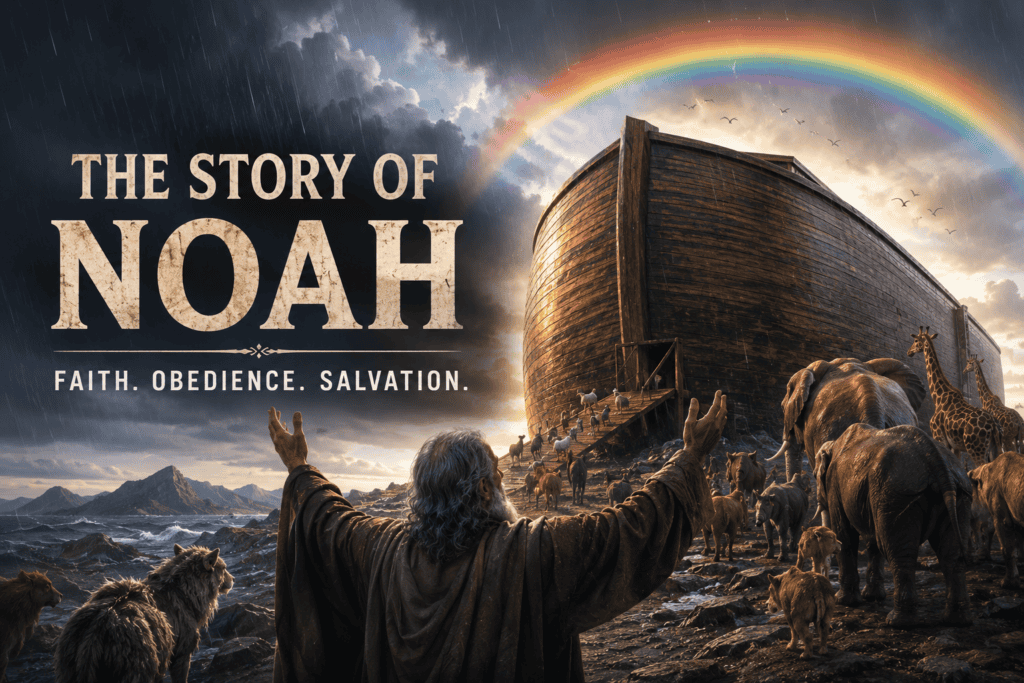
Noah stands as one of the clearest examples of faith and obedience in biblical history. Scripture describes him as a righteous and blameless man who walked with God. When God saw how deeply human wickedness had spread across the earth and determined to judge the world through a devastating flood, Noah found favor in God’s sight.
Following God’s instructions, Noah built the ark and entered it with his family. Animals were also preserved inside the ark. Noah’s story brings together several major biblical themes: God’s justice, His grace, human wickedness, faith, obedience, judgment, and salvation.
1. Noah’s Family Line: From Adam to Noah
Noah was the tenth generation from Adam. Genesis 5 records the family line leading from Adam to Noah:
Adam — At 130 years old, he became the father of Seth and lived a total of 930 years.
Seth — At 105 years old, he became the father of Enosh and lived a total of 912 years.
Enosh — At 90 years old, he became the father of Kenan and lived a total of 905 years.
Kenan — At 70 years old, he became the father of Mahalalel and lived a total of 910 years.
Mahalalel — At 65 years old, he became the father of Jared and lived a total of 895 years.
Jared — At 162 years old, he became the father of Enoch and lived a total of 962 years.
Enoch — At 65 years old, he became the father of Methuselah. He lived a total of 365 years, and God took him.
Methuselah — At 187 years old, he became the father of Lamech and lived a total of 969 years. He is recorded in the Bible as the longest-lived person.
Lamech — At 182 years old, he became the father of Noah and lived a total of 777 years.
Noah — At 500 years old, he became the father of Shem, Ham, and Japheth.
This genealogy places Noah within the family line that began with Adam and shows his place in the continuing biblical story of God’s dealings with humanity.
2. Noah’s Birth and the Meaning Behind His Name
Noah was the son of Lamech. When Noah was born, his father said:
“This same shall comfort us concerning our work and toil of our hands, because of the ground which the LORD hath cursed.” — Genesis 5:29, KJV
The name Noah is connected in Genesis 5:29 with the ideas of comfort and relief. Lamech’s words express the hope that through this child, humanity would receive some relief from the difficult labor associated with the cursed ground.
At the age of 500, Noah became the father of three sons: Shem, Ham, and Japheth. Through these three sons, humanity would spread across the earth after the Flood.
3. Wickedness on the Earth and the Nephilim in Noah’s Day
As humanity multiplied across the earth, human wickedness became widespread. Scripture gives a sobering description:
“And GOD saw that the wickedness of man was great in the earth, and that every imagination of the thoughts of his heart was only evil continually.” — Genesis 6:5, KJV
The passage then describes the “sons of God” taking wives from among the daughters of men. Genesis also mentions the Nephilim:
“There were giants in the earth in those days; and also after that, when the sons of God came in unto the daughters of men…” — Genesis 6:4, KJV
The Bible gives different interpretations concerning the identity of the “sons of God” and the Nephilim. Genesis 6 itself, however, does not provide every detail that later interpretations sometimes attempt to establish. It is therefore important to distinguish between what the biblical text directly states and what later interpretations suggest.
God saw the wickedness of humanity and determined to destroy mankind from the face of the earth. Yet Noah found grace in the sight of the LORD.
4. Noah’s Righteousness and His Walk with God
Scripture gives Noah a remarkable description:
“Noah was a just man and perfect in his generations, and Noah walked with God.” — Genesis 6:9, KJV
While the earth around him had become filled with corruption and violence, Noah continued to live according to God’s will. He was described as righteous and blameless among the people of his generation.
The New Testament also identifies Noah as a preacher of righteousness.
His life presents a powerful contrast: an increasingly corrupt world on one side, and a man choosing to walk with God on the other.
5. God Speaks to Noah and Commands Him to Build the Ark
God told Noah that the end of all flesh had come before Him and instructed him to build an ark from gopher wood.
The dimensions were given precisely:
- Length: 300 cubits
- Width: 50 cubits
- Height: 30 cubits
The ark was to have a window, a door, and three levels. Noah was also instructed to cover it with pitch inside and outside.
God told Noah that He would establish His covenant with him. Noah, his sons, his wife, and his sons’ wives were to enter the ark. Animals were also to be preserved: creatures of every kind, male and female, along with birds, livestock, and creatures that move along the ground.
The instructions were not a suggestion. Noah was being given a specific command, and his response would require complete trust in God.
6. How Long Did Noah Build the Ark?
The Bible does not directly state how many years Noah spent building the ark.
Genesis 6:3 records God’s statement:
“My spirit shall not always strive with man, for that he also is flesh: yet his days shall be an hundred and twenty years.” — Genesis 6:3, KJV
Many readers understand these 120 years as a period of warning and an opportunity for repentance, and some connect it with the period during which Noah was preparing the ark. However, the text itself does not explicitly say that Noah spent exactly 120 years building the ark.
Second Peter 2:5 describes Noah as a “preacher of righteousness.”
Therefore, when discussing this subject carefully, it is better not to claim that the Bible explicitly says Noah built the ark for 120 years. What Scripture clearly tells us is that God commanded Noah to build the ark and that Noah obeyed God’s command.
7. Entering the Ark and the Animals
Noah did exactly what God had commanded.
Before the Flood began, God instructed Noah and his family to enter the ark. Noah was told to take seven pairs of clean animals, male and female, while unclean animals were to be taken in pairs, male and female.
Noah entered the ark with his sons, his wife, and his sons’ wives.
According to God’s command, the animals, birds, and creatures that moved along the ground came to Noah and entered the ark.
The preservation of Noah’s family and the animals was not the result of human strength. It happened because Noah followed God’s instructions.
8. The Flood Begins
When Noah was 600 years old, on the seventeenth day of the second month, the fountains of the great deep broke open and the windows of heaven were opened.
Rain fell upon the earth for forty days and forty nights.
The waters increased and lifted the ark above the earth. The waters rose over the mountains, covering the highest mountains beneath them. The water rose fifteen cubits above the mountains.
Every living creature on the earth died: birds, livestock, wild animals, creatures moving along the ground, and human beings.
Only Noah and those who were with him inside the ark were preserved.
The waters prevailed upon the earth for 150 days.
9. The Complete Timeline of the Flood
Based on the dates recorded in Genesis, the Flood narrative follows this sequence:
- Noah’s 600th year, second month, 17th day: The Flood begins.
- 40 days and 40 nights: Rain falls upon the earth.
- 150 days: The waters prevail strongly upon the earth.
- Seventh month, 17th day: The ark rests upon the mountains of Ararat.
- Tenth month, first day: The tops of the mountains become visible.
- After 40 days: Noah sends out a raven.
- Afterward: Noah sends out a dove, but it returns because the waters are still covering the earth.
- Seven days later: Noah sends the dove out again, and it returns with a fresh olive leaf.
- Another seven days later: Noah sends the dove out again, and it does not return.
- Noah’s 601st year, first month, first day: Noah removes the covering of the ark and sees that the surface of the ground is drying.
- Second month, 27th day: The earth is completely dry.
God then told Noah:
“Go forth of the ark, thou, and thy wife, and thy sons, and thy sons’ wives with thee.” — Genesis 8:16, KJV
God also instructed Noah to bring the animals out so that they could spread across the earth and multiply.
Noah did exactly as God commanded.
10. Noah’s Altar and God’s Promise
After leaving the ark, Noah built an altar to the LORD. He took some of the clean animals and clean birds and offered burnt offerings on the altar.
Scripture says:
“And the LORD smelled a sweet savour; and the LORD said in his heart, I will not again curse the ground any more for man’s sake…” — Genesis 8:21, KJV
God also promised that as long as the earth remained, seedtime and harvest, cold and heat, summer and winter, and day and night would continue.
The Flood had brought judgment, but the story did not end with destruction. God established a continuing order for life on the earth.
11. The Covenant and the Rainbow
God blessed Noah and his sons and told them to be fruitful, multiply, and fill the earth.
He explained that animals would fear humanity and that animals were given to mankind for food. However, God commanded them not to eat flesh with its blood.
God then established an everlasting covenant with Noah, his descendants, and every living creature:
“And I will establish my covenant with you… neither shall all flesh be cut off any more by the waters of a flood.” — Genesis 9:11, KJV
God gave the rainbow as the sign of this covenant:
“I do set my bow in the cloud, and it shall be for a token of a covenant between me and the earth.” — Genesis 9:13, KJV
The rainbow became a visible sign of God’s covenant concerning the earth and the waters.
12. Noah’s Drunkenness, Ham’s Actions, and Canaan’s Curse
After the Flood, Noah began working the ground and planted a vineyard.
One day, he drank wine and became drunk. He was uncovered inside his tent.
Ham, the father of Canaan, saw his father’s nakedness and went outside and told his two brothers.
Shem and Japheth took a garment, placed it over their shoulders, and walked backward into the tent so they could cover their father without looking at his nakedness.
When Noah woke and learned what had happened, he said:
“Cursed be Canaan; a servant of servants shall he be unto his brethren.” — Genesis 9:25, KJV
It is important to notice that the curse recorded in the passage is directed toward Canaan, the son of Ham, rather than directly toward Ham himself.
The text does not fully explain why Canaan received the curse. Therefore, additional explanations should be distinguished from what Genesis itself explicitly states.
Noah blessed Shem and Japheth. He declared that the LORD God of Shem would be blessed, and that Japheth would be enlarged.
This part of Noah’s story is also important because it shows that Noah himself was not portrayed as a sinless man. Even after being saved from the Flood, he was capable of serious human failure.
13. Noah’s Later Life and Death
After the Flood, Noah lived another 350 years.
He lived a total of 950 years and then died.
Through Noah’s three sons — Shem, Ham, and Japheth — humanity spread across the earth after the Flood.
Their descendants became the various peoples and nations described in the biblical account.
14. The Descendants of Noah and the Spread of Nations
Genesis 10 records the descendants of Noah’s three sons. Some of the major family lines include:
The sons of Japheth: Gomer, Magog, Madai, Javan, Tubal, Meshech, and Tiras. Their descendants spread into different regions and became associated with various peoples.
The sons of Ham: Cush, Mizraim, Put, and Canaan. Cush became the father of Nimrod, who is described as a mighty man and a mighty hunter. His kingdom was associated with cities such as Babel, Erech, Accad, and Calneh. Later, Nineveh and other cities in Assyria are also mentioned in connection with him. The descendants of Canaan became the Canaanite peoples.
The sons of Shem: Elam, Asshur, Arphaxad, Lud, and Aram. Arphaxad became the ancestor of Eber, and Eber became the ancestor of Peleg. Abraham would later come from this family line.
Genesis 10 therefore connects Noah’s family with the spread of nations described in the biblical account.
15. After Noah: The Tower of Babel
After the Flood, the people of the earth were described as having one language. They traveled from the east and settled in the land of Shinar.
There they said:
“Go to, let us build us a city and a tower, whose top may reach unto heaven; and let us make us a name, lest we be scattered abroad upon the face of the whole earth.” — Genesis 11:4, KJV
God saw what they were doing and confused their language. As a result, they could no longer understand one another’s speech and were scattered across the earth.
The place was called Babel because the LORD confused the language of the whole earth there.
The Babel account comes after the Flood narrative and shows another major turning point in the biblical story of humanity.
16. Noah and Enoch: A Comparison
The Bible uses a remarkable description for both Enoch and Noah: they walked with God.
Enoch was Noah’s great-grandfather.
“And Enoch walked with God: and he was not; for God took him.” — Genesis 5:24, KJV
Noah also walked with God.
Hebrews 11:5–7 presents both Enoch and Noah in the context of faith. Enoch was taken by God without experiencing death, while Noah believed God’s warning about things that had not yet been seen and prepared the ark for the saving of his household.
Both men lived in their own generations and chose to walk with God.
Their stories are different, but the same central idea appears in both: faith was expressed through a real relationship with God.
17. Noah in the New Testament
The New Testament refers to Noah several times, especially when discussing faith, judgment, patience, and the coming of Christ.
Hebrews 11:7 — By faith Noah, being warned by God about things not yet seen, moved with reverent fear and prepared an ark for the saving of his household.
1 Peter 3:20 — The passage refers to God’s patience in the days of Noah while the ark was being prepared. Only a few people, eight in total, were saved through water.
2 Peter 2:5 — Peter says that God did not spare the ancient world but preserved Noah, a preacher of righteousness, along with seven others.
Matthew 24:37–38 — Jesus compared the days of Noah with the coming of the Son of Man. Before the Flood, people continued eating, drinking, marrying, and giving in marriage until Noah entered the ark.
Luke 17:26–27 — Jesus again referred to the days of Noah when describing the days surrounding the coming of the Son of Man.
Noah’s life therefore becomes more than an Old Testament story. In the New Testament, his faith and the events of his generation are used as an example when discussing God’s judgment, human indifference, faith, and the future coming of the Son of Man.
Lessons from Noah’s Story
Faith and obedience: Noah believed God’s word and built the ark according to God’s instructions.
God’s justice: Scripture shows that God does not simply ignore wickedness. At the same time, He provides salvation to those who trust Him and walk with Him.
God’s grace: Noah is described as righteous, but he was not sinless. What happened after the Flood demonstrates that Noah remained a human being capable of failure. Yet he had found grace in God’s sight.
Patience and perseverance: Noah trusted God’s command and continued with the work God had given him.
Covenant: The rainbow became the sign of God’s covenant with Noah and the earth.
Judgment and salvation: The Flood illustrates God’s judgment, while the ark represents the means of deliverance God provided for Noah and his family. Within Christian theology, Noah’s story is also considered an important biblical picture for understanding salvation through Christ.
Want to Read More Bible Articles in English?
Explore more Bible-based articles, biblical stories, and faith-centered topics written for English readers.
Bible Passages Related to Noah’s Story
Noah’s birth and genealogy — Genesis 5:28–32
Human wickedness and the Nephilim — Genesis 6:1–8
Noah’s righteousness, God’s command, and the dimensions of the ark — Genesis 6:9–22
Entering the ark and the animals — Genesis 7:1–9
The Flood — Genesis 7:10–24
The waters recede and Noah leaves the ark — Genesis 8:1–19
Noah’s offering and God’s promise — Genesis 8:20–22
The rainbow covenant — Genesis 9:1–17
Noah’s drunkenness, Ham’s actions, and the curse — Genesis 9:18–27
Noah’s death — Genesis 9:28–29
Noah’s descendants and the spread of nations — Genesis 10:1–32
The Tower of Babel — Genesis 11:1–9
Enoch and Noah compared — Genesis 5:22–24; 6:9; Hebrews 11:5–7
New Testament references to Noah — Hebrews 11:7; 1 Peter 3:20; 2 Peter 2:5; Matthew 24:37–38; Luke 17:26–27
Related Articles
- Who Were the Nephilim in the Bible? What Genesis 6 Really Says
- Who Are the Sons of God? What Does the Bible Say About Genesis 6?
- Adam and Eve: Their Story, Sin, and Life After Eden
- Browse all English Bible articles
Disclaimer
Verses: All Bible verses in this article are quoted from the King James Version (KJV). Under each verse, we explain in plain words the situation in which it was written. To understand a verse fully, we encourage you to read the whole chapter in your own Bible.
Language: We wrote this article in simple, everyday English for readers who may not know the Bible well. It is meant for personal study and understanding, not as an official Bible commentary.
History: Where this article adds extra detail beyond what the Bible states directly, that detail is a reasonable illustration meant to aid understanding, not a claimed historical fact.
Written by Team HolyBibleWithYou.com