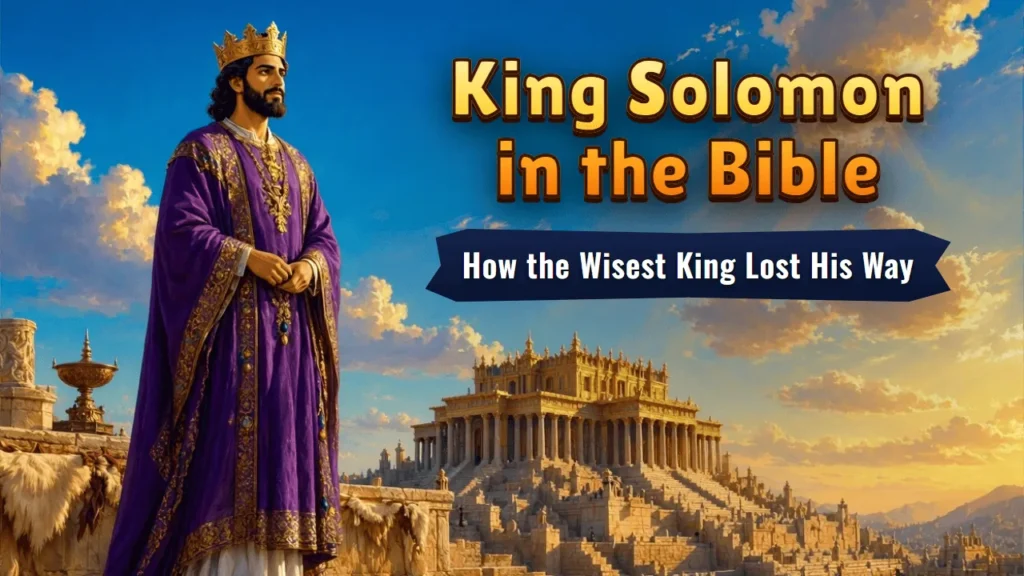
Who Was King Solomon?
Every so often the news tells the same sad story. Someone who seemed to have it all, with real talent, a sharp mind, money, and a spotless reputation, slowly comes apart. Nobody can point to one bad day. It happened a little at a time, and by the time anyone noticed, it was too late.
The Bible tells that story too, and the man in it is King Solomon.
Most people know Solomon for one thing: wisdom. Even kids in Sunday school hear about the day two women fought over one baby and the young king settled it with a single command. But that’s only the beginning. Solomon was the son of David and Bathsheba. God loved him from the day he was born. He became king while he was still young. When God offered him anything he wanted, he didn’t ask for money. He asked for wisdom. He built God a magnificent temple in Jerusalem, became the richest king of his day, and had royalty traveling from far-off lands just to hear him talk.
And yet the same Solomon ended his life with his heart pulled away from God. How does the wisest man in the world lose his way? That question is what makes his life worth reading. Let’s walk through it from his birth to his death, in the order the Bible tells it.
How Was Solomon Born?
Solomon’s story starts in the wreckage of his father’s worst failure. King David had slept with Bathsheba, the wife of one of his soldiers, and then arranged for her husband Uriah to be killed in battle. The prophet Nathan confronted David, and David repented, but the child Bathsheba had conceived died (2 Samuel 12:1-23). After that grief, the Bible says:
“And David comforted Bath-sheba his wife, and went in unto her, and lay with her: and she bare a son, and he called his name Solomon: and the LORD loved him. And he sent by the hand of Nathan the prophet; and he called his name Jedidiah, because of the LORD.”
— 2 Samuel 12:24-25 (KJV)
A grieving mother and father were given another son. And before the boy could do anything to earn it, God sent Nathan back with a second name for him: Jedidiah. (A note on the language: in Hebrew, Jedidiah means “beloved of the LORD.”) This family’s story had started with a terrible sin, but God’s kindness didn’t stop there. Solomon began his life already loved.
How Did Solomon Become King?
Years later, David was old and bedridden. One of his other sons, Adonijah, decided not to wait. He declared himself king, and two powerful men backed him: Joab, the army commander, and Abiathar the priest. Adonijah threw a big feast and invited his brothers, but he left out Solomon, Nathan the prophet, Zadok the priest, and Benaiah, one of David’s top soldiers (1 Kings 1:5-10).
Nathan moved fast. He sent Bathsheba to remind David that he had promised Solomon would be the next king, and then Nathan came in himself to back her up. David acted that same day. He ordered his men to put Solomon on David’s own mule, take him down to the spring of Gihon, and anoint him king (1 Kings 1:11-37). Here’s what happened there:
“And Zadok the priest took an horn of oil out of the tabernacle, and anointed Solomon. And they blew the trumpet; and all the people said, God save king Solomon.”
— 1 Kings 1:39 (KJV)
The noise of the trumpets and the crowd carried all the way to Adonijah’s party. His guests panicked and scattered. Adonijah ran to the altar and grabbed its horns, hoping for mercy. Solomon told him that if he behaved himself, not a hair on his head would be harmed, and sent him home (1 Kings 1:41-53). On his very first day, the young king chose patience over revenge.
What Did David Tell Solomon Before He Died?
When David knew he was dying, he called Solomon in for one last talk, father to son and king to king:
“I go the way of all the earth: be thou strong therefore, and shew thyself a man; And keep the charge of the LORD thy God, to walk in his ways, to keep his statutes, and his commandments, and his judgments, and his testimonies, as it is written in the law of Moses, that thou mayest prosper in all that thou doest, and whithersoever thou turnest thyself”
— 1 Kings 2:2-3 (KJV)
David had seen great victories and made huge mistakes, and all of it boiled down to one piece of advice: do what God says, and you’ll do well wherever you go. In a way, the rest of Solomon’s life is a test of that one sentence. When he followed it, he flourished. When he let go of it, he fell.
David died and was buried in Jerusalem, the city of David.
“Then sat Solomon upon the throne of David his father; and his kingdom was established greatly.”
— 1 Kings 2:12 (KJV)
Adonijah soon made another play for power, and the scores David had warned Solomon about, with Joab and with a man named Shimei, were settled (1 Kings 2:13-46). By the end of that chapter, the kingdom was firmly in Solomon’s hands.
Why Did Solomon Ask God for Wisdom?
Solomon loved the LORD. But the temple hadn’t been built yet, so people offered their sacrifices at local hilltop shrines called “high places.” Solomon did too:
“And Solomon loved the LORD, walking in the statutes of David his father: only he sacrificed and burnt incense in high places.”
— 1 Kings 3:3 (KJV)
Keep an eye on that little word “only.” Right from the start, there was a small crack in Solomon’s devotion. By the end of his story, you’ll see how wide that crack became.
Solomon went to Gibeon, the most important of these high places, and offered a thousand burnt offerings there (1 Kings 3:4). That night something remarkable happened:
“In Gibeon the LORD appeared to Solomon in a dream by night: and God said, Ask what I shall give thee.”
— 1 Kings 3:5 (KJV)
Stop and imagine that. God himself shows up and invites you to ask for anything at all. What would you ask for? Solomon started by admitting how small he felt. He said he was like a little child who didn’t know how to lead, and that he’d been put in charge of more people than anyone could count (1 Kings 3:6-8). Then he made his request:
“Give therefore thy servant an understanding heart to judge thy people, that I may discern between good and bad: for who is able to judge this thy so great a people?”
— 1 Kings 3:9 (KJV)
He didn’t ask for anything for himself. He asked for an “understanding heart,” literally a heart that listens, so he could lead people well and tell right from wrong. God’s answer shows how much he liked that request:
“And God said unto him, Because thou hast asked this thing, and hast not asked for thyself long life; neither hast asked riches for thyself, nor hast asked the life of thine enemies; but hast asked for thyself understanding to discern judgment; Behold, I have done according to thy words: lo, I have given thee a wise and an understanding heart; so that there was none like thee before thee, neither after thee shall any arise like unto thee. And I have also given thee that which thou hast not asked, both riches, and honour: so that there shall not be any among the kings like unto thee all thy days.”
— 1 Kings 3:11-13 (KJV)
Solomon asked for wisdom, and God threw in the riches and honor he hadn’t asked for. But God also attached a condition: if Solomon walked in God’s ways the way David had, God would give him a long life as well (1 Kings 3:14). Solomon woke up, went back to Jerusalem, offered sacrifices in front of the ark of the covenant, and threw a feast for his whole staff.
What Was Solomon’s Famous Judgment Between Two Mothers?
It didn’t take long for that wisdom to be tested. Two women who worked as prostitutes came before the king. They shared a house, and each had given birth to a baby boy, just three days apart. One night one of the women rolled over on her baby in her sleep, and he died. According to the first woman, the other mother got up in the middle of the night, put her dead baby next to her, and took the living one. The second woman said that was a lie. Right there in front of the king, they argued back and forth, each one insisting, “the living is my son” (1 Kings 3:16-22).
There were no witnesses and no proof. So Solomon asked for a sword. He ordered the living baby cut in two, half for each woman. The real mother’s heart broke. She begged the king not to kill the child and to give him to the other woman instead. The other woman said, in effect, go ahead and divide him, so neither of us gets him (1 Kings 3:23-26). Then:
“Then the king answered and said, Give her the living child, and in no wise slay it: she is the mother thereof. And all Israel heard of the judgment which the king had judged; and they feared the king: for they saw that the wisdom of God was in him, to do judgment.”
— 1 Kings 3:27-28 (KJV)
Solomon never meant to harm that baby. He knew a real mother’s love would show itself. The woman willing to give up her claim to save the child’s life was the true mother. With that one decision, the whole country knew God really had given this king wisdom.
How Wise Was Solomon?
Under Solomon, the people of Israel and Judah grew as many as the sand by the sea. They ate, drank, and enjoyed life, and everyone lived safely “under his vine and under his fig tree” (1 Kings 4:20, 25). Then the Bible describes his wisdom this way:
“And God gave Solomon wisdom and understanding exceeding much, and largeness of heart, even as the sand that is on the sea shore. And Solomon’s wisdom excelled the wisdom of all the children of the east country, and all the wisdom of Egypt. For he was wiser than all men; than Ethan the Ezrahite, and Heman, and Chalcol, and Darda, the sons of Mahol: and his fame was in all nations round about. And he spake three thousand proverbs: and his songs were a thousand and five.”
— 1 Kings 4:29-32 (KJV)
In that era, Egypt and the nations to the east were famous for their wise men. The Bible says Solomon outdid all of them. He could talk about everything from the great cedars of Lebanon to the little hyssop plant growing out of a wall, and about animals, birds, reptiles, and fish. Kings from all over sent people to listen to him (1 Kings 4:33-34). Some of those three thousand proverbs are in your Bible today, in the book of Proverbs.
How Did Solomon Build the Temple?
David had wanted to build a house for God, but God told him his son would be the one to do it (2 Samuel 7:12-13). Now that time had come. Hiram, king of Tyre, had been David’s friend, and Solomon made a deal with him for cedar and fir logs from Lebanon. Tens of thousands of workers cut stone in the hills (1 Kings 5:1-18).
“And it came to pass in the four hundred and eightieth year after the children of Israel were come out of the land of Egypt, in the fourth year of Solomon’s reign over Israel, in the month Zif, which is the second month, that he began to build the house of the LORD.”
— 1 Kings 6:1 (KJV)
The Bible ties the start of construction to the Exodus itself, as if to say this is the next big chapter in the story that began when God brought Israel out of Egypt. The building site was strangely quiet: every stone was cut and shaped at the quarry, so no hammer, axe, or iron tool was heard at the temple while it went up (1 Kings 6:7). Inside, the walls were paneled with cedar and covered with gold, and golden cherubim stood in the Most Holy Place. While the work was going on, God sent Solomon a message:
“Concerning this house which thou art in building, if thou wilt walk in my statutes, and execute my judgments, and keep all my commandments to walk in them; then will I perform my word with thee, which I spake unto David thy father: And I will dwell among the children of Israel, and will not forsake my people Israel.”
— 1 Kings 6:12-13 (KJV)
Notice what God didn’t talk about. He didn’t mention the gold or the cedar or the craftsmanship. He talked about obedience. What mattered to God wasn’t a beautiful building but a heart that listened to him. The temple took seven years to finish (1 Kings 6:38). Solomon’s own palace took him thirteen (1 Kings 7:1).
What Happened When the Temple Was Dedicated?
When the temple was done, Solomon gathered all the leaders of Israel. The priests carried the ark of the covenant into the Most Holy Place. Then:
“And it came to pass, when the priests were come out of the holy place, that the cloud filled the house of the LORD, So that the priests could not stand to minister because of the cloud: for the glory of the LORD had filled the house of the LORD.”
— 1 Kings 8:10-11 (KJV)
This was God’s way of showing that the house now belonged to him. His glory came down so powerfully that the priests couldn’t even stay on their feet to do their jobs. Then Solomon stood in front of the altar with the whole nation watching, spread his hands toward heaven, and prayed. One line in that prayer is stunning:
“But will God indeed dwell on the earth? behold, the heaven and heaven of heavens cannot contain thee; how much less this house that I have builded?”
— 1 Kings 8:27 (KJV)
Solomon had just finished the most impressive building Israel had ever seen, and he knew it couldn’t hold God. The whole universe can’t hold God. Still, he asked God to listen whenever anyone prayed toward that house: to forgive his people when they sinned and turned back, to help them in famine, war, and sickness, and even to hear foreigners who came to pray there (1 Kings 8:28-53).
What Did God Warn Solomon About?
After all of this was finished, God appeared to Solomon a second time, just as he had at Gibeon. He told Solomon he had heard his prayer. Then he said this:
“And if thou wilt walk before me, as David thy father walked, in integrity of heart, and in uprightness, to do according to all that I have commanded thee, and wilt keep my statutes and my judgments: Then I will establish the throne of thy kingdom upon Israel for ever, as I promised to David thy father, saying, There shall not fail thee a man upon the throne of Israel. But if ye shall at all turn from following me, ye or your children, and will not keep my commandments and my statutes which I have set before you, but go and serve other gods, and worship them: Then will I cut off Israel out of the land which I have given them; and this house, which I have hallowed for my name, will I cast out of my sight; and Israel shall be a proverb and a byword among all people”
— 1 Kings 9:4-7 (KJV)
God laid two roads in front of Solomon. Walk with an honest heart like David, and your throne will last. Turn to other gods, and Israel will lose the land, and even this beautiful temple will be abandoned. Notice the timing. God gave this warning at the very top of Solomon’s success, not after he had already fallen.
Who Was the Queen of Sheba, and Why Did She Visit Solomon?
Solomon’s reputation spread far beyond Israel. The queen of Sheba came to test him with hard questions. (Many historians place Sheba in the southern part of the Arabian Peninsula, around modern-day Yemen. That’s a historical opinion. The Bible itself doesn’t say exactly where Sheba was.) She arrived with a caravan of camels loaded with spices, a huge amount of gold, and precious stones. She asked him everything on her mind, and he answered every question. Nothing stumped him (1 Kings 10:1-5). When she saw his wisdom, his palace, the way his servants worked, and the offerings at the temple, she was overwhelmed:
“And she said to the king, It was a true report that I heard in mine own land of thy acts and of thy wisdom. Howbeit I believed not the words, until I came, and mine eyes had seen it: and, behold, the half was not told me: thy wisdom and prosperity exceedeth the fame which I heard.”
— 1 Kings 10:6-7 (KJV)
Hearing about something and seeing it with your own eyes are two different things. The queen admitted that the reports hadn’t told her even half of it. She also praised Israel’s God, saying that because the LORD loved Israel, he had made Solomon king to do what was right and fair (1 Kings 10:9). Then she gave Solomon lavish gifts and went home.
How Rich Was King Solomon?
The promise God made at Gibeon came true to the letter:
“So king Solomon exceeded all the kings of the earth for riches and for wisdom. And all the earth sought to Solomon, to hear his wisdom, which God had put in his heart.”
— 1 Kings 10:23-24 (KJV)
Every year, 666 talents of gold came in to Solomon (1 Kings 10:14). He sat on a great ivory throne overlaid with gold, with lions on its six steps, and the Bible says no kingdom had anything like it. All his drinking cups were gold. In his day, silver was so common in Jerusalem that it was treated like ordinary stones (1 Kings 10:18-27). He also imported horses and chariots from Egypt (1 Kings 10:28-29).
But there’s something important here that’s easy to miss. Hundreds of years earlier, in the law of Moses, God had spelled out what a king of Israel should and shouldn’t do. The king was not to build up a big supply of horses from Egypt (Deuteronomy 17:16). And:
“Neither shall he multiply wives to himself, that his heart turn not away: neither shall he greatly multiply to himself silver and gold.”
— Deuteronomy 17:17 (KJV)
Horses, gold, and wives. God had warned, long before Solomon was born, that these three things would pull a king’s heart away. Solomon went past the line on all three. The blessings God had given him were slowly starting to become a trap.
How Many Wives Did Solomon Have, and Why Did He Fall?
Solomon married Pharaoh’s daughter, and then women from Moab, Ammon, Edom, Sidon, and the Hittites. God had specifically told Israel not to intermarry with those nations, because they would turn Israel’s heart toward their gods. Solomon did it anyway and held on to these women in love (1 Kings 11:1-2).
“And he had seven hundred wives, princesses, and three hundred concubines: and his wives turned away his heart. For it came to pass, when Solomon was old, that his wives turned away his heart after other gods: and his heart was not perfect with the LORD his God, as was the heart of David his father.”
— 1 Kings 11:3-4 (KJV)
This didn’t happen overnight. The Bible says it happened “when Solomon was old.” The same man who as a young king had asked God for wisdom drifted away slowly, one small compromise at a time, as the years went by. David had committed terrible sins too, but his heart never turned away from God. Solomon’s heart ended up split, partly toward God and partly toward other gods. This verse shows how far he went:
“Then did Solomon build an high place for Chemosh, the abomination of Moab, in the hill that is before Jerusalem, and for Molech, the abomination of the children of Ammon.”
— 1 Kings 11:7 (KJV)
The same hands that built a temple for God now built shrines for Chemosh and Molech, on a hill facing Jerusalem. Molech worship included sacrificing children. You can read more about why God hated it so much in Who Was Molech?
How Did God Judge Solomon?
God had appeared to Solomon twice. Both times he warned him. Solomon still didn’t listen:
“And the LORD was angry with Solomon, because his heart was turned from the LORD God of Israel, which had appeared unto him twice, And had commanded him concerning this thing, that he should not go after other gods: but he kept not that which the LORD commanded. Wherefore the LORD said unto Solomon, Forasmuch as this is done of thee, and thou hast not kept my covenant and my statutes, which I have commanded thee, I will surely rend the kingdom from thee, and will give it to thy servant. Notwithstanding in thy days I will not do it for David thy father’s sake: but I will rend it out of the hand of thy son. Howbeit I will not rend away all the kingdom; but will give one tribe to thy son for David my servant’s sake, and for Jerusalem’s sake which I have chosen.”
— 1 Kings 11:9-13 (KJV)
Even in judgment, God’s mercy shows up. Because of his promise to David, the kingdom wouldn’t split while Solomon was alive, and Solomon’s son would still keep one tribe. God didn’t walk away from his word. Solomon walked away from God.
After this, God raised up enemies against Solomon: Hadad the Edomite, and Rezon in Damascus (1 Kings 11:14-25). Then a prophet named Ahijah met one of Solomon’s officials, a man named Jeroboam, out in a field. Ahijah took the new cloak he was wearing, tore it into twelve pieces, and told Jeroboam to take ten. It was a sign: God was going to give ten of Israel’s tribes to Jeroboam (1 Kings 11:29-31). Solomon tried to kill Jeroboam, who fled to Egypt and stayed there until Solomon died (1 Kings 11:40).
How Did Solomon Die, and What Happened After?
“And the time that Solomon reigned in Jerusalem over all Israel was forty years. And Solomon slept with his fathers, and was buried in the city of David his father: and Rehoboam his son reigned in his stead.”
— 1 Kings 11:42-43 (KJV)
Like his father David, Solomon reigned for forty years. But when David died, the kingdom was united and strong. When Solomon died, it was on the edge of breaking apart.
After Solomon’s death, the people came to his son Rehoboam with a request:
“Thy father made our yoke grievous: now therefore make thou the grievous service of thy father, and his heavy yoke which he put upon us, lighter, and we will serve thee.”
— 1 Kings 12:4 (KJV)
Those words reveal what was behind all of Solomon’s palaces, the temple, and his building projects: heavy taxes and forced labor carried by ordinary people. Rehoboam ignored the advice of the older counselors and answered even more harshly. So ten tribes rejected him and made Jeroboam their king. Just as Ahijah had said, the kingdom split in two: Israel in the north and Judah in the south (1 Kings 12:1-20).
What Books of the Bible Did Solomon Write?
Several books in the Bible are connected to Solomon’s name:
- Proverbs: it opens with “The proverbs of Solomon the son of David, king of Israel” (Proverbs 1:1). The book itself says a few sections came from other writers (Proverbs 30:1; 31:1).
- Song of Solomon: it opens with “The song of songs, which is Solomon’s” (Song of Solomon 1:1).
- Ecclesiastes: the writer calls himself “the Preacher, the son of David, king in Jerusalem” (Ecclesiastes 1:1). An old tradition holds that this is Solomon, but the book never actually uses his name.
- Psalms 72 and 127: both have Solomon’s name in their titles.
The whole book of Proverbs rests on this one verse:
“The fear of the LORD is the beginning of knowledge: but fools despise wisdom and instruction.”
— Proverbs 1:7 (KJV)
Real wisdom doesn’t start with books or a high IQ. It starts with a deep respect for God. Solomon taught that to everyone else, and then forgot it himself near the end of his life. If you want to go deeper on this, read What is the True Foundation of Wisdom?
Ecclesiastes opens with “Vanity of vanities, saith the Preacher, vanity of vanities; all is vanity” (Ecclesiastes 1:2). In plain words: it’s all smoke. Money, pleasure, big projects, even wisdom itself can’t satisfy a person without God. And the book ends like this:
“Let us hear the conclusion of the whole matter: Fear God, and keep his commandments: for this is the whole duty of man.”
— Ecclesiastes 12:13 (KJV)
That’s where a man who had tried everything finally landed. Some people believe Solomon wrote Ecclesiastes as an old man looking back with regret. That’s only an opinion, though. The Bible never clearly says that Solomon came back to God at the end.
What Did Jesus Say About Solomon?
Centuries later, Jesus mentioned Solomon twice. Once, while teaching people not to worry about tomorrow, he said:
“And why take ye thought for raiment? Consider the lilies of the field, how they grow; they toil not, neither do they spin: And yet I say unto you, That even Solomon in all his glory was not arrayed like one of these.”
— Matthew 6:28-29 (KJV)
Everyone listening knew how splendid Solomon had been. Jesus said a wildflower in a field is dressed more beautifully by God than the richest king who ever lived. So if God takes care of the flowers, won’t he take care of you? Another time, speaking to people who demanded a sign from him, Jesus said:
“The queen of the south shall rise up in the judgment with this generation, and shall condemn it: for she came from the uttermost parts of the earth to hear the wisdom of Solomon; and, behold, a greater than Solomon is here.”
— Matthew 12:42 (KJV)
The “queen of the south” is the queen of Sheba we met earlier. She traveled an enormous distance just to hear Solomon’s wisdom. Jesus said that someone greater than Solomon was standing right in front of them. Solomon was a wise king who lost his way in the end. Christians believe God’s promise to David of a throne that lasts forever wasn’t fulfilled in Solomon but in Jesus, the Son of David.
What Can We Learn from Solomon’s Life?
Solomon’s life isn’t just a story about wisdom. It’s a story about how a heart can drift even when the mind is brilliant.
A few things stand out:
- When we ask God for the right things, he often gives us more than we asked for (1 Kings 3:11-13).
- A great start isn’t enough. Staying faithful to the finish is what counts.
- Big falls usually begin with small compromises. One little “only” (1 Kings 3:3) eventually ended at an altar to Molech.
- The people we share our lives with shape our hearts (1 Kings 11:4).
- God’s good gifts become traps when they take God’s place.
- Even in judgment, God doesn’t forget his promises (1 Kings 11:12-13).
Solomon built God a temple, but he couldn’t guard the temple of his own heart.
We can ask God for wisdom, too. The real test is living by it every day. And Solomon himself wrote the answer: fear God and keep his commandments.
Further Reading
For more articles, visit our English Articles page.
Related articles:
- David’s Story: From a Shepherd Boy to the King of Israel
- What is the True Foundation of Wisdom?
- Who Was Molech? The Dark History of Child Sacrifice in the Bible
Bible Passages About Solomon
- Solomon’s birth and the name Jedidiah: 2 Samuel 12:24-25
- Adonijah’s plot and Solomon’s anointing: 1 Kings 1:1-53
- David’s last charge and Solomon’s kingdom secured: 1 Kings 2:1-46
- The prayer for wisdom at Gibeon: 1 Kings 3:1-15; 2 Chronicles 1:1-13
- The two mothers: 1 Kings 3:16-28
- Solomon’s reign and wisdom: 1 Kings 4:1-34
- Building the temple: 1 Kings 5:1-6:38; 2 Chronicles 2:1-5:1
- Solomon’s palace and other buildings: 1 Kings 7:1-51
- Dedicating the temple and Solomon’s prayer: 1 Kings 8:1-66; 2 Chronicles 5:2-7:10
- God appears a second time: 1 Kings 9:1-9; 2 Chronicles 7:11-22
- The queen of Sheba: 1 Kings 10:1-13; 2 Chronicles 9:1-12
- Solomon’s wealth: 1 Kings 10:14-29
- God’s rules for Israel’s kings: Deuteronomy 17:14-20
- Solomon’s wives and idol worship: 1 Kings 11:1-8
- God’s judgment, Solomon’s enemies, and Jeroboam: 1 Kings 11:9-40
- Solomon’s death: 1 Kings 11:41-43; 2 Chronicles 9:29-31
- The kingdom splits: 1 Kings 12:1-20
- Books connected to Solomon: Proverbs 1:1; Song of Solomon 1:1; Ecclesiastes 1:1; Psalms 72 and 127
- Jesus on Solomon: Matthew 6:28-29; 12:42
Disclaimers
On language: we’ve written this article in plain, everyday English that anyone can follow, even without a church background.
On the story: there’s no fictional illustration drawn from the Bible anywhere in this article. The opening lines about people who “seemed to have it all” describe a common kind of news story, not any specific real person. Solomon’s story is told the way the Bible records it, with nothing invented. Historical background (such as where Sheba was located) and traditional or scholarly opinions (such as who wrote Ecclesiastes) are clearly labeled as such where they appear; they are not statements of the Bible itself.
On the verses: every Bible quotation in this article is from the King James Version (KJV), a public-domain English translation. Under each verse, we’ve explained the situation it was spoken in, in plain words, for readers who may not know the Bible well. To understand any verse fully, read the whole chapter it comes from in your own Bible. This article is not a complete or final explanation of the subject, and it isn’t arguing for or against any particular church tradition. Treat it as a study aid only.