Introduction
If you grew up going to Sunday school, you probably remember a colorful chart on the classroom wall: twelve names, twelve little banners, maybe a map with the land cut into strips. Reuben, Simeon, Levi, Judah… most of us could rattle off a few before getting stuck somewhere around Issachar. The 12 tribes of Israel show up all over the Bible, from Genesis to the very last chapters of Revelation, yet a lot of Christians have never had someone walk them through the whole story.
So that’s what we’re going to do here. Who were the twelve tribes? Where did their names come from, and what do those names mean? Why does Joseph not have a tribe named after him, and why did Levi get no land? What happened to the “ten lost tribes”? Which tribe was Jesus from? Why is the tribe of Dan missing from the list in Revelation 7? And are there people today who claim to come from these tribes?
We’ll take these questions one at a time. When we say “the Bible says,” we’ll show you the verse. When we talk about history after the Bible, or about what’s happening today, we’ll tell you right there that it comes from historians and researchers, not from Scripture, and we’ll name our sources.
Questions in this article:
- What is a “tribe” in the Bible?
- Where did the 12 tribes of Israel come from?
- What are the names of the 12 tribes, and what does each name mean?
- Why is there no tribe of Joseph? Who were Ephraim and Manasseh?
- Why didn’t the tribe of Levi get any land?
- Why did God organize His people into tribes in the first place?
- Where did each tribe settle in the Promised Land?
- What happened to the tribes under Solomon? Why did the kingdom split in two?
- What happened to the ten northern tribes?
- Did the “ten lost tribes” really vanish?
- What happened to Judah and Benjamin? Where does the word “Jew” come from?
- Which tribe was Jesus from? How does the story of the tribes lead to Him?
- Where are the 12 tribes of Israel today?
- A timeline of the 12 tribes
- What does the Bible say about the tribe of Dan? Why is Dan missing from Revelation 7?
- Why do the 12 tribes still matter today?
What Is a “Tribe” in the Bible?
In the Bible, a tribe is all the descendants of one ancestor. Take Judah, one of Jacob’s sons. His children, his grandchildren, and every generation after them together made up “the tribe of Judah.” Each tribe was divided into clans, and each clan into households. When an Israelite introduced himself and said, “I’m from the tribe of Benjamin,” that one phrase told you his family history, his identity, and even which piece of land his family had a right to.
Think of it as something bigger than a family reunion but smaller than a nation. A tribe decided where you camped, where you farmed, who you married, and in one case (Levi) what your whole life’s work would be. To see how all of that started, we have to go back to one man.
Where Did the 12 Tribes of Israel Come From?
The story starts with Jacob, the grandson of Abraham. One night Jacob wrestled with a mysterious man until daybreak, and at the end of that struggle he walked away with a new name:
“And he said, Thy name shall be called no more Jacob, but Israel: for as a prince hast thou power with God and with men, and hast prevailed.”
— Genesis 32:28 (KJV)
This happened the night before Jacob had to face his brother Esau, the brother he had cheated years earlier and who, as far as Jacob knew, still wanted him dead. Jacob was scared, alone, and wrestling in the dark. From that night on he was called “Israel.” His children and their descendants became “the children of Israel,” the Israelites. The modern country of Israel takes its name from this same man.
Jacob had twelve sons by four women (Genesis 35:22). The Bible lists them by their mothers:
“The sons of Leah; Reuben, Jacob’s firstborn, and Simeon, and Levi, and Judah, and Issachar, and Zebulun: The sons of Rachel; Joseph, and Benjamin: And the sons of Bilhah, Rachel’s handmaid; Dan, and Naphtali: And the sons of Zilpah, Leah’s handmaid; Gad, and Asher: these are the sons of Jacob, which were born to him in Padan-aram.”
— Genesis 35:23-26 (KJV)
While Jacob was working for his uncle Laban, he married two sisters, Leah and Rachel. He also had children through their servants, Bilhah and Zilpah (Genesis 29:31–30:24). Most of the boys were born in Padan-aram, far from home. The youngest, Benjamin, was born after Jacob came back to Canaan, on the road to Bethlehem, and Rachel died giving birth to him (Genesis 35:16-19). These twelve men became the founding fathers of the twelve tribes. The chart below puts the whole story in one place: who was born to whom, what each name means, where each tribe settled, and what happened to them later.
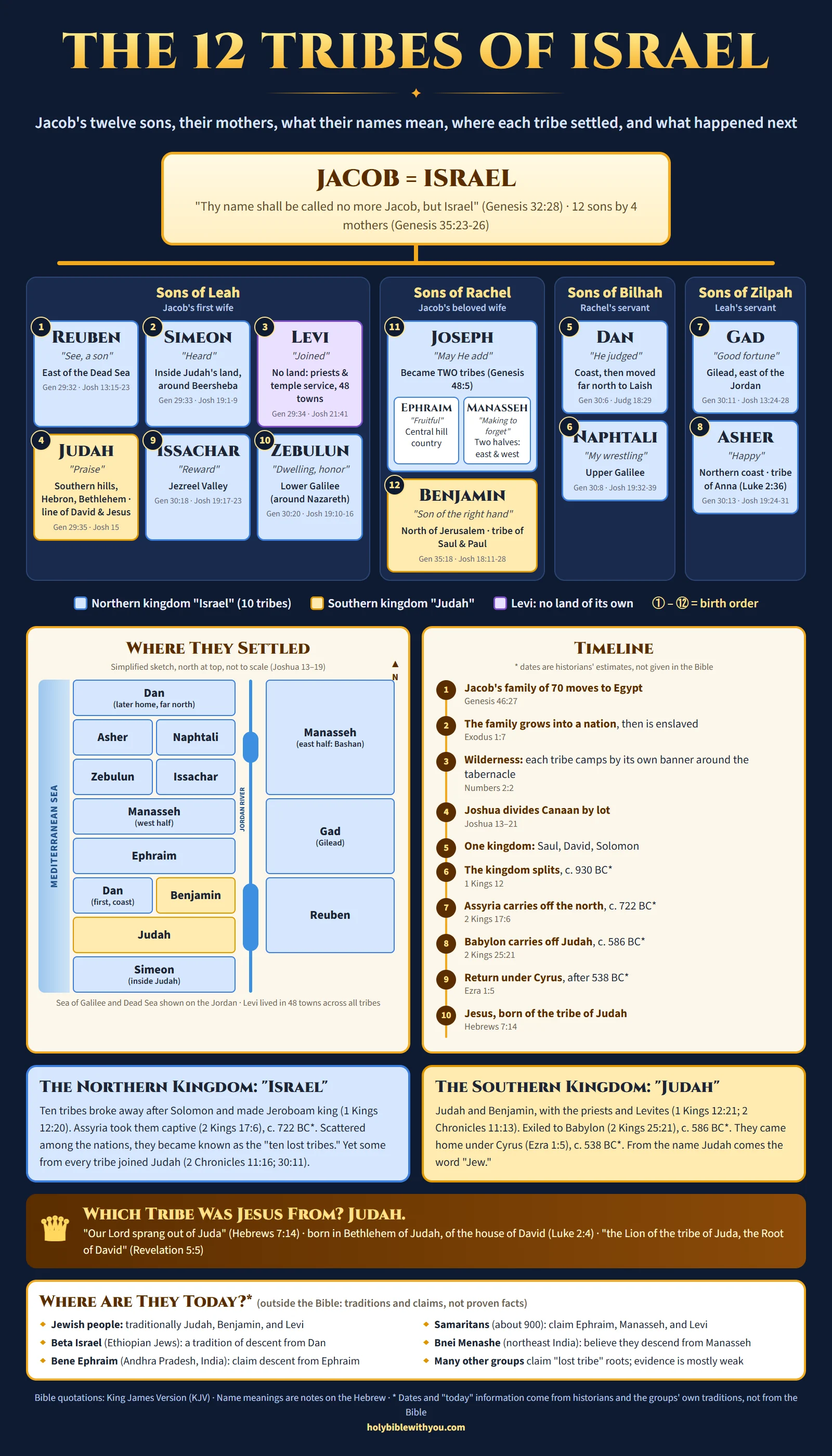
Before he died, Jacob called all of his sons together:
“And Jacob called unto his sons, and said, Gather yourselves together, that I may tell you that which shall befall you in the last days. Gather yourselves together, and hear, ye sons of Jacob; and hearken unto Israel your father.”
— Genesis 49:1-2 (KJV)
By then a famine had driven the whole family out of Canaan and down to Egypt. Old Jacob, lying on his deathbed, spoke to each son in turn about what lay ahead for him and his descendants. When he finished, the Bible sums it up like this:
“All these are the twelve tribes of Israel: and this is it that their father spake unto them, and blessed them; every one according to his blessing he blessed them.”
— Genesis 49:28 (KJV)
This is the first time the phrase “the twelve tribes of Israel” appears in the Bible. At this point they were still just one big family. When Jacob’s household moved to Egypt, it numbered only seventy people (Genesis 46:27). A few generations later, things looked very different:
“And the children of Israel were fruitful, and increased abundantly, and multiplied, and waxed exceeding mighty; and the land was filled with them.”
— Exodus 1:7 (KJV)
This verse comes right after the death of Joseph. A family of seventy had grown into a whole people, so large that a later Pharaoh felt threatened and turned them into slaves. If you’d like the full story of the man behind the name “Israel,” read our article on Jacob in the Bible.
What Are the Names of the 12 Tribes, and What Does Each Name Mean?
In Bible times, a child’s name was never picked at random. It often carried whatever the mother was feeling at the moment of birth: her pain, her joy, her prayer. Genesis 29 and 30 record, one by one, what Jacob’s wives said as they named their sons. The table below puts those words side by side.
A note on the table: the third column quotes the Bible (KJV) word for word. The fourth column, “What the name means,” is a language note about the Hebrew. Scholars point out that each Hebrew name sounds like a key word in what the mother said.
| Son (tribe) | Mother | What was said at his naming | What the name means (language note) |
|---|---|---|---|
| Reuben | Leah | “Surely the LORD hath looked upon my affliction; now therefore my husband will love me.” (Genesis 29:32) | “See, a son” |
| Simeon | Leah | “Because the LORD hath heard that I was hated, he hath therefore given me this son also” (29:33) | “Heard” |
| Levi | Leah | “Now this time will my husband be joined unto me, because I have born him three sons” (29:34) | “Joined, attached” |
| Judah | Leah | “Now will I praise the LORD” (29:35) | “Praise” |
| Dan | Bilhah (Rachel’s servant; Rachel named him) | “God hath judged me, and hath also heard my voice, and hath given me a son” (30:6) | “He judged” |
| Naphtali | Bilhah (Rachel named him) | “With great wrestlings have I wrestled with my sister, and I have prevailed” (30:8) | “My wrestling” |
| Gad | Zilpah (Leah’s servant; Leah named him) | “A troop cometh” (30:11) | “Good fortune” or “a troop” |
| Asher | Zilpah (Leah named him) | “Happy am I, for the daughters will call me blessed” (30:13) | “Happy, blessed” |
| Issachar | Leah | “God hath given me my hire, because I have given my maiden to my husband” (30:18) | “Reward, wages” |
| Zebulun | Leah | “God hath endued me with a good dowry; now will my husband dwell with me, because I have born him six sons” (30:20) | “Dwelling, honor” |
| Joseph | Rachel | “The LORD shall add to me another son.” (30:24) | “May He add” |
| Benjamin | Rachel | As she was dying, Rachel named him “Ben-oni”; Jacob renamed him “Benjamin” (35:18) | Ben-oni = “son of my sorrow”; Benjamin = “son of the right hand” |
| Manasseh (Joseph’s son) | Asenath (Joseph’s wife) | Joseph: “God, said he, hath made me forget all my toil, and all my father’s house.” (41:51) | “Making to forget” |
| Ephraim (Joseph’s son) | Asenath | Joseph: “God hath caused me to be fruitful in the land of my affliction.” (41:52) | “Fruitful” |
Read that table slowly and you’ll notice the heartache running through this family. Jacob loved Rachel, but his uncle Laban tricked him on the wedding night and gave him her older sister Leah instead (Genesis 29:21-30). Leah spent years longing for her husband’s love, and you can hear it in her first three sons’ names: “now therefore my husband will love me,” “now this time will my husband be joined unto me.” Then something shifts. When her fourth son is born, she stops looking at Jacob and looks to God instead: “Now will I praise the LORD.” That son was Judah, the tribe that would one day produce King David and, eventually, Jesus.
Rachel, meanwhile, couldn’t have children for a long time. Jealous of her sister, she gave her servant Bilhah to Jacob, and Leah answered by giving him her servant Zilpah (Genesis 30:1-13). Rachel’s words at Naphtali’s birth, “with great wrestlings have I wrestled with my sister,” tell you everything about the rivalry between those two women. The Bible doesn’t try to make this family look good. There’s jealousy, competition, deception, and a lot of loneliness. And yet this is the family God used to build His people. It’s a good reminder that God’s plans have never depended on perfect people.
Why Is There No Tribe of Joseph? Who Were Ephraim and Manasseh?
If you look closely at the lists of tribes in the Bible, you’ll notice something odd. Joseph, Jacob’s favorite son, usually doesn’t appear. Instead you see two other names: Ephraim and Manasseh. The reason goes back to something Jacob said to Joseph near the end of his life:
“And now thy two sons, Ephraim and Manasseh, which were born unto thee in the land of Egypt before I came unto thee into Egypt, are mine; as Reuben and Simeon, they shall be mine.”
— Genesis 48:5 (KJV)
Joseph had risen to become one of the most powerful men in Egypt, married there, and had two sons, Ephraim and Manasseh. When Jacob fell sick, Joseph brought the boys to see their grandfather. That’s when Jacob announced that he was adopting them as his own sons, on the same level as his firstborn Reuben and second-born Simeon. In other words, Joseph didn’t get one share of the inheritance. He got two. You can read Joseph’s whole remarkable story in our article Joseph’s Life: The Complete Biblical Story.
But wait. If Joseph’s line became two tribes, shouldn’t there be thirteen? This is where the tribe of Levi comes in. When the land was being handed out, the book of Joshua spells out the math:
“For Moses had given the inheritance of two tribes and an half tribe on the other side Jordan: but unto the Levites he gave none inheritance among them. For the children of Joseph were two tribes, Manasseh and Ephraim: therefore they gave no part unto the Levites in the land, save cities to dwell in, with their suburbs for their cattle and for their substance.”
— Joshua 14:3-4 (KJV)
This was said when the Israelites, under Joshua’s leadership, had entered Canaan and were dividing the land tribe by tribe. Joseph produced two tribes, and Levi received no territory. So the number of land-holding tribes stayed at twelve. The count of “twelve tribes” never changed, but which twelve names show up in a given list depends on what that list is about.
Why Didn’t the Tribe of Levi Get Any Land?
Levi going without land wasn’t a punishment. God gave the Levites a different job and a different kind of inheritance. While Israel was in the wilderness and Moses was taking a census, God told him:
“But the Levites after the tribe of their fathers were not numbered among them. For the LORD had spoken unto Moses, saying, Only thou shalt not number the tribe of Levi, neither take the sum of them among the children of Israel: But thou shalt appoint the Levites over the tabernacle of testimony, and over all the vessels thereof, and over all things that belong to it: they shall bear the tabernacle, and all the vessels thereof; and they shall minister unto it, and shall encamp round about the tabernacle.”
— Numbers 1:47-50 (KJV)
In the second year after leaving Egypt, God told Moses to count every man old enough to go to war. The Levites were left out of that count, because they weren’t set apart for battle. They were set apart to take care of God’s tabernacle, the portable tent where Israel worshiped. Aaron and his sons became priests, and the rest of the Levites became their assistants. So how were they supposed to make a living? God answered that question when He spoke to Aaron:
“And the LORD spake unto Aaron, Thou shalt have no inheritance in their land, neither shalt thou have any part among them: I am thy part and thine inheritance among the children of Israel.”
— Numbers 18:20 (KJV)
Every other tribe got fields and towns. The priests got something else: “I am thy part.” Serving God was their inheritance. And God also spelled out how, in practical terms, they would be provided for:
“But the tithes of the children of Israel, which they offer as an heave offering unto the LORD, I have given to the Levites to inherit: therefore I have said unto them, Among the children of Israel they shall have no inheritance.”
— Numbers 18:24 (KJV)
The other tribes gave a tenth of their harvest to God, and that tenth supported the Levites. If you want to dig deeper into this, see our article Tithing in the Bible: What Does the Bible Actually Say?
Even without a territory of their own, the Levites weren’t homeless:
“All the cities of the Levites within the possession of the children of Israel were forty and eight cities with their suburbs.”
— Joshua 21:41 (KJV)
Once the land had been divided, every tribe gave some of its towns to the Levites. That meant the Levites were spread out across the whole country, and every tribe had people living among them who knew God’s law.
Why Did God Organize His People Into Tribes in the First Place?
You won’t find a single verse that says, “Here’s why there are tribes.” But the Bible shows us what the tribes actually did, and five big purposes stand out.
1. Order. When hundreds of thousands of people were traveling through the wilderness, God told them exactly where each group belonged:
“Every man of the children of Israel shall pitch by his own standard, with the ensign of their father’s house: far off about the tabernacle of the congregation shall they pitch.”
— Numbers 2:2 (KJV)
God gave Moses and Aaron these instructions in the Sinai wilderness. The tabernacle stood in the center, and the tribes camped around it, three on each side, each under its own banner (Numbers 2:3-31). Every family knew its place. There was no chaos, and God was in the middle of them all.
2. Dividing the land fairly. Here’s the rule God gave for dividing Canaan:
“Unto these the land shall be divided for an inheritance according to the number of names. To many thou shalt give the more inheritance, and to few thou shalt give the less inheritance: to every one shall his inheritance be given according to those that were numbered of him. Notwithstanding the land shall be divided by lot: according to the names of the tribes of their fathers they shall inherit.”
— Numbers 26:53-55 (KJV)
After forty years of wandering, on the plains of Moab right before entering Canaan, Israel took a second census, and then God gave this rule. Bigger tribes got more land. But which region went to which tribe was decided by casting lots, so nobody could accuse anyone of playing favorites.
3. Protecting each family’s inheritance. Land given to a tribe was supposed to stay in that tribe:
“So shall not the inheritance of the children of Israel remove from tribe to tribe: for every one of the children of Israel shall keep himself to the inheritance of the tribe of his fathers.”
— Numbers 36:7 (KJV)
A man named Zelophehad, from the tribe of Manasseh, had no sons, only daughters, and they were given their father’s land. But the leaders of their tribe raised a concern with Moses: if these women married into another tribe, their land would go with them. This rule was God’s answer, and the daughters married within their own tribe (Numbers 36:1-12). God didn’t want any family to lose its share for good.
4. Serving God. As we’ve seen, one entire tribe, Levi, was set apart for God’s service, and the rest of the tribes supported them.
5. Showing which family line God’s promise would come through. Jacob said this about his son Judah:
“The sceptre shall not depart from Judah, nor a lawgiver from between his feet, until Shiloh come; and unto him shall the gathering of the people be.”
— Genesis 49:10 (KJV)
This is part of the blessing Jacob gave on his deathbed. A scepter is the staff a king holds, a symbol of royal power. Centuries later, David, from the tribe of Judah, became king (see our article on David’s story). And the New Testament is very clear about which tribe Jesus came from:
“For it is evident that our Lord sprang out of Juda; of which tribe Moses spake nothing concerning priesthood.”
— Hebrews 7:14 (KJV)
The writer of Hebrews is explaining how Jesus can be our priest. In the Old Testament, priests came from the tribe of Levi. Jesus was born into the tribe of Judah instead, so the writer argues that His priesthood works in a completely different way. Notice that the writer could say “it is evident” precisely because family records by tribe had been carefully kept for centuries. We’ll trace how that promise traveled from Judah to Jesus in its own section further down.
Where Did Each Tribe Settle in the Promised Land?
While Moses was still alive, the tribes of Reuben and Gad, along with half of Manasseh, asked for land on the east side of the Jordan River, because they had large herds of livestock:
“And Moses gave unto them, even to the children of Gad, and to the children of Reuben, and unto half the tribe of Manasseh the son of Joseph, the kingdom of Sihon king of the Amorites, and the kingdom of Og king of Bashan, the land, with the cities thereof in the coasts, even the cities of the country round about.”
— Numbers 32:33 (KJV)
Sihon and Og were two kings Israel had defeated on the way. These two and a half tribes promised to leave their families on the east side and march across the Jordan with everyone else until the other tribes had their land too (Numbers 32:16-32). The rest of the tribes received land west of the Jordan in Joshua’s day (Joshua 13–19).
The table below shows the territory the Bible gives each tribe and roughly where that is today. Please note: the “Roughly today” column isn’t from the Bible. It’s an approximate guide based on Bible atlases, and scholars disagree on some of the exact ancient borders.
| Tribe | Territory in the Bible | Roughly today |
|---|---|---|
| Reuben | East of the Dead Sea (Joshua 13:15-23) | Jordan |
| Gad | Gilead, east of the Jordan (Joshua 13:24-28) | Jordan |
| Manasseh (east half) | Bashan (Joshua 13:29-31) | Northern Jordan, southern Syria, the Golan |
| Judah | Southern hill country, Hebron, Bethlehem (Joshua 15) | Southern Israel, southern West Bank |
| Simeon | Inside Judah’s territory, around Beersheba (Joshua 19:1-9) | The Negev, Israel |
| Benjamin | Between Judah and Ephraim, from Jericho to Jerusalem (Joshua 18:11-28) | North of Jerusalem, West Bank |
| Ephraim | Central hill country (Joshua 16:5-10) | Central West Bank |
| Manasseh (west half) | North of Ephraim (Joshua 17:1-13) | Northern West Bank (around Nablus), part of Israel’s coast |
| Issachar | Jezreel Valley (Joshua 19:17-23) | Northern Israel |
| Zebulun | Lower Galilee (Joshua 19:10-16) | Northern Israel (around Nazareth) |
| Asher | Northern coast (Joshua 19:24-31) | Northern Israel’s coast, southern Lebanon |
| Naphtali | North and west of the Sea of Galilee (Joshua 19:32-39) | Northern Israel (Upper Galilee) |
| Dan | First near the western coast (Joshua 19:40-48), later Laish in the far north (Judges 18) | First around Tel Aviv, later northern Israel (Tel Dan) |
| Levi | No single territory; 48 towns spread among all the tribes (Joshua 21) | Throughout the land |
Dan’s story is a little unusual. The tribe never managed to fully take the coastal land it was given, so many of its people moved far north and captured a town called Laish:
“And they called the name of the city Dan, after the name of Dan their father, who was born unto Israel: howbeit the name of the city was Laish at the first.”
— Judges 18:29 (KJV)
This happened in the days of the judges, before Israel had a king. The Danites renamed the town after their ancestor. But the same chapter also tells us they set up an idol there (Judges 18:30-31). (Historical note: archaeologists have identified the ruins of this city at a site in northern Israel called Tel Dan.) We’ll come back to Dan in more detail near the end of this article.
What Happened to the Tribes Under Solomon? Why Did the Kingdom Split in Two?
This is one of the biggest turning points in the whole story of the tribes, so let’s take it slowly, one step at a time.
After the land was divided in Joshua’s day, the tribes lived fairly independently for about three to four hundred years. During the period of the judges, each tribe mostly handled its own problems. Sometimes the tribes even fought each other. On one occasion the tribe of Benjamin was nearly wiped out, and the rest of Israel wept over it:
“And said, O LORD God of Israel, why is this come to pass in Israel, that there should be to day one tribe lacking in Israel?”
— Judges 21:3 (KJV)
Men from the Benjamite town of Gibeah had committed a horrific crime. When the other tribes came to punish them, the tribe of Benjamin refused to hand over the guilty men and sided with them instead. In the war that followed, Benjamin was nearly destroyed, and only six hundred men escaped into the wilderness (Judges 20:47). Afterward, the very tribes that had fought them sat before God and cried, because one of the twelve was disappearing. Losing even one tribe felt like losing a member of the family. That shows you how strongly they saw themselves as one people.
The tribes become one kingdom. Later the people asked the prophet Samuel for a king (1 Samuel 8). The first king was Saul, from Benjamin. Then came David, from Judah. David united all twelve tribes into one kingdom and made Jerusalem its capital. Under his son Solomon, the kingdom reached its peak: peace, wealth, a magnificent temple, and foreign rulers coming to visit. From the outside, the twelve tribes had never looked so united or so strong.
But behind all that glory, two problems were quietly growing. One was the heavy burden on ordinary people. The other was that Solomon’s heart was drifting away from God.
Problem one: a growing burden on the people. Solomon’s royal household was enormous, and the Bible tells us how it was paid for:
“And Solomon had twelve officers over all Israel, which provided victuals for the king and his household: each man his month in a year made provision.”
— 1 Kings 4:7 (KJV)
Solomon split the country into twelve districts, each with an officer in charge. For one month every year, a whole district had to supply all the food the royal court needed. The Bible even lists what the palace went through in a single day: thirty measures of fine flour, sixty measures of meal, ten fattened oxen, twenty pasture-fed oxen, a hundred sheep, plus deer, gazelles, roebucks, and fattened fowl (1 Kings 4:22-23). That’s essentially a heavy tax. And it wasn’t only paid in grain. It was also paid in labor:
“And king Solomon raised a levy out of all Israel; and the levy was thirty thousand men. And he sent them to Lebanon ten thousand a month by courses: a month they were in Lebanon, and two months at home: and Adoniram was over the levy.”
— 1 Kings 5:13-14 (KJV)
The cedar wood for the temple had to come from the forests of Lebanon, so Solomon drafted thirty thousand Israelite men to go get it. Each man spent one month out of every three far from home. Picture a farmer today being told that one month out of every quarter, he has to leave his farm, his family, and his house to do unpaid government work in another country. Who milks the cows? Who brings in the crop? The temple took seven years to build and the palace thirteen (1 Kings 6:38; 7:1), and this burden lasted for all those years.
To be fair, the Bible also tells us that Solomon didn’t turn Israelites into permanent slaves. They served as his soldiers, officials, and commanders (1 Kings 9:22), and the hardest forced labor was put on the non-Israelite peoples still living in the land (1 Kings 9:20-21). Even so, you’ll see in a moment, in the people’s own words, just how heavy those taxes and work drafts felt.
Problem two: Solomon’s heart wanders. This was the bigger problem. Solomon married many foreign princesses, even though God had warned Israel not to marry into those nations, because they would turn Israel’s hearts toward their gods (1 Kings 11:1-2). That’s exactly what happened:
“For it came to pass, when Solomon was old, that his wives turned away his heart after other gods: and his heart was not perfect with the LORD his God, as was the heart of David his father.”
— 1 Kings 11:4 (KJV)
The same Solomon who as a young man asked God for wisdom built shrines for his wives’ gods on a hill east of Jerusalem in his old age, including one for Molech, a god worshiped with child sacrifice (1 Kings 11:5-8). David made plenty of mistakes, but he never worshiped other gods. Solomon crossed that line. Here is God’s response:
“And the LORD was angry with Solomon, because his heart was turned from the LORD God of Israel, which had appeared unto him twice, And had commanded him concerning this thing, that he should not go after other gods: but he kept not that which the LORD commanded. Wherefore the LORD said unto Solomon, Forasmuch as this is done of thee, and thou hast not kept my covenant and my statutes, which I have commanded thee, I will surely rend the kingdom from thee, and will give it to thy servant. Notwithstanding in thy days I will not do it for David thy father’s sake: but I will rend it out of the hand of thy son. Howbeit I will not rend away all the kingdom; but will give one tribe to thy son for David my servant’s sake, and for Jerusalem’s sake which I have chosen.”
— 1 Kings 11:9-13 (KJV)
God had personally appeared to Solomon twice, once at Gibeon and once after the temple was finished. This was a man who had known God up close, and he still walked away. So the consequence was serious. Notice three things in these words. First, the kingdom would be torn apart, and most of it would go to one of Solomon’s servants. Second, it wouldn’t happen in Solomon’s lifetime but in his son’s. Third, for the sake of His promise to David, God would leave David’s family one tribe. All three happened exactly as God said.
God soon showed who that “servant” would be. A capable young man named Jeroboam, from the tribe of Ephraim, worked for Solomon. Impressed with his work, Solomon put him in charge of the whole labor force from the house of Joseph, meaning Ephraim and Manasseh (1 Kings 11:26-28). So Jeroboam saw up close just how heavy the people’s burden was. One day, as he was leaving Jerusalem, a prophet named Ahijah met him on the road, tore his own new cloak into twelve pieces, and said:
“And he said to Jeroboam, Take thee ten pieces: for thus saith the LORD, the God of Israel, Behold, I will rend the kingdom out of the hand of Solomon, and will give ten tribes to thee: (But he shall have one tribe for my servant David’s sake, and for Jerusalem’s sake, the city which I have chosen out of all the tribes of Israel:)”
— 1 Kings 11:31-32 (KJV)
The twelve pieces of the cloak stood for the twelve tribes. Ten pieces went to Jeroboam, and the rest stayed with David’s family. The message was clear: because of Solomon’s sin, the kingdom would be torn in two, but because of His promise to David, God would not wipe out David’s line completely.
When Solomon heard about this, he tried to kill Jeroboam. Jeroboam fled to Egypt and stayed there until Solomon died (1 Kings 11:40).
What happened after Solomon died? Solomon reigned forty years and died. His son Rehoboam went to the city of Shechem to be crowned. Shechem sat in the hill country of Ephraim, right in the middle of the northern tribes. The northern tribes met Rehoboam there and told him plainly what was on their minds:
“Thy father made our yoke grievous: now therefore make thou the grievous service of thy father, and his heavy yoke which he put upon us, lighter, and we will serve thee.”
— 1 Kings 12:4 (KJV)
A yoke is the heavy wooden beam laid across the necks of oxen so they can pull a plow. The people were comparing themselves to work animals: Solomon’s taxes and labor drafts had been a yoke on their necks. Notice they didn’t threaten a revolt. They made a reasonable request: lighten the load, and we’ll serve you.
Rehoboam asked for three days to think it over and consulted his advisers. The older men who had served his father told him, “If thou wilt be a servant unto this people this day, and wilt serve them, and answer them, and speak good words to them, then they will be thy servants for ever” (1 Kings 12:7). But Rehoboam listened to the young men he had grown up with instead (1 Kings 12:8-11). On the third day, this was his answer:
“And the king answered the people roughly, and forsook the old men’s counsel that they gave him; And spake to them after the counsel of the young men, saying, My father made your yoke heavy, and I will add to your yoke: my father also chastised you with whips, but I will chastise you with scorpions.”
— 1 Kings 12:13-14 (KJV)
Many commentators explain “scorpions” as a harsher kind of whip with sharp points that tore the skin (that’s an interpretation, not something the verse spells out). Either way, Rehoboam was saying, “I’ll be even tougher than my father.” One kind answer would have kept the whole kingdom in his hands. Instead, his pride cost him most of it. But the Bible adds something important: all of this happened so that the word God had spoken through Ahijah would come true (1 Kings 12:15). Human pride and God’s judgment were working together here.
The people’s answer came right away:
“So when all Israel saw that the king hearkened not unto them, the people answered the king, saying, What portion have we in David? neither have we inheritance in the son of Jesse: to your tents, O Israel: now see to thine own house, David. So Israel departed unto their tents.”
— 1 Kings 12:16 (KJV)
“What portion have we in David?” meant “We’re done with David’s family.” Jesse was David’s father. “To your tents, O Israel” was basically “Everybody go home; this king isn’t ours.” Rehoboam then sent Adoniram, the official in charge of forced labor, to deal with them. This was the same man who had overseen the Lebanon work crews under Solomon (1 Kings 5:14). The people were so angry that they stoned him to death, and Rehoboam jumped into his chariot and fled to Jerusalem (1 Kings 12:18). Then exactly what the prophet had said came to pass:
“And it came to pass, when all Israel heard that Jeroboam was come again, that they sent and called him unto the congregation, and made him king over all Israel: there was none that followed the house of David, but the tribe of Judah only.”
— 1 Kings 12:20 (KJV)
The ten northern tribes made Jeroboam their king. Their kingdom kept the name “Israel.” The southern kingdom that was left became known as “Judah.” The very next verse shows that one more tribe stayed with Judah:
“And when Rehoboam was come to Jerusalem, he assembled all the house of Judah, with the tribe of Benjamin, an hundred and fourscore thousand chosen men, which were warriors, to fight against the house of Israel, to bring the kingdom again to Rehoboam the son of Solomon.”
— 1 Kings 12:21 (KJV)
Rehoboam wanted to take back what he’d lost by force. But God stopped him through a prophet named Shemaiah: “Ye shall not go up, nor fight against your brethren” (1 Kings 12:22-24). This verse makes one thing clear: the southern kingdom included both Judah and Benjamin. Jerusalem itself sat right on Benjamin’s border.
Here’s a detail many readers miss. Not everyone in the north stayed in the north:
“And the priests and the Levites that were in all Israel resorted to him out of all their coasts.”
— 2 Chronicles 11:13 (KJV)
Jeroboam didn’t want his people going to the temple in Jerusalem, so he set up golden calves in the towns of Dan and Bethel and appointed his own priests (1 Kings 12:28-31; 2 Chronicles 11:14-15). As a result, God’s priests and the Levites left their property behind and moved south to Judah. And they weren’t the only ones:
“And after them out of all the tribes of Israel such as set their hearts to seek the LORD God of Israel came to Jerusalem, to sacrifice unto the LORD God of their fathers.”
— 2 Chronicles 11:16 (KJV)
So people “out of all the tribes” who genuinely wanted to follow God made their way toward Jerusalem. Keep this in mind, because it matters a lot when we get to the question of the “lost” tribes.
And this wasn’t a one-time thing. Years later, when King Asa of Judah turned back to God and removed the idols from the land, even more people came over from the north:
“And he gathered all Judah and Benjamin, and the strangers with them out of Ephraim and Manasseh, and out of Simeon: for they fell to him out of Israel in abundance, when they saw that the LORD his God was with him.”
— 2 Chronicles 15:9 (KJV)
Asa called a great assembly at the temple, where the people renewed their covenant with God (2 Chronicles 15:8-15). This verse tells us the crowd wasn’t just from Judah and Benjamin. People from the northern tribes of Ephraim, Manasseh, and Simeon came too. Simeon is worth a closer look. Its land had been inside Judah’s territory from the very beginning (Joshua 19:1). So while Simeon was counted among the “ten tribes” on paper, many scholars think that in practice most Simeonites ended up blending into the southern kingdom (this is a scholarly view, not a statement of the Bible). In other words, the southern kingdom may have been called “Judah,” but it had people from many tribes living in it.
Putting It Simply: What Did Solomon’s Reign Do to the Tribes?
Let’s put the whole story together in plain words.
By David’s time, the twelve tribes had come together as one family and one kingdom. Solomon made that kingdom rich and famous. But the people paid for all that splendor with food taxes and years of forced labor. That burden seems to have weighed especially heavily on the northern tribes, since the king was from Judah and the capital was in Jerusalem, yet everyone carried the load. (Many scholars have written about this older tension between the northern tribes and Judah; that’s their analysis. But the Bible itself shows the two sides, “the men of Israel” and “the men of Judah,” arguing back in David’s day, in 2 Samuel 19:41-43 and 20:1-2.)
On top of that, Solomon built shrines for his wives’ gods and weakened the one bond that had really held Israel together: faith in the one true God. So God announced that the kingdom would split in his son’s time.
After Solomon died, the people asked for relief. Rehoboam arrogantly promised them more of the same, only worse. That was the last straw. Ten tribes broke away, declared they had nothing more to do with David’s family, and made Jeroboam their king. Only Judah and Benjamin stayed with David’s line, along with the priests, the Levites, and people from the northern tribes who truly wanted to follow God.
Jeroboam was afraid that if his people kept going to the temple in Jerusalem, their hearts would turn back to David’s family. So he did this:
“Whereupon the king took counsel, and made two calves of gold, and said unto them, It is too much for you to go up to Jerusalem: behold thy gods, O Israel, which brought thee up out of the land of Egypt.”
— 1 Kings 12:28 (KJV)
He put one calf in Bethel, near his southern border, and the other in the town of Dan in the far north (1 Kings 12:29). That decision, made for political reasons, led the entire northern kingdom into idolatry. Not one of the northern kings who came after him ever removed those calves. Again and again, the Bible says these kings “walked in the way of Jeroboam” and led Israel into the same sin (for example, 1 Kings 15:34).
So here’s what Solomon’s reign did to the tribes: twelve tribes that had been one kingdom became two. In the north was the ten-tribe kingdom of “Israel”; in the south, the kingdom of “Judah” with Judah and Benjamin. They never reunited. The northern kingdom lasted about two hundred years before Assyria scattered it. The southern kingdom lasted roughly another hundred and thirty years, went into exile in Babylon, and later returned. We’ll follow both stories in the next sections. You can read Solomon’s whole life story in our article King Solomon in the Bible.
What Happened to the Ten Northern Tribes?
For about two hundred years, the northern kingdom of Israel went through one king after another, and idol worship kept spreading (see our article on Baal worship in the Bible). Meanwhile, a powerful empire was rising to the northeast: Assyria. The first blow fell on the tribes in the far north and east:
“In the days of Pekah king of Israel came Tiglath-pileser king of Assyria, and took Ijon, and Abel-beth-maachah, and Janoah, and Kedesh, and Hazor, and Gilead, and Galilee, all the land of Naphtali, and carried them captive to Assyria.”
— 2 Kings 15:29 (KJV)
Gilead was the land east of the Jordan where Gad, Reuben, and half of Manasseh lived. Galilee and Naphtali were in the north. So these tribes were the first to be carried off as captives. A few years later, the capital city of Samaria fell too:
“In the ninth year of Hoshea the king of Assyria took Samaria, and carried Israel away into Assyria, and placed them in Halah and in Habor by the river of Gozan, and in the cities of the Medes.”
— 2 Kings 17:6 (KJV)
Hoshea was the last king of northern Israel. He stopped paying tribute to Assyria and asked Egypt for help instead. So the king of Assyria besieged Samaria for three years and captured it (2 Kings 17:3-5). The people were moved far from their homeland and scattered to different parts of the Assyrian empire. The Bible is direct about why this happened: they abandoned the God who had rescued them from Egypt and worshiped other gods (2 Kings 17:7-17). Then:
“Therefore the LORD was very angry with Israel, and removed them out of his sight: there was none left but the tribe of Judah only.”
— 2 Kings 17:18 (KJV)
“None left but the tribe of Judah only” means that only the southern kingdom of Judah was still standing in its land. (As we saw above, that southern kingdom also included Benjamin and the Levites.)
Historical background (this is not from the Bible): Assyria’s own royal records also mention this event. King Sargon II had it inscribed on his palace walls and in his annals that he besieged and captured Samaria and carried off 27,290 of its people. (Some copies give the number as 27,280.) Historians usually date the fall of Samaria to around 722 BC. You might wonder about something here: the Bible names the Assyrian king who came against Samaria as Shalmaneser (2 Kings 17:3), but the inscription names Sargon. The usual explanation scholars give is that Shalmaneser started the three-year siege, died during it or right around the time it ended, and Sargon took the throne. The deportation of the people was completed under Sargon. Ancient kings commonly took credit for victories their predecessors had started, which is why Sargon’s inscription claims the capture as his own. So there’s no real contradiction between the Bible and the inscription. Sources: Encyclopaedia Judaica, “Exile, Assyrian” (Jewish Virtual Library); “Annals of Sargon II.”
The Bible tells us one more important thing: the king of Assyria didn’t just take the Israelites out. He also brought other people in:
“Until the LORD removed Israel out of his sight, as he had said by all his servants the prophets. So was Israel carried away out of their own land to Assyria unto this day. And the king of Assyria brought men from Babylon, and from Cuthah, and from Ava, and from Hamath, and from Sepharvaim, and placed them in the cities of Samaria instead of the children of Israel: and they possessed Samaria, and dwelt in the cities thereof.”
— 2 Kings 17:23-24 (KJV)
When the writer of Kings says “unto this day,” he means in his own time. Historians tell us that scattering conquered peoples and resettling others in their place was standard Assyrian policy. It kept defeated nations from regrouping and rebelling. The northern tribes were spread across many lands and gradually mixed in with the local populations. That’s how people started calling them “the ten lost tribes.”
Did the “Ten Lost Tribes” Really Vanish?
A lot of books and documentaries talk about the ten tribes as if they disappeared overnight. But the picture the Bible paints is more complicated than that. Even after the northern kingdom fell, some Israelites were still living in the land. King Hezekiah of Judah sent messengers all through the north, inviting people to come to Jerusalem for the Passover:
“So the posts passed from city to city through the country of Ephraim and Manasseh even unto Zebulun: but they laughed them to scorn, and mocked them. Nevertheless divers of Asher and Manasseh and of Zebulun humbled themselves, and came to Jerusalem.”
— 2 Chronicles 30:10-11 (KJV)
As soon as Hezekiah became king of Judah, he cleaned out the temple and restored the Passover celebration, which hadn’t been kept properly for a long time. Many people in the north laughed at his messengers, but some from Asher, Manasseh, and Zebulun came anyway. So people from those tribes were still in the land, and some of them joined their brothers and sisters in the south.
Centuries later, in New Testament times, we still meet people from the northern tribes who knew exactly which tribe they belonged to. Luke tells us about an elderly woman who saw the baby Jesus at the temple:
“And there was one Anna, a prophetess, the daughter of Phanuel, of the tribe of Aser: she was of a great age, and had lived with an husband seven years from her virginity;”
— Luke 2:36 (KJV)
This was when Mary and Joseph brought the newborn Jesus to the temple to present Him to God. Anna belonged to the tribe of Asher (“Aser” in the KJV), one of the so-called lost tribes. Yet there she was, still knowing her tribe’s name and serving God in Jerusalem.
The apostle Paul, standing before King Agrippa, also spoke of Israel as twelve tribes:
“Unto which promise our twelve tribes, instantly serving God day and night, hope to come. For which hope’s sake, king Agrippa, I am accused of the Jews.”
— Acts 26:7 (KJV)
Paul was a prisoner, answering the charges against him. He said that “our twelve tribes” were still waiting in hope for the promise God made to their ancestors. James, too, opened his letter “to the twelve tribes which are scattered abroad” (James 1:1).
So from the Bible’s point of view, the ten tribes weren’t simply erased. Many were scattered among other nations and blended in. Some joined the people of Judah. And some kept the memory of their tribe alive. (Historians’ view: most historians think that many of those taken into exile were gradually absorbed into the peoples of the Assyrian empire over time. That’s their assessment, not a statement of the Bible.)
What Happened to Judah and Benjamin? Where Does the Word “Jew” Come From?
The southern kingdom of Judah outlasted the northern kingdom by about a hundred and thirty years. But Judah drifted away from God too, and in the end King Nebuchadnezzar of Babylon destroyed Jerusalem and the temple:
“And the king of Babylon smote them, and slew them at Riblah in the land of Hamath. So Judah was carried away out of their land.”
— 2 Kings 25:21 (KJV)
After Jerusalem fell, the Babylonian commander took some of the city’s top officials and priests to Nebuchadnezzar, and the king had them executed. Many of the people were taken to Babylon as captives. (Historical note: historians date the fall of Jerusalem to 587 or 586 BC.)
But this time the story ended differently. About seventy years later, King Cyrus of Persia issued a decree allowing the Jews to go home and rebuild the temple (Ezra 1:1-4). Look at who answered the call:
“Then rose up the chief of the fathers of Judah and Benjamin, and the priests, and the Levites, with all them whose spirit God had raised, to go up to build the house of the LORD which is in Jerusalem.”
— Ezra 1:5 (KJV)
Judah, Benjamin, and Levi are the three tribes named here. Even so, the people who returned didn’t think of themselves as just two or three tribes. Look at what they did when the rebuilt temple was dedicated:
“And offered at the dedication of this house of God an hundred bullocks, two hundred rams, four hundred lambs; and for a sin offering for all Israel, twelve he goats, according to the number of the tribes of Israel.”
— Ezra 6:17 (KJV)
Twelve goats for twelve tribes. They believed they were standing before God on behalf of “all Israel.” The ten tribes might have been far away, but they hadn’t been forgotten.
After the Babylonian exile, these people were most often called “Jews.” The word comes from the name Judah, the tribe and the kingdom. When Judah was born, his mother Leah named him with the words “Now will I praise the LORD” (Genesis 29:35). (Language note: scholars say the Hebrew name “Judah” is closely related to the word for “praise.”) But not everyone called a “Jew” was from the tribe of Judah. Take Mordecai, from the book of Esther:
“Now in Shushan the palace there was a certain Jew, whose name was Mordecai, the son of Jair, the son of Shimei, the son of Kish, a Benjamite;”
— Esther 2:5 (KJV)
Mordecai lived in Shushan (Susa), the Persian capital. He was from the tribe of Benjamin, yet the Bible calls him “a Jew.” By then, “Jew” was no longer just the name of one tribe. It had become a name for the whole people of Israel. The apostle Paul also said he was from Benjamin:
“I say then, Hath God cast away his people? God forbid. For I also am an Israelite, of the seed of Abraham, of the tribe of Benjamin.”
— Romans 11:1 (KJV)
Paul is answering a hard question here: since so many Jews had not believed in Jesus, had God given up on Israel? “God forbid!” he says, and he points to himself as proof: an Israelite who believed in Jesus. This verse, along with Philippians 3:5, shows that in the first century people still knew which tribe they came from.
Which Tribe Was Jesus From? How Does the Story of the Tribes Lead to Him?
The whole story of the twelve tribes circles around one big question: how would God keep the promises He made to Abraham, to Jacob, and to David? The kingdom split. Ten tribes were scattered. Judah went into exile. David’s throne sat empty. And yet God didn’t forget His word. Let’s trace, step by step, how that promise made its way to Jesus.
Step 1: Judah’s blessing. We’ve already seen that Jacob said the scepter would not depart from Judah (Genesis 49:10). In that same blessing, Jacob compared Judah to a lion:
“Judah is a lion’s whelp: from the prey, my son, thou art gone up: he stooped down, he couched as a lion, and as an old lion; who shall rouse him up?”
— Genesis 49:9 (KJV)
A lion stands for strength and authority. Once a lion has eaten and lies down to rest, nobody is brave enough to wake it. Jacob was saying that strong leadership would come out of Judah. Hold on to that word “lion,” because it shows up again in the last book of the Bible.
Step 2: God’s promise to David. Centuries later, David from the tribe of Judah became king. When David wanted to build God a house (a temple), God sent the prophet Nathan with a surprising answer: David wouldn’t build God a house; instead, “the LORD telleth thee that he will make thee an house” (2 Samuel 7:1-11). God Himself would build David a “house,” meaning a royal family line. God ended that message with these words:
“And thine house and thy kingdom shall be established for ever before thee: thy throne shall be established for ever.”
— 2 Samuel 7:16 (KJV)
Notice the words “for ever.” No human kingdom lasts forever. David’s son Solomon did build the temple, but this promise didn’t stop with Solomon. From this point on, Israel began looking for a king from David’s line who would reign forever.
Step 3: A shoot from a stump. After the Babylonian exile, David’s descendants lost the throne. From the outside, David’s family tree looked like it had been chopped down. But long before that, the prophet Isaiah had written:
“And there shall come forth a rod out of the stem of Jesse, and a Branch shall grow out of his roots:”
— Isaiah 11:1 (KJV)
Jesse was David’s father. The “stem” here means the stump left in the ground after a tree is cut down. The prophet is saying that even when the tree looks dead, a new shoot will sprout from that stump. David’s family might shrink down to almost nothing, but God would raise up a new king from it. The same chapter says God’s Spirit would rest on this king and that he would judge with perfect fairness (Isaiah 11:2-5).
Step 4: Jesus’ family tree. The very first sentence of the New Testament picks up this story:
“The book of the generation of Jesus Christ, the son of David, the son of Abraham.”
— Matthew 1:1 (KJV)
Matthew opens his Gospel with a list of names. It starts with Abraham, Isaac, and Jacob, and then comes “Judas” (Judah) (Matthew 1:2-3). From there the list runs through David, Solomon, the kings of Judah, the exile in Babylon, and finally to Joseph, the husband of Mary. Matthew counts it out in three sections of fourteen generations each: Abraham to David, David to the exile, and the exile to Christ (Matthew 1:17). The history of the tribes we’ve been following in this article is right there in that list, and Matthew is telling us that all of it was leading to Jesus.
Step 5: Born in Bethlehem. When Jesus was about to be born, Joseph and Mary were living in Nazareth, up in Galilee. But the Roman emperor Caesar Augustus ordered a census, and everyone had to go to their ancestral hometown to register (Luke 2:1-3). So:
“And Joseph also went up from Galilee, out of the city of Nazareth, into Judaea, unto the city of David, which is called Bethlehem; (because he was of the house and lineage of David:)”
— Luke 2:4 (KJV)
Bethlehem was a town in Judah’s territory and the town where David was born. Because Joseph was from David’s family line, that’s where he had to go, and that’s where Jesus was born. A decree from a Roman emperor ended up serving God’s plan. Later, when the wise men from the east came asking, “Where is he that is born King of the Jews?”, King Herod called in the chief priests and scribes and asked them where the Christ was supposed to be born (Matthew 2:1-4). Their answer:
“And they said unto him, In Bethlehem of Judaea: for thus it is written by the prophet, And thou Bethlehem, in the land of Juda, art not the least among the princes of Juda: for out of thee shall come a Governor, that shall rule my people Israel.”
— Matthew 2:5-6 (KJV)
The Jewish scholars pointed to the words of the prophet Micah (Micah 5:2). That prophecy said a ruler of Israel would come out of Bethlehem, a small town in Judah. And that’s exactly where Jesus was born: in the tribe of Judah, in the family of David.
Step 6: A kingdom with no end. Before Jesus was born, the angel Gabriel came to Mary and told her about the child she would have:
“He shall be great, and shall be called the Son of the Highest: and the Lord God shall give unto him the throne of his father David: And he shall reign over the house of Jacob for ever; and of his kingdom there shall be no end.”
— Luke 1:32-33 (KJV)
Every step we’ve looked at comes together in these words. “The throne of his father David” is the promise from 2 Samuel 7:16. “The house of Jacob” is the twelve tribes. “Of his kingdom there shall be no end” echoes God’s “for ever” to David. The kingdom splitting, the tribes scattering, the throne sitting empty… none of it could stop God’s promise. That’s what the angel was announcing.
The final step: the Lion of the tribe of Judah. In the last book of the Bible, John sees a scroll in heaven sealed with seven seals. No one is found worthy to open it, and John begins to weep. Then:
“And one of the elders saith unto me, Weep not: behold, the Lion of the tribe of Juda, the Root of David, hath prevailed to open the book, and to loose the seven seals thereof. And I beheld, and, lo, in the midst of the throne and of the four beasts, and in the midst of the elders, stood a Lamb as it had been slain, having seven horns and seven eyes, which are the seven Spirits of God sent forth into all the earth.”
— Revelation 5:5-6 (KJV)
In Genesis 49, Jacob called Judah a lion. In Isaiah 11, a shoot was promised from the roots of David’s family. Here both images come together in one sentence about Jesus. But here’s the surprise: when John turns to look at the Lion, what he sees is “a Lamb as it had been slain.” The Lion of the tribe of Judah didn’t win by going to war. He won by giving His life on the cross.
That’s why, for Christians, the story of the twelve tribes is more than ancient history. A story that began with Jacob’s family runs through the tribe of Judah and the house of David, and arrives at Jesus. (Note: the two genealogies of Jesus, in Matthew 1 and Luke 3, differ in places. Scholars offer several explanations for this, and that topic is beyond the scope of this article.)
Where Are the 12 Tribes of Israel Today?
Here we step outside the Bible and into the present day. Nothing in this section comes from the Bible. It comes from historians, researchers, and news organizations, and we name the source under each item. When a group says, “We’re descended from such-and-such tribe,” that is the group’s own belief or tradition. We are not claiming that it’s a proven fact.
1. Jewish People Today: Judah, Benjamin, and Levi
According to Jewish tradition, most Jewish people living today, in Israel, the United States, and around the world, are descended from the tribes of Judah, Benjamin, and Levi, the ones who returned from Babylon. Most don’t know their specific tribe. But some families have passed down, generation after generation, that they’re descended from Aaron the priest (the kohanim) or from the Levites. Common Jewish last names like Cohen and Levi come from that tradition.
In 1997, a team led by Dr. Karl Skorecki tested this tradition by studying the Y chromosome (the genetic material passed from father to son) in men from families with a “Cohen” tradition. They reported that certain genetic markers showed up more often in these men than in other Jewish men, which might point to a shared ancient ancestor. However, not every Cohen carries those markers, and scientists still debate what the results really mean. Source: Skorecki et al., “Y chromosomes of Jewish priests,” Nature, 1997.
2. The Samaritans: Ephraim, Manasseh, and Levi
The Gospel of John shows how deep the divide was between Jews and Samaritans in Jesus’ day:
“Then saith the woman of Samaria unto him, How is it that thou, being a Jew, askest drink of me, which am a woman of Samaria? for the Jews have no dealings with the Samaritans.”
— John 4:9 (KJV)
Jesus was tired from traveling and sat down by a well in Samaria. When a woman came to draw water, He asked her for a drink. She was shocked that a Jewish man would even speak to a Samaritan woman. Later in the conversation she pointed to a nearby mountain and said, “Our fathers worshipped in this mountain” (John 4:20). Historians identify that mountain as Mount Gerizim.
Today (historical information): The Samaritans still exist as a small community. They say they’re descended from the northern tribes of Ephraim and Manasseh, plus the priestly tribe of Levi, and that their ancestors were never taken to Assyria. Jewish tradition, on the other hand, has generally seen them as descendants of the foreign peoples resettled in the land, described in 2 Kings 17:24. There are about 900 Samaritans (2024). Some live in Kiryat Luza on Mount Gerizim, near the West Bank city of Nablus (ancient Shechem), and the rest in the Israeli city of Holon. They still offer a Passover sacrifice on Mount Gerizim every year. Source: “Samaritans” (Wikipedia, based on the community’s own figures).
3. Beta Israel (Ethiopian Jews): The Tradition of Dan
For centuries, a community in northern Ethiopia (in the Amhara and Tigray regions) practiced Judaism in hundreds of small villages. They’re known as “Beta Israel,” meaning “House of Israel.” In the 16th century, a rabbi known as the Radbaz wrote that they were descendants of the tribe of Dan. In 1973, Israel’s Chief Rabbi Ovadia Yosef relied on that opinion to rule that they were descendants of Israel and therefore Jewish.
After that, the Israeli government brought them to Israel in secret airlifts. About 8,000 came in “Operation Moses” in 1984, and on May 24, 1991, “Operation Solomon” flew about 14,400 people to Israel in roughly 34 hours. Today around 160,000 Jews of Ethiopian descent live in Israel (2021 figure). Sources: Jewish Virtual Library, “Ethiopian Jewry: Timeline”; “Aliyah from Ethiopia” and “Beta Israel” (Wikipedia).
Note: historians disagree about whether Beta Israel are actually descended from the tribe of Dan. This is a tradition and a rabbinic ruling, not a statement of the Bible.
4. Bnei Menashe (Northeast India): A Belief in Descent From Manasseh
In the northeastern Indian states of Mizoram and Manipur, some members of the Kuki, Mizo, and Chin peoples believe they’re descended from the tribe of Manasseh. They identify an ancestor named “Manmasi” in their old oral traditions with the biblical Manasseh. “Bnei Menashe” means “sons of Manasseh.” In 2005 it was reported that one of Israel’s chief rabbis recognized them as one of the lost tribes, though that recognition later became controversial. In any case, those who move to Israel have had to formally convert to Judaism.
Over the past two decades, roughly 4,000 to 5,000 of them have moved to Israel. In November 2025, the Israeli government approved a plan to bring the remaining 5,800 or so to Israel by 2030. Sources: JNS, “Israel approves immigration of 5,800 Bnei Menashe by 2030” (November 2025); “Bnei Menashe” (Wikipedia).
5. Bene Ephraim (Andhra Pradesh, India)
In South India, a small community in the village of Kothareddypalem near Chebrolu (Guntur district) and in the town of Machilipatnam (Krishna district) of Andhra Pradesh says it descends from the tribe of Ephraim. They’re known as “Bene Ephraim” (sons of Ephraim) and are sometimes called “Telugu Jews.” Their tradition says their ancestors traveled for centuries from Israel through Persia, Afghanistan, Tibet, and China before reaching South India. The community began practicing Judaism in the 1980s under its leader Shmuel Yacobi, a former Christian preacher, and built a synagogue in Kothareddypalem around 1991–92. It numbers roughly 40–50 families (about 350 people by some counts). In the sources we found, neither Israel’s chief rabbinate nor the Israeli government has officially recognized them as descendants of an Israelite tribe. Sources: Yulia Egorova, “The Children of Ephraim: Being Jewish in Andhra Pradesh,” Anthropology Today (2010); Kulanu, “India – Bene Ephraim”; “Bene Ephraim” (Wikipedia).
6. Who Else?
Many other groups around the world, from Afghanistan to Africa, say they descend from the “lost tribes.” Researchers say the historical evidence behind most of these traditions is weak. The Bible doesn’t name any of these groups. So if someone tells you with great confidence that a certain people group is a certain tribe, it’s fair to ask, “What’s the evidence?”
A Timeline of the 12 Tribes
Here’s the whole story in order. (The dates are historians’ estimates, not dates given in the Bible, and scholars disagree on some ancient dates.)
- Jacob’s family: twelve sons; a family of seventy moves to Egypt (Genesis 35, 46).
- In Egypt: the family grows into a nation, then is enslaved (Exodus 1).
- In the wilderness: a census by tribe, the tribal camp, and the Levites set apart (Numbers 1–3). For Moses’ story, see our Life of Moses article.
- In Canaan: the land is divided by tribe under Joshua (Joshua 13–21).
- One kingdom: the reigns of Saul, David, and Solomon.
- The kingdom splits: after Solomon, the ten-tribe “Israel” in the north and “Judah” in the south (1 Kings 12). Historians’ estimate: around 930 BC.
- The Assyrian exile: the northern tribes are carried away and scattered (2 Kings 15:29; 17:6). Historians’ estimate: 732–722 BC.
- The Babylonian exile: Judah and Benjamin are taken to Babylon (2 Kings 25). Historians’ estimate: 587/586 BC.
- The return: by Cyrus’s decree, Judah, Benjamin, and the Levites come home (Ezra 1). Historians’ estimate: after 538 BC.
- New Testament times: people still know their tribe (Luke 2:36; Romans 11:1).
- Today: Jewish people worldwide; the Samaritans; and groups in Ethiopia and India who say they descend from the lost tribes (see the section above; these are not Bible statements).
What Does the Bible Say About the Tribe of Dan? Why Is Dan Missing From Revelation 7?
One of the most common questions people ask about the tribes is, “Why isn’t Dan listed in Revelation 7?” Before we get to that, let’s look at what the Bible says about Dan from the beginning. (We already covered Dan’s land and the move north to Laish in the section Where Did Each Tribe Settle in the Promised Land?)
1. Jacob’s Blessing on Dan: “A Serpent by the Way”
Before he died, Jacob called his twelve sons together and told each one what the future held for his descendants (Genesis 49:1). Here’s what he said about Dan:
“Dan shall judge his people, as one of the tribes of Israel. Dan shall be a serpent by the way, an adder in the path, that biteth the horse heels, so that his rider shall fall backward.”
— Genesis 49:16-17 (KJV)
There are two parts to this blessing. The first plays on Dan’s name. Dan’s mother was Bilhah, Rachel’s servant, and Rachel named the baby “Dan,” meaning “he judged” (see the names table above). Jacob picks up that same word: “Dan shall judge his people.” Even though Dan was the son of a servant, his tribe would stand as a full tribe, equal to the others.
The second part is a picture. A small snake hiding beside the road bites the heel of a passing horse, and the rider, high up on that big animal, tumbles off backward. In other words: small, but able to bring down a much stronger enemy. The Bible doesn’t explain this picture right there. (Scholars’ views, not statements of the Bible: some read it as praise, meaning the small tribe of Dan would beat bigger enemies through cleverness and surprise attacks. Others hear a warning in the word “serpent,” a hint of the idolatry the tribe would later fall into.)
Notice one more thing. Right after speaking about Dan, Jacob stops and prays, “I have waited for thy salvation, O LORD” (Genesis 49:18). In the middle of all these words about his sons’ futures, Jacob reminds himself where his real hope lies: in God.
2. Samson Was From the Tribe of Dan
The Bible’s most famous strongman, Samson, was born into the tribe of Dan:
“And there was a certain man of Zorah, of the family of the Danites, whose name was Manoah; and his wife was barren, and bare not.”
— Judges 13:2 (KJV)
This was the period of the judges, before Israel had a king. Because the Israelites had again done evil in God’s sight, He handed them over to the Philistines for forty years (Judges 13:1). Zorah was in the land originally assigned to Dan (Joshua 19:40-41), close to Philistine territory. The angel of the LORD appeared to Manoah’s wife, who had no children, and told her she would have a son and that “he shall begin to deliver Israel out of the hand of the Philistines” (Judges 13:5). That boy was Samson. One man, often working alone, struck the powerful Philistines blow after blow. (The Bible never directly says that Jacob’s “serpent by the way” was fulfilled in Samson. That’s a comparison many commentators make.)
The Bible also shows the pressure the tribe of Dan was under at that time. They couldn’t fully take the land they’d been given: “unto that day all their inheritance had not fallen unto them among the tribes of Israel” (Judges 18:1). That’s why many of them moved north and captured Laish.
3. Why Is Dan Not Listed in Revelation 7?
In the last book of the Bible, John hears the number of those from the tribes of Israel who receive God’s seal:
“And I heard the number of them which were sealed: and there were sealed an hundred and forty and four thousand of all the tribes of the children of Israel. Of the tribe of Juda were sealed twelve thousand. Of the tribe of Reuben were sealed twelve thousand. Of the tribe of Gad were sealed twelve thousand. Of the tribe of Aser were sealed twelve thousand. Of the tribe of Nepthalim were sealed twelve thousand. Of the tribe of Manasses were sealed twelve thousand. Of the tribe of Simeon were sealed twelve thousand. Of the tribe of Levi were sealed twelve thousand. Of the tribe of Issachar were sealed twelve thousand. Of the tribe of Zabulon were sealed twelve thousand. Of the tribe of Joseph were sealed twelve thousand. Of the tribe of Benjamin were sealed twelve thousand.”
— Revelation 7:4-8 (KJV)
John saw this vision while he was on the island of Patmos. Before judgments fall on the earth, God’s servants are sealed on their foreheads. (The KJV uses Greek spellings for some names: Juda is Judah, Aser is Asher, Nepthalim is Naphtali, Manasses is Manasseh, Zabulon is Zebulun.) Look carefully at the list and you’ll notice two things: Levi is included, and both Joseph and Manasseh are there, but Dan is missing. Ephraim isn’t listed by name either.
The Bible never says why Dan is left out. (Scholars’ views, not statements of the Bible: some say it’s because Dan was the first tribe to fall into organized idolatry (Judges 18:30; 1 Kings 12:29). Others say it’s simply a matter of how the list was put together, with no special meaning behind it. Christians also disagree about whether these numbers are meant literally or symbolically.)
Where does the idea that “the Antichrist will come from the tribe of Dan” come from? You may have heard this in a sermon or a YouTube video. But it isn’t in the Bible. (Historical background, not a statement of the Bible: in the second century, a Christian writer named Irenaeus wrote in his book “Against Heresies” (5.30.2) that the Antichrist would come from the tribe of Dan, and that this is why Dan is left out of Revelation. He based it on Jeremiah 8:16, “The snorting of his horses was heard from Dan.” Some later writers repeated the idea.) But if you read Jeremiah 8 in context, the prophet is describing an enemy army coming down on Judah from the north. Since the city of Dan sat at the far northern edge of Israel, many commentators understand the verse to mean that the sound of the invaders would be heard there first. The Bible never says which tribe the Antichrist will come from. So this is one ancient writer’s opinion, not a teaching of Scripture.
4. So Is the Tribe of Dan Left Out Forever?
Dan may be missing from Revelation 7, but in the vision the prophet Ezekiel saw, the list of tribes actually begins with Dan:
“Now these are the names of the tribes. From the north end to the coast of the way of Hethlon, as one goeth to Hamath, Hazar-enan, the border of Damascus northward, to the coast of Hamath; for these are his sides east and west; a portion for Dan. And by the border of Dan, from the east side unto the west side, a portion for Asher.”
— Ezekiel 48:1-2 (KJV)
While Ezekiel was in exile in Babylon, God gave him a long vision of a new temple and of the land being divided once again among the twelve tribes (Ezekiel 40–48). The division starts at the northern border, and the first portion goes to Dan. On top of that, the city in this vision has twelve gates, each named for a tribe, and one of the gates on the east side is “one gate of Dan” (Ezekiel 48:32). So the Bible does not erase Dan’s name. (Christians hold different views on how and when this vision will be fulfilled: some expect a literal future fulfillment, while others read it as a symbolic picture of the future of God’s people.)
Putting it simply: the story of Dan begins with Jacob’s blessing. The tribe gave Israel a judge like Samson. But it also became known as the tribe that set up an idol in its city (Judges 18:30). The Bible doesn’t tell us why Dan is missing from Revelation 7, yet Dan does have a portion in Ezekiel’s vision. Since this is something Scripture doesn’t spell out, it’s wise not to build a firm doctrine on it.
Why Do the 12 Tribes Still Matter Today?
The story of the tribes isn’t just old history. These twelve names keep showing up all the way to the end of the Bible. Jesus said this to His disciples:
“Then answered Peter and said unto him, Behold, we have forsaken all, and followed thee; what shall we have therefore? And Jesus said unto them, Verily I say unto you, That ye which have followed me, in the regeneration when the Son of man shall sit in the throne of his glory, ye also shall sit upon twelve thrones, judging the twelve tribes of Israel.”
— Matthew 19:27-28 (KJV)
This conversation happened right after a rich young man walked away from Jesus because he couldn’t let go of his wealth. Peter spoke up and asked what the disciples, who had left everything to follow Him, would receive. Jesus answered with this promise. Twelve disciples, twelve tribes: in these words you can see Jesus carrying forward, through His disciples, the story of God’s people that began in the Old Testament.
Through the prophets, God also promised to bring the divided tribes back together:
“And say unto them, Thus saith the Lord GOD; Behold, I will take the children of Israel from among the heathen, whither they be gone, and will gather them on every side, and bring them into their own land: And I will make them one nation in the land upon the mountains of Israel; and one king shall be king to them all: and they shall be no more two nations, neither shall they be divided into two kingdoms any more at all:”
— Ezekiel 37:21-22 (KJV)
While Ezekiel was in exile in Babylon, God told him to take two sticks, write “For Judah” on one and “For Joseph, the stick of Ephraim” (the northern tribes) on the other, and hold them together so they became one stick in his hand (Ezekiel 37:15-20). It was a picture of God reuniting the two divided kingdoms under one king. (Christians hold different views on how and when this prophecy is fulfilled.)
At the very end of the Bible, in John’s vision of the New Jerusalem, the tribes’ names appear again:
“And had a wall great and high, and had twelve gates, and at the gates twelve angels, and names written thereon, which are the names of the twelve tribes of the children of Israel:”
— Revelation 21:12 (KJV)
The New Jerusalem is the place where God will live with His people forever. On its gates are the names of the twelve tribes, and on its foundations, the names of the twelve apostles (Revelation 21:14). God never forgot the story He started with Israel.
So what about the rest of us? Most of us weren’t born into any of these tribes. Here’s Paul’s answer:
“There is neither Jew nor Greek, there is neither bond nor free, there is neither male nor female: for ye are all one in Christ Jesus. And if ye be Christ’s, then are ye Abraham’s seed, and heirs according to the promise.”
— Galatians 3:28-29 (KJV)
Some people in the churches of Galatia were teaching that you had to keep Jewish customs to truly belong to God’s people. Paul wrote these words in response. Sharing in the promise God made to Abraham doesn’t depend on which tribe you were born into. It depends on belonging to Christ. On that point, Jew and non-Jew, whatever your family background, stand on the same ground. For more on Abraham, read our Abraham biography.
What the Story of the 12 Tribes Teaches Us
- God is a God of order. He gave hundreds of thousands of people their place in the camp and their share of the land.
- God cares about every family. He made a rule so that even a small family, like Zelophehad’s daughters, wouldn’t lose its inheritance.
- When a people abandons God, it can come apart. The Bible says plainly that idolatry was behind the exile of the ten tribes.
- Even in scattered times, those who seek God find their way to Him. The people from every tribe who went to Jerusalem, and Anna from the tribe of Asher, are proof.
- God’s promise didn’t stop with one tribe. Through Jesus, who came from the tribe of Judah, that promise has been opened to every nation and every family.
Related Articles
- Jacob in the Bible
- Joseph’s Life: The Complete Biblical Story of His Trials, Faith, and Forgiveness
- The Life of Moses: A Complete Biblical Biography
- David’s Story: From a Shepherd Boy to the King of Israel
- King Solomon in the Bible
- More English Bible articles
Bible Passages About the 12 Tribes
- Jacob renamed Israel — Genesis 32:28; 35:10
- The births and names of Jacob’s twelve sons — Genesis 29:31–30:24; 35:16-26; 41:50-52
- Ephraim and Manasseh adopted as Jacob’s sons — Genesis 48:1-20
- Jacob’s final blessings — Genesis 49:1-28
- The census and camp by tribe — Numbers 1–2; 26
- The Levites’ service and portion — Numbers 3; 18:20-24; Deuteronomy 10:9
- Zelophehad’s daughters and the inheritance rule — Numbers 27:1-11; 36:1-12
- Two and a half tribes east of the Jordan — Numbers 32
- The division of Canaan — Joshua 13–19
- The 48 Levite towns — Joshua 21
- Dan moves north — Judges 18
- The tribe of Dan: Jacob’s blessing, Samson, Ezekiel’s vision — Genesis 49:16-18; Judges 13:1-5; Jeremiah 8:16; Ezekiel 48:1-2, 32
- Benjamin nearly wiped out — Judges 20–21
- Solomon’s reign, taxes, and forced labor — 1 Kings 4:7-28; 5:13-18; 9:15-23
- Solomon’s idolatry and God’s judgment — 1 Kings 11:1-13
- Jeroboam, Rehoboam, and the divided kingdom — 1 Kings 11:26-43; 12:1-33; 2 Chronicles 11:13-17; 15:8-15
- The Assyrian exile — 2 Kings 15:29; 17:1-41
- Northern tribes at Hezekiah’s Passover — 2 Chronicles 30:1-27
- The Babylonian exile — 2 Kings 25
- The return from exile — Ezra 1; 6:13-22
- The prophecy of the two sticks — Ezekiel 37:15-28
- From the tribe of Judah to Jesus — Genesis 49:9-10; 2 Samuel 7:11-16; Isaiah 11:1-5; Micah 5:2; Matthew 1:1-17; 2:1-6; Luke 1:32-33; 2:1-7; Revelation 5:5-6
- The tribes in the New Testament — Matthew 19:28; Luke 2:36; Acts 26:7; Romans 11:1; Philippians 3:5; Hebrews 7:14; James 1:1
- The tribes in Revelation — Revelation 7:4-8; 21:12-14
Historical Sources Used in This Article
For history outside the Bible and for information about today, we used the following sources:
- Encyclopaedia Judaica, “Exile, Assyrian” — Jewish Virtual Library
- “Annals of Sargon II” — Wikipedia
- Skorecki K. et al., “Y chromosomes of Jewish priests”, Nature 385 (1997) — Nature
- “Samaritans” — Wikipedia
- “Ethiopian Jewry: Timeline of Ethiopian Jewish History” — Jewish Virtual Library
- “Aliyah from Ethiopia” — Wikipedia
- “Israel approves immigration of 5,800 Bnei Menashe by 2030” (2025) — JNS
- “Bnei Menashe” — Wikipedia
- “India – Bene Ephraim” — Kulanu
- “Bene Ephraim” — Wikipedia (based on Yulia Egorova, Anthropology Today, 2010)
- Irenaeus, “Against Heresies” 5.30.2 — New Advent
Disclaimers
On language: we’ve written this article in plain, everyday English that anyone can follow, even without a church background.
On the story and history: there are no fictional stories or illustrations in this article. The story of the twelve tribes is told the way the Bible records it. History after the Bible, dates, where people live today, and which groups claim descent from which tribe are not statements of the Bible. They come from historians, researchers, and news organizations, and we’ve labeled them clearly where they appear and named our sources. The views of scholars and early Christian writers (such as Irenaeus) are not Bible statements either, and they’re labeled as such too. We are not deciding which group truly descends from which tribe. Numbers are as published by those sources and may change over time. The “Roughly today” column in the land table is an approximation only and is not a political statement about any country’s borders.
On the verses: every Bible quotation in this article is from the King James Version (KJV), a public-domain English translation. Under each verse, we’ve explained the situation it was spoken in, in plain words, for readers who may not know the Bible well. To understand any verse fully, read the whole chapter it comes from in your own Bible. This article is not a complete or final explanation of the subject, and it isn’t arguing for or against any particular church tradition. Treat it as a study aid only.