The food laws God gave Israel shaped their daily life for centuries. We covered what those laws actually said in the first article: What Foods Were Forbidden in the Bible? So what does the New Testament say about food? Let’s walk through what Jesus, Peter, the Jerusalem church, and Paul said, quoting the text in order.
In short: based on these verses, most Christian traditions don’t see the Old Testament food divisions as binding on believers today. Some groups, like Seventh-day Adventists, still keep them. The apostles did give new believers from non-Jewish backgrounds a few specific instructions about blood and the meat of strangled animals. We’re not defending or arguing against any particular tradition here — we’re leaving the decision to your own conscience, prayer, and your church’s guidance.
In Jesus’s time: “Not what goes in, but what comes out”
During Jesus’s ministry, Pharisees and teachers of the law who had come from Jerusalem noticed that his disciples were eating without washing their hands first:
“Then the Pharisees and scribes asked him, Why walk not thy disciples according to the tradition of the elders, but eat bread with unwashen hands?”
— Mark 7:5 (KJV)
The issue here was the “tradition of the elders” — customs around washing hands, cups, and pots (Mark 7:3-4). This has nothing to do with the clean/unclean food list in Leviticus 11, so the two shouldn’t be mixed up. They weren’t asking “Is it okay to eat pork?” — they were asking why he let his disciples skip a hand-washing ritual. Jesus called the crowd over and told them to listen closely:
“There is nothing from without a man, that entering into him can defile him: but the things which come out of him, those are they that defile the man.”
— Mark 7:15 (KJV)
(Some older manuscripts don’t include verse 16, so your Bible may have a footnote there.) Afterward, inside the house, the disciples didn’t understand the saying and asked him about it:
“And he saith unto them, Are ye so without understanding also? Do ye not perceive, that whatsoever thing from without entereth into the man, it cannot defile him; Because it entereth not into his heart, but into the belly, and goeth out into the draught, purging all meats? And he said, That which cometh out of the man, that defileth the man. For from within, out of the heart of men, proceed evil thoughts, adulteries, fornications, murders, Thefts, covetousness, wickedness, deceit, lasciviousness, an evil eye, blasphemy, pride, foolishness: All these evil things come from within, and defile the man.”
— Mark 7:18-23 (KJV)
This is what Jesus explained inside the house once the disciples asked about the parable. There’s a phrase in verse 19 worth a closer look below.
Translators don’t fully agree on how to render the end of verse 19. The King James Version reads it as describing digestion — food passing through the body and being “purged,” eventually leaving it. Many modern English translations instead render that same clause as a parenthetical remark: “(In saying this, Jesus declared all foods clean).” Greek scholars are genuinely divided on whose words that closing phrase represents — some, like the respected Greek scholar A.T. Robertson, argue it’s Mark’s own editorial comment rather than something Jesus said aloud (that’s his view, not a settled fact). Both readings exist within serious biblical scholarship. Read all of verses 14-23 together for the fuller picture. The Old Testament food divisions were framed in the language of “clean” and “unclean”; Jesus redirected that language toward the heart.
The vision given to Peter
Even after Jesus ascended to heaven, Peter still hadn’t eaten anything unclean in his entire life. Then one day in Joppa, around noon, while he was praying on the rooftop and very hungry (Acts 10:9-10), he had a vision:
“And saw heaven opened, and a certain vessel descending upon him, as it had been a great sheet knit at the four corners, and let down to the earth: Wherein were all manner of fourfooted beasts of the earth, and wild beasts, and creeping things, and fowls of the air. And there came a voice to him, Rise, Peter; kill, and eat. But Peter said, Not so, Lord; for I have never eaten any thing that is common or unclean. And the voice spake unto him again the second time, What God hath cleansed, that call not thou common. This was done thrice: and the vessel was received up again into heaven.”
— Acts 10:11-16 (KJV)
Peter’s response makes clear the sheet held unclean animals along with clean ones. Just before this, an angel had appeared to a Roman centurion named Cornelius in Caesarea, telling him to send for Peter (10:1-8). The men sent by Cornelius were nearly at Joppa at the very moment Peter received this vision (10:9). Peter went to Cornelius’s house and said to those gathered there:
“Ye know how that it is an unlawful thing for a man that is a Jew to keep company, or come unto one of another nation; but God hath shewed me that I should not call any man common or unclean.”
— Acts 10:28 (KJV)
The vision used food imagery, but Peter himself applied it to how God was changing the relationship between Jews and Gentiles. That’s why it would be too quick, in our view, to call this “simply the abolition of food laws” — and equally too quick to say “this has nothing at all to do with food.” One more thing worth noting: the Bible never says Peter actually ate anything right after the vision. He was left puzzled about what it meant (10:17), then traveled to Cornelius’s house and explained it there. So it isn’t accurate to say “Peter immediately ate pork.”
In the Greek of 10:14, two different words are used for the two ideas: “koinos” (common) and “akathartos” (unclean). That same word “koinos” shows up in Mark 7:2 and 7:5 regarding unwashed hands, again in Acts 10:28 and 11:8, and in Romans 14:14. One Adventist publication argues this shared word ties all these passages together — that’s that article’s interpretation, not something the text states outright.
When Peter went back to Jerusalem from Cornelius’s house, believers who held to circumcision criticized him:
“And the apostles and brethren that were in Judaea heard that the Gentiles had also received the word of God. And when Peter was come up to Jerusalem, they that were of the circumcision contended with him, Saying, Thou wentest in to men uncircumcised, and didst eat with them.”
— Acts 11:1-3 (KJV)
Notice what their complaint actually was — not “did you eat pork?” but “you ate with uncircumcised men.” Peter then recounted the vision from the start:
“But I said, Not so, Lord: for nothing common or unclean hath at any time entered into my mouth. But the voice answered me again from heaven, What God hath cleansed, that call not thou common.”
— Acts 11:8-9 (KJV)
And he closed with this:
“Forasmuch then as God gave them the like gift as he did unto us, who believed on the Lord Jesus Christ; what was I, that I could withstand God?”
— Acts 11:17 (KJV)
When they heard that God had given the Holy Spirit to Gentiles too, they praised God (11:18). This whole exchange reads, in our view, as being fundamentally about fellowship with Gentiles.
The Jerusalem council
Some time later, a dispute broke out in Antioch:
“And certain men which came down from Judaea taught the brethren, and said, Except ye be circumcised after the manner of Moses, ye cannot be saved.”
— Acts 15:1 (KJV)
Antioch had Gentile believers in its congregation. When these men from Judea began teaching this, Paul and Barnabas got into sharp debate with them, so the question was brought to the apostles and elders in Jerusalem (15:2). Some believers from the Pharisee party argued that Gentiles needed to keep the Law of Moses and be circumcised (15:5). After extensive discussion, Peter stood up and said:
“And God, which knoweth the hearts, bare them witness, giving them the Holy Ghost, even as he did unto us; And put no difference between us and them, purifying their hearts by faith. Now therefore why tempt ye God, to put a yoke upon the neck of the disciples, which neither our fathers nor we were able to bear?”
— Acts 15:8-10 (KJV)
He reminded them that God himself had given the Holy Spirit to Gentiles like Cornelius (15:8) and argued it wasn’t right to place the “yoke” of the Law on them. Then James, the leader of the Jerusalem church, gave his judgment:
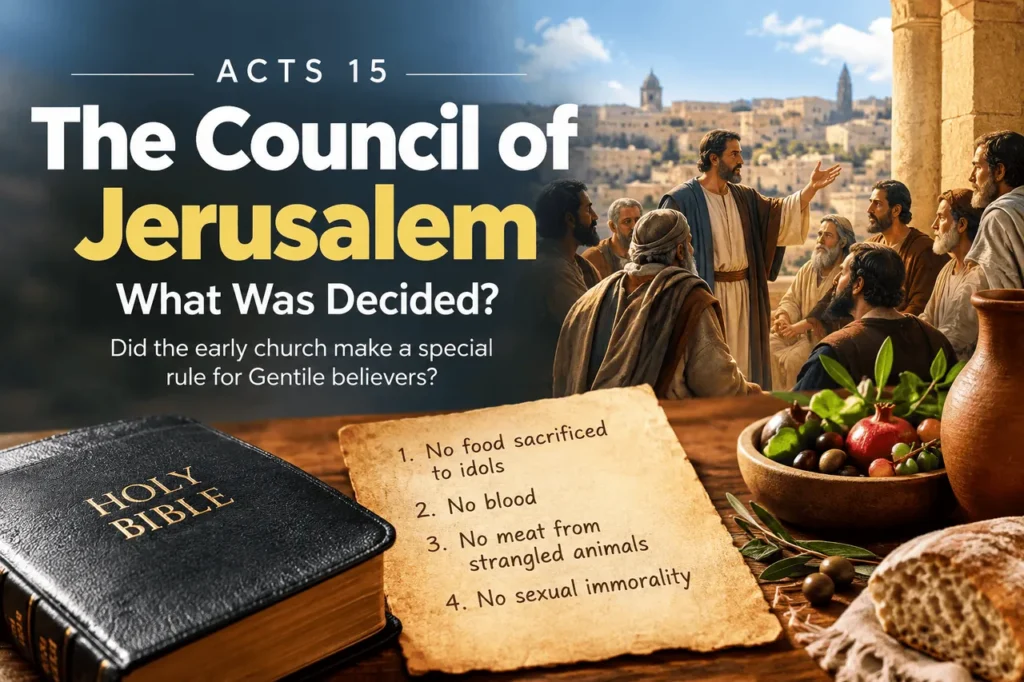
“Wherefore my sentence is, that we trouble not them, which from among the Gentiles are turned to God: But that we write unto them, that they abstain from pollutions of idols, and from fornication, and from things strangled, and from blood.”
— Acts 15:19-20 (KJV)
This was James’s own judgment. He noted that these laws had already been known to Jewish communities for generations (15:21). The apostles, elders, and the whole church then sent a letter to the Gentile believers in Antioch, Syria, and Cilicia saying this (15:22-23):
“For it seemed good to the Holy Ghost, and to us, to lay upon you no greater burden than these necessary things; That ye abstain from meats offered to idols, and from blood, and from things strangled, and from fornication: from which if ye keep yourselves, ye shall do well. Fare ye well.”
— Acts 15:28-29 (KJV)
That was the council’s decision: the full weight of the Law of Moses was not placed on Gentile believers. The last of these four items wasn’t a food rule, so these four shouldn’t be labeled “four food laws” — they’re four things Gentile believers were asked to abstain from.
Acts 15 doesn’t explain why these four specific items were chosen. Catholic Bible scholars such as Brant Pitre connect them to the laws in Leviticus 17-18: idolatry (17:7-9), blood (17:10-13), improperly slaughtered meat (17:15-16), and sexual immorality (18:6-30). That’s his interpretation — it isn’t stated in the text itself, and scholars disagree on how to read this connection.
A common question is, “If all foods are clean, why did blood and strangled meat remain on the list?” We saw in the first article that blood held a special place under the Old Testament law. It seems these items were singled out specifically because the congregation included both Jewish and Gentile believers worshiping together (that’s our reading). Many people say strangling an animal leaves the blood in the meat — but the text itself doesn’t say that. Scholars disagree on exactly why these two items were named separately, so it’s best not to guess beyond what’s written.
Paul’s teaching
In the Roman church, believers held different convictions about food and special days. Some believed they could eat anything; others ate only vegetables. Paul wrote to them:
“For one believeth that he may eat all things: another, who is weak, eateth herbs. Let not him that eateth despise him that eateth not; and let not him which eateth not judge him that eateth: for God hath received him.”
— Romans 14:2-3 (KJV)
Here’s Paul’s own answer to this debate:
“I know, and am persuaded by the Lord Jesus, that there is nothing unclean of itself: but to him that esteemeth any thing to be unclean, to him it is unclean.”
— Romans 14:14 (KJV)
He went on to say that one person’s convictions shouldn’t become an obstacle for another:
“But if thy brother be grieved with thy meat, now walkest thou not charitably. Destroy not him with thy meat, for whom Christ died.”
— Romans 14:15 (KJV)
He pushed this point a bit further:
“For meat destroy not the work of God. All things indeed are pure; but it is evil for that man who eateth with offence.”
— Romans 14:20 (KJV)
Paul told the church to welcome weaker believers rather than get drawn into disputes (14:1). Each person should be fully convinced in their own mind (14:5); no one’s convictions should cause a brother to stumble, and eating with doubt is itself sin for that person (14:23). So it’s not quite right to summarize this as just “Paul said all foods are clean” — three threads run through this chapter together: freedom regarding food, conscience, and love.
The church in Corinth had its own questions about food offered to idols. Paul told them not to take part in feasts held in idols’ temples (10:14-22). But about meat sold in the ordinary marketplace, he said:
“Whatsoever is sold in the shambles, that eat, asking no question for conscience sake.”
— 1 Corinthians 10:25 (KJV)
He also said not to eat it if someone specifically pointed out, “This was offered in sacrifice” (10:28). Writing to Timothy in Ephesus, he warned about false teachers who would forbid marriage and certain foods:
“Now the Spirit speaketh expressly, that in the latter times some shall depart from the faith, giving heed to seducing spirits, and doctrines of devils; Speaking lies in hypocrisy; having their conscience seared with a hot iron; Forbidding to marry, and commanding to abstain from meats, which God hath created to be received with thanksgiving of them which believe and know the truth. For every creature of God is good, and nothing to be refused, if it be received with thanksgiving: For it is sanctified by the word of God and prayer.”
— 1 Timothy 4:1-5 (KJV)
To the church at Colossae, after warning them not to let anyone take them captive through human tradition rather than through Christ (2:8), he wrote:
“Let no man therefore judge you in meat, or in drink, or in respect of an holyday, or of the new moon, or of the sabbath days: Which are a shadow of things to come; but the body is of Christ.”
— Colossians 2:16-17 (KJV)
Paul closed this whole discussion to the Corinthians this way:
“Whether therefore ye eat, or drink, or whatsoever ye do, do all to the glory of God.”
— 1 Corinthians 10:31 (KJV)
The very next verse adds that believers shouldn’t give offense to anyone, Jew or Gentile (10:32).
Putting it all together
A question naturally comes up here. Jesus said “what goes in from the outside doesn’t defile a person,” Paul said “nothing is unclean of itself,” and yet the Jerusalem council still told Gentile believers to avoid blood and strangled meat. That can look like a contradiction. But in our view, each of these passages needs to be read in its own setting. In Mark 7, Jesus is talking about the nature of defilement itself. In Acts 15, the church gave specific guidance to new Gentile believers. In Romans 14, Paul is dealing with food, special days, conscience, and love for a brother or sister. Most Christian traditions understand the Old Testament’s clean/unclean division as no longer binding on believers in the same way it once was. The apostles’ specific instructions in Acts 15 look, on their face, like a separate matter — and traditions differ on exactly how those instructions apply to Christians today.
What do today’s Christian traditions say?
Different traditions read these same verses differently. The disagreement really comes down to how Mark 7, Acts 10, Acts 15, and Romans 14 should be interpreted. What follows is how each tradition describes its own position; sources are listed at the end of the article.
Catholic
The Catholic Church treats the Old Testament food laws as ceremonial law, fulfilled in Christ. Practices like abstaining from meat during Lent exist in Catholic life, but that’s understood as a spiritual discipline, not an Old Testament requirement.
Orthodox
The Orthodox Church doesn’t keep the old food laws literally. During fasting periods it abstains from meat, eggs, dairy, and oil, with variations by region and jurisdiction. It also holds to an early church rule against eating blood.
Protestant
Most Protestant churches don’t regard these laws as binding today. They point to Mark 7:19, Acts 10:15, Romans 14:14 and 20, 1 Timothy 4:4, Colossians 2:16-17, and Galatians 5:1. This covers a wide range of denominations — Lutheran, Anglican, Baptist, Pentecostal, and more — and practice can vary between them.
Seventh-day Adventist
Adventists still follow the Leviticus 11 rules today; they don’t eat pork, rabbit, shrimp, or crab. Health and holiness are the reasons they cite. Their 22nd Fundamental Belief states that believers “are to abstain from unclean foods” identified in Scripture, citing Genesis 7:2, Leviticus 11:1-47, and 1 Corinthians 6:19-20 and 10:31.
Jehovah’s Witnesses
Jehovah’s Witnesses apply the instruction to “abstain from blood” (Acts 15:28-29; Leviticus 17:10-14) to medical decisions as well, teaching that blood represents life itself. Their position changed somewhat in 2026. According to news reports, in March storing and later transfusing one’s own blood during surgery became a matter of individual conscience. On September 18, accepting the four components of blood — red cells, white cells, plasma, and platelets — from another donor was also declared a matter of conscience. A ban on whole blood transfusion remains in place. Check their official website for the latest details.
Latter-day Saints (Mormon)
Under what’s called the “Word of Wisdom,” alcohol, tobacco, coffee, and tea are avoided; meat is to be eaten sparingly, with an emphasis on grains, fruits, and vegetables. This is understood as health guidance given by God.
Messianic Judaism and Hebrew Roots
Jews who believe Jesus is the Messiah often keep kosher practices as part of their Jewish identity, while acknowledging that Acts 15 says these shouldn’t be imposed on Gentile believers. Many groups within the broader Hebrew Roots movement, however, teach that Gentile Christians should also keep Torah food laws, the Sabbath, and the biblical feasts. Their argument is that God doesn’t change, and that Jesus didn’t abolish the Law but fulfilled it (Matthew 5:17-18; Malachi 3:6; Psalm 119:160). There’s real disagreement even among these groups.
Every tradition points to Scripture to support its position. We’re not telling you here which one is “right.” Each believer is called to work this out through their own study of Scripture, prayer, and the guidance of their church (Romans 14:5, 22-23).
A few common questions
Do the Old Testament food laws apply to Christians today? The answer depends on which tradition you ask. Most say no (Mark 7:15; Romans 14:14); groups like Seventh-day Adventists still keep them.
Did Jesus declare all foods clean in Mark 7:19? It depends on the translation. We walked through both readings above.
Did Peter eat something unclean right after his vision? The Bible doesn’t say that. He applied the vision to people, not food (Acts 10:28).
What does Acts 15 say about blood? It told Gentile believers to abstain from blood (15:28-29). How that applies today is something traditions interpret differently.
Conclusion
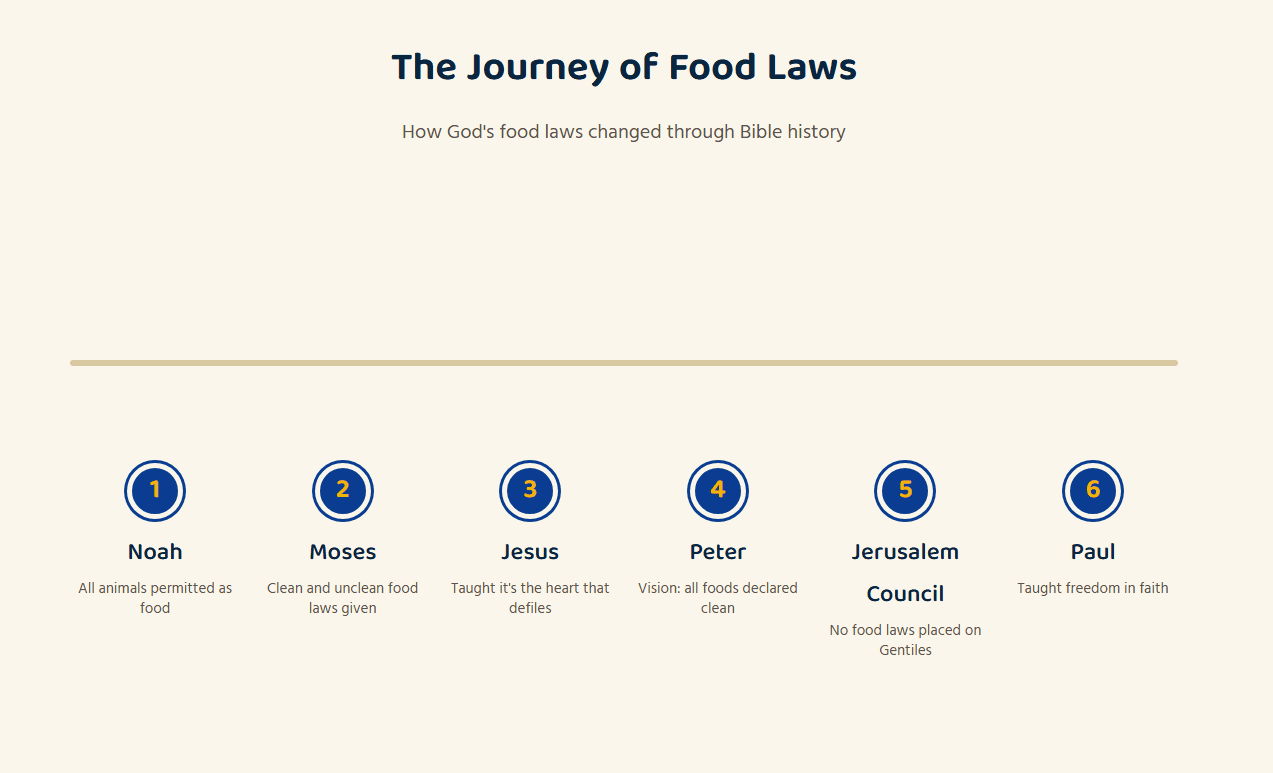
The New Testament doesn’t settle the food-law question in a single verse. Jesus spoke about the heart; Peter received a vision; the Jerusalem church gave Gentile believers four specific instructions; Paul wrote about conscience and love. What the Bible says is one thing; what you decide to do about it is another. This article has tried to lay the verses and the different traditions’ interpretations side by side. The final decision is yours.
Further reading
Click here to read more English articles: English Articles
Related articles:
- What Foods Were Forbidden in the Bible? Leviticus 11 Explained
- Six Days of Labor, One Day of Rest
- Tithing in the Bible: What Does the Bible Actually Say?
Sources for this article
- Catholic: Pope Eugene IV’s “Cantate Domino” (1442, Council of Florence) — portions state that the clean/unclean food distinction belonged to ceremonial law, that it has passed away, and that no food received by people is condemned. Council of Trent, Session 25 (1563), on “choice of foods, fasts, and feast days.” Catechism of the Catholic Church, paragraphs 1961-1964: the Old Law was a preparation for the Gospel, its moral commandments are contained in the Ten Commandments, and its “shadows and symbols” were fulfilled in Christ. The moral/ceremonial law distinction is associated with the teaching of Thomas Aquinas.
- Orthodox: “Fasting and Non-Fasting Days” guidance published by the Orthodox Church in America. The Quinisext Council (692 A.D.), Canon 56 (eggs and cheese on Lenten Saturdays and Sundays), Canon 67 (blood and strangled meat). The Orthodox Church accepts this council’s canons; the Western (Latin) church did not.
- Adventist: Fundamental Belief #22 (“Christian Behavior”) of their 28 Fundamental Beliefs; the book “Seventh-day Adventists Believe.”
- Jehovah’s Witnesses: International news reports on the March and September 2026 policy changes; their official website.
- Mormon: “Doctrine and Covenants” 89:5-17; the church’s official website (church leaders have taught that “hot drinks” in 89:9 refers to tea and coffee).
- Greek words: Strong’s, Thayer’s, and Bill Mounce’s Greek lexicons. A.T. Robertson’s “Word Pictures in the New Testament” on Mark 7:19. The claim that “koinos” links these passages comes from an article in the Adventist publication “Ministry Magazine.”
- Acts 15 background: A study paper by Catholic Bible scholar Brant Pitre connecting it to Leviticus 17-18.
Disclaimers
On language: We wrote this article in plain English, meant to be understandable even for readers who’ve never opened a Bible before. This is a fresh English treatment of the subject, written independently rather than translated word-for-word from any other version of this article.
On storytelling: There’s no invented story in this article. Events like Peter’s vision and the Jerusalem council are told as the Bible presents them, with nothing imagined added. Scholarly opinions and our own observations are clearly marked as such, not presented as the Bible’s own words.
On the verses: The Bible verses in this article are quoted from the King James Version (KJV), a public-domain English translation first published in 1611. Next to each verse, we’ve explained the situation it was spoken in, in plain words for readers who don’t already know the Bible. To fully understand any verse, read the whole chapter it comes from in your own Bible. This article is not a complete or final explanation, and it isn’t arguing for or against any particular tradition — treat it as a study aid only.