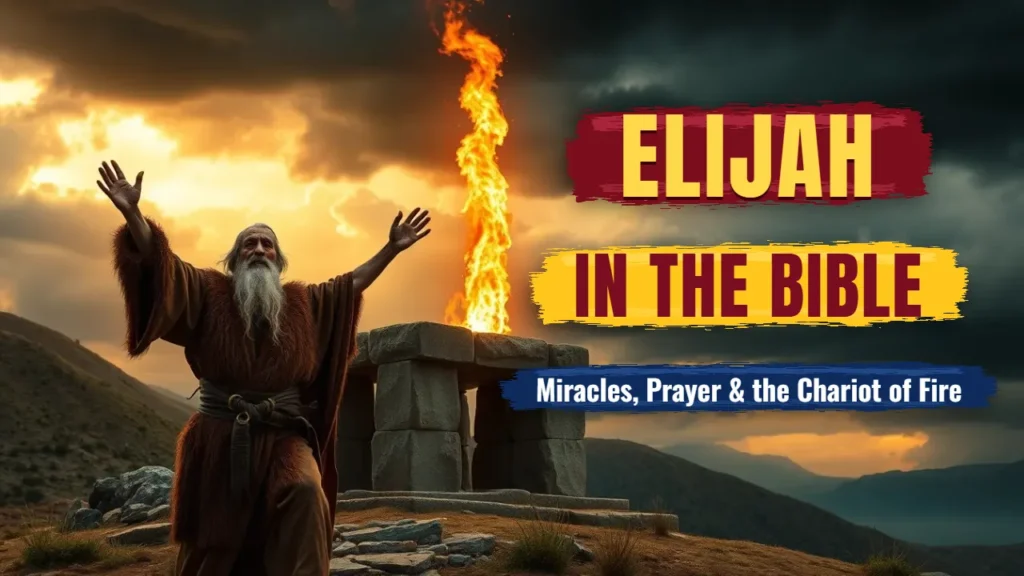
Introduction
Ask anyone who farmed the Great Plains in a dry year what it’s like to wait for rain. You check the sky every morning. You watch the wheat curl up and the stock pond shrink. A single cloud on the horizon is enough to get your hopes up, and when it drifts past without a drop, it’s hard not to take it personally.
Now picture a man walking into a royal palace, looking the king in the eye, and saying: there won’t be any rain in this country until I say so. And then picture the sky staying shut, not for a season, but for three and a half years. In the Bible, that man’s name is Elijah.
Elijah is one of the best-known prophets in the whole Bible. He prayed and the rain stopped; he prayed again and it came back. Fire fell from heaven on Mount Carmel. A dead boy came back to life after Elijah prayed over him. And in the end, he didn’t die at all. He was carried up to heaven in a whirlwind. But Elijah wasn’t a superhero. One threat from an angry queen sent him running for his life, and he sat down under a tree and asked God to let him die. The Bible’s own summary of him is surprisingly down-to-earth: “Elias was a man subject to like passions as we are.”
In this article we’ll walk through the life of Elijah from beginning to end, the way the Bible tells it. Who was Elijah in the Bible? What does his name mean? What happened on Mount Carmel? Why did he run away right after his biggest victory? How many miracles did Elijah do? Did Elijah die? And what does the New Testament say about him and John the Baptist? When we say “the Bible says,” we’ll show you the verse. When we share history or scholars’ opinions, we’ll tell you right there that they’re not Scripture.
Questions in this article:
- Who was Elijah in the Bible, and what does his name mean?
- When did Elijah live, and what was going on in Israel?
- Why did Elijah stop the rain?
- How did the ravens feed Elijah at the brook Cherith?
- Elijah and the widow of Zarephath: why didn’t the flour and oil run out?
- How did Elijah raise the widow’s son from the dead?
- Who was Obadiah, and how did Elijah face Ahab again?
- What happened on Mount Carmel?
- Why did Elijah pray seven times for rain?
- Why did Elijah run away and want to die after such a big victory?
- What happened at Mount Horeb? What is the “still small voice”?
- How did Elijah call Elisha?
- What did Elijah tell Ahab about Naboth’s vineyard?
- Fire from heaven: what happened to King Ahaziah’s soldiers?
- Did Elijah die? How was he taken up in a whirlwind?
- How many miracles did Elijah do, and what were they?
- Why was Elijah’s prayer so powerful?
- What does the New Testament say about Elijah? Was John the Baptist Elijah?
- What does Elijah’s life teach us?
A quick note on spelling: in the New Testament, the King James Version follows the Greek form of the name and calls Elijah “Elias.” Elias and Elijah are the same man. Don’t mix him up with Elisha, though. Elisha was Elijah’s apprentice and a different prophet, even if the names sound almost alike.
Who Was Elijah in the Bible, and What Does His Name Mean?
Elijah was a prophet in Old Testament times who carried God’s message to the people and the kings of the northern kingdom of Israel. His story runs from 1 Kings 17 to 2 Kings 2. What’s striking is how little the Bible tells us about his background. There’s no list of his parents, nothing about his childhood, and no account of how he became a prophet. He simply walks onto the stage in one sentence:
“And Elijah the Tishbite, who was of the inhabitants of Gilead, said unto Ahab, As the LORD God of Israel liveth, before whom I stand, there shall not be dew nor rain these years, but according to my word.”
— 1 Kings 17:1 (KJV)
This one verse tells us three things about Elijah. First, he was a “Tishbite,” meaning he came from a place called Tishbe. Second, he was from Gilead, the rugged hill country east of the Jordan River, a long way from the capital city of Samaria. In other words, Elijah wasn’t a palace insider or a member of some powerful family. He was a man from the backcountry. Third, notice how he describes himself: he serves the God “before whom I stand.” He’s standing in front of a king, but he makes it clear he answers to a higher authority.
(Historical note, not in the Bible:) Nobody knows for certain where Tishbe was. The Bible says it was in Gilead, and historians have suggested a few possible locations, but none of them has been proven.
What does the name Elijah mean?
(Language note, not a Bible verse:) In Hebrew, Elijah’s name is Eliyahu. “Eli” means “my God,” and “yahu” is a short form of God’s personal name, Yahweh (the LORD). So Bible dictionaries explain that the name Elijah means “My God is the LORD” or “The LORD is my God.” That name fits his life perfectly. In his day, the people of Israel were wavering between Baal and the LORD, and Elijah’s whole ministry boiled down to one message: the LORD is God. As we’ll see, that’s exactly what the crowd ended up shouting on Mount Carmel.
What did Elijah look like?
The Bible describes his appearance in only one place. Many years later, a stranger stopped King Ahaziah’s messengers on the road and gave them a message from God. When the king asked what the man looked like, they said:
“And they answered him, He was an hairy man, and girt with a girdle of leather about his loins. And he said, It is Elijah the Tishbite.”
— 2 Kings 1:8 (KJV)
The messengers didn’t even know his name. All they described was a hairy man (many translations understand this as a man wearing a rough garment of hair) with a leather belt around his waist. That was enough. The king knew immediately who it was. Elijah was famous for dressing like a plain, rough country man, in a world where the royal court wore fine clothes. (In the New Testament, John the Baptist dressed almost the same way, in camel’s hair with a leather belt, according to Matthew 3:4. We’ll see why that matters near the end of this article.)
Did Elijah have a wife or children? How old was he, and how long did he serve?
The Bible doesn’t say. It never names Elijah’s parents, a wife, or children, and it never gives his age or the length of his ministry. Any numbers you find online are guesses. Here’s what we can say from the Bible: Elijah’s ministry began during the reign of King Ahab and continued until after the death of Ahab’s son Ahaziah (1 Kings 17:1; 2 Kings 1:17; 2:1). Ahab reigned twenty-two years, and Ahaziah reigned two (1 Kings 16:29; 22:51). But since the Bible doesn’t tell us which year of Ahab’s reign Elijah first appeared, there’s no way to calculate an exact figure. (Tradition, not in the Bible:) Some later Christian traditions say Elijah came from Aaron’s family, the priestly line. The Bible says nothing of the kind.
When Did Elijah Live, and What Was Going On in Israel?
To understand Elijah, you have to understand his times. After King Solomon died, the kingdom of Israel split in two. In the south was the kingdom of Judah, with Jerusalem as its capital. In the north were ten tribes, still called Israel. We told the story of how that split happened in our articles on King Solomon in the Bible and the 12 tribes of Israel. The northern kingdom’s first king, Jeroboam, set up golden calves at Bethel and Dan so his people wouldn’t travel to the temple in Jerusalem. The kings who followed him went from bad to worse. Then Ahab, the son of Omri, took the throne:
“And in the thirty and eighth year of Asa king of Judah began Ahab the son of Omri to reign over Israel: and Ahab the son of Omri reigned over Israel in Samaria twenty and two years. And Ahab the son of Omri did evil in the sight of the LORD above all that were before him.”
— 1 Kings 16:29-30 (KJV)
That’s a heavy verdict. The kings before Ahab had already set up idols, but the Bible says Ahab was worse than all of them. He didn’t just tolerate false worship. He replaced the LORD, the God of Israel, with a different god as the official religion of the country. The next verses show how:
“And it came to pass, as if it had been a light thing for him to walk in the sins of Jeroboam the son of Nebat, that he took to wife Jezebel the daughter of Ethbaal king of the Zidonians, and went and served Baal, and worshipped him. And he reared up an altar for Baal in the house of Baal, which he had built in Samaria. And Ahab made a grove; and Ahab did more to provoke the LORD God of Israel to anger than all the kings of Israel that were before him.”
— 1 Kings 16:31-33 (KJV)
Here a major character enters the story: Jezebel. She was the daughter of the king of the Zidonians (Sidon was on the coast north of Israel). Even her father’s name, Ethbaal, has “Baal” built into it. (Historical note:) The Bible uses “Zidonians” for the coastal Phoenician peoples in general, and historians identify Ethbaal with Ithobaal I, a king of the city of Tyre. Jezebel brought the worship of her homeland’s god, Baal, with her, and Ahab built a temple for Baal right in his capital, Samaria. The “grove” mentioned here was a sacred pole or image connected with the goddess Asherah. So Baal worship was no longer something done quietly in the villages. It was now the state religion, backed by the king himself. And Jezebel didn’t stop there. She hunted down and killed the LORD’s prophets (1 Kings 18:4). If you want to know what Baal worship actually involved and why God opposed it so strongly, see our article on Baal worship in the Bible.
(Historical note, not in the Bible:) Historians date Ahab’s reign to the ninth century BC, roughly 870 to 850 BC, though scholars differ a little on the exact years. Ahab’s name also shows up outside the Bible. The Kurkh Monolith, a stone inscription set up by the Assyrian king Shalmaneser III, says that “Ahab the Israelite” sent 2,000 chariots and 10,000 soldiers to the Battle of Qarqar in 853 BC. Some scholars think that chariot number was exaggerated or miscopied. (The monolith is in the British Museum in London today.) Either way, it shows that Ahab was a real and powerful king.
So picture the scene. A strong king, an even stronger queen, Baal worship everywhere, and the LORD’s prophets hiding in caves. Into that world walks a plain man from Gilead. That man is Elijah.
Why Did Elijah Stop the Rain?
We’ve already read Elijah’s first words to Ahab: there would be no dew or rain “but according to my word” (1 Kings 17:1). This wasn’t a curse Elijah came up with because he was angry. Centuries earlier, God had warned Israel through Moses:
“Take heed to yourselves, that your heart be not deceived, and ye turn aside, and serve other gods, and worship them; And then the LORD’S wrath be kindled against you, and he shut up the heaven, that there be no rain, and that the land yield not her fruit; and lest ye perish quickly from off the good land which the LORD giveth you.”
— Deuteronomy 11:16-17 (KJV)
Moses said this before Israel ever entered the Promised Land. Unlike Egypt, which had the Nile, Canaan depended completely on rain falling from the sky. God told them ahead of time: if you turn to other gods, the sky will close up. What Elijah did was announce to the king that this old warning was about to come true. The New Testament letter of James adds an important detail: Elijah “prayed earnestly that it might not rain” (James 5:17, which we’ll read in full later). In other words, before Elijah ever stood in front of the king, he had already been on his knees before God.
Why was a drought a challenge to Baal?
(Historical note, not in the Bible:) According to ancient texts from the region, the Canaanites and Phoenicians worshipped Baal as the god of rain, thunder, storms, and harvest. Images of Baal often show him holding a lightning bolt. So when Elijah said there would be no rain, it was a direct challenge to Baal’s followers: if Baal is really the rain god, let him make it rain. More than three years without rain showed the whole nation that Baal couldn’t send rain, and that the LORD alone controls it. (The Bible doesn’t spell out this contrast in so many words. It’s an explanation scholars give based on the historical background.)
How Did the Ravens Feed Elijah at the Brook Cherith?
After saying something like that to a king’s face, Elijah’s life was in danger. So God told him:
“Get thee hence, and turn thee eastward, and hide thyself by the brook Cherith, that is before Jordan. And it shall be, that thou shalt drink of the brook; and I have commanded the ravens to feed thee there.”
— 1 Kings 17:3-4 (KJV)
God didn’t send Elijah straight on to some bigger assignment. First He said: hide. Later we learn that Ahab searched every nation and kingdom looking for him (1 Kings 18:10). Meanwhile God tucked Elijah away beside a small brook where nobody thought to look. But how would he eat out there? God’s answer is startling: ravens.
“So he went and did according unto the word of the LORD: for he went and dwelt by the brook Cherith, that is before Jordan. And the ravens brought him bread and flesh in the morning, and bread and flesh in the evening; and he drank of the brook.”
— 1 Kings 17:5-6 (KJV)
Ravens are birds that take food, not birds that bring it. In the Law of Moses they’re even on the list of unclean birds (Leviticus 11:15). Yet God used them to bring His prophet breakfast and supper every single day. Elijah’s part was simple: go where God told him and stay there. The Bible specifically says he “did according unto the word of the LORD.” Trusting God sometimes means going where He says before you can see where the next meal is coming from.
But after a while, even the brook gave out:
“And it came to pass after a while, that the brook dried up, because there had been no rain in the land.”
— 1 Kings 17:7 (KJV)
This little verse is refreshingly honest. The drought Elijah announced hit Elijah too. Being God’s servant didn’t mean his brook stayed full. He watched the water drop day after day and stayed put anyway. Only when the brook was completely dry did God give him his next instruction. If you’re watching your own “brook” dry up, one support after another, we’ve written about that in What Does God Say When You Reach a Dead End in Life?
Elijah and the Widow of Zarephath: Why Didn’t the Flour and Oil Run Out?
When the brook dried up, God sent Elijah somewhere no one would have expected:
“And the word of the LORD came unto him, saying, Arise, get thee to Zarephath, which belongeth to Zidon, and dwell there: behold, I have commanded a widow woman there to sustain thee.”
— 1 Kings 17:8-9 (KJV)
Zarephath was a town in Sidon, Jezebel’s home country and a center of Baal worship. God sent His prophet right into enemy territory. And the person who would take care of him wasn’t a wealthy patron. It was a poor widow. In that culture, a widow was about as vulnerable as a person could be, and God says, “I have commanded a widow woman there to sustain thee.”
“So he arose and went to Zarephath. And when he came to the gate of the city, behold, the widow woman was there gathering of sticks: and he called to her, and said, Fetch me, I pray thee, a little water in a vessel, that I may drink. And as she was going to fetch it, he called to her, and said, Bring me, I pray thee, a morsel of bread in thine hand.”
— 1 Kings 17:10-11 (KJV)
Elijah had walked a long way. At the town gate he found a woman picking up sticks and asked her for a drink. In a drought, even water is precious, but she went to get it. Then he asked for bread too. Her answer shows just how bad the famine had become:
“And she said, As the LORD thy God liveth, I have not a cake, but an handful of meal in a barrel, and a little oil in a cruse: and, behold, I am gathering two sticks, that I may go in and dress it for me and my son, that we may eat it, and die.”
— 1 Kings 17:12 (KJV)
Her words are heartbreaking. She had one handful of flour and a little oil left. She was gathering sticks to cook a last meal for herself and her son, and after that, she expected them both to starve. Notice that she says “the LORD thy God.” She wasn’t an Israelite, but she seems to have recognized Elijah as a prophet of Israel’s God, maybe from the way he dressed.
“And Elijah said unto her, Fear not; go and do as thou hast said: but make me thereof a little cake first, and bring it unto me, and after make for thee and for thy son. For thus saith the LORD God of Israel, The barrel of meal shall not waste, neither shall the cruse of oil fail, until the day that the LORD sendeth rain upon the earth.”
— 1 Kings 17:13-14 (KJV)
At first, Elijah’s request sounds selfish: use your last bit of flour to make me something first. But look at the order of his words. He starts with “Fear not,” and then he gives her God’s promise. The real test wasn’t about Elijah’s hunger. It was whether she would trust God’s word enough to take the first step. Handing her last handful of flour to a foreign prophet meant putting her life, and her son’s, on that promise.
“And she went and did according to the saying of Elijah: and she, and he, and her house, did eat many days. And the barrel of meal wasted not, neither did the cruse of oil fail, according to the word of the LORD, which he spake by Elijah.”
— 1 Kings 17:15-16 (KJV)
She trusted, and she gave. Her barrel didn’t suddenly overflow, and a pantry full of groceries didn’t appear. Instead, there was enough “many days.” Every morning she reached into the barrel, and there was enough flour for that day. God provided for that household one day at a time until the drought ended.
Nearly nine hundred years later, Jesus brought up this very story in the synagogue in Nazareth:
“But I tell you of a truth, many widows were in Israel in the days of Elias, when the heaven was shut up three years and six months, when great famine was throughout all the land; But unto none of them was Elias sent, save unto Sarepta, a city of Sidon, unto a woman that was a widow.”
— Luke 4:25-26 (KJV)
Jesus was teaching in His hometown, and the people there could only see Him as “Joseph’s son,” a local boy. So Jesus gave this example: Israel was full of widows, but God sent Elijah to a foreign widow. God’s grace isn’t limited to one nation or one group of people. He finds those who trust Him wherever they are. (The people of Nazareth were so furious at this that they tried to throw Jesus off a cliff, according to Luke 4:28-29.)
How Did Elijah Raise the Widow’s Son from the Dead?
After the miracle of the flour and oil, you’d expect a happy ending. Instead, an even greater sorrow came to that home:
“And it came to pass after these things, that the son of the woman, the mistress of the house, fell sick; and his sickness was so sore, that there was no breath left in him. And she said unto Elijah, What have I to do with thee, O thou man of God? art thou come unto me to call my sin to remembrance, and to slay my son?”
— 1 Kings 17:17-18 (KJV)
The son God had saved from starvation now died of an illness. In her grief, the mother turned on Elijah. She assumed God was punishing her for some past sin, and that Elijah’s presence had reminded God of it. That fear is as human as it gets: when something terrible happens, we wonder if we’re being punished. Elijah didn’t argue with her or correct her:
“And he said unto her, Give me thy son. And he took him out of her bosom, and carried him up into a loft, where he abode, and laid him upon his own bed. And he cried unto the LORD, and said, O LORD my God, hast thou also brought evil upon the widow with whom I sojourn, by slaying her son?”
— 1 Kings 17:19-20 (KJV)
Elijah took the boy from his mother’s arms and carried him to the upstairs room where he was staying. There, he was brutally honest with God. He asked God straight out why this had happened. Elijah’s prayer shows us that we don’t have to hide our pain or our questions when we pray.
“And he stretched himself upon the child three times, and cried unto the LORD, and said, O LORD my God, I pray thee, let this child’s soul come into him again. And the LORD heard the voice of Elijah; and the soul of the child came into him again, and he revived.”
— 1 Kings 17:21-22 (KJV)
This is the first time in the Bible that a dead person comes back to life. Elijah stretched himself over the boy and prayed, not once but three times. And the Bible is careful about who did what: it wasn’t Elijah’s power that raised the boy. “The LORD heard the voice of Elijah.” God gives life. The prophet only prayed.
“And Elijah took the child, and brought him down out of the chamber into the house, and delivered him unto his mother: and Elijah said, See, thy son liveth. And the woman said to Elijah, Now by this I know that thou art a man of God, and that the word of the LORD in thy mouth is truth.”
— 1 Kings 17:23-24 (KJV)
The mother’s last words are important. Even after watching the flour and oil last day after day, she still had doubts. But on the day her son came back to life, she said, “Now by this I know.” A widow born in Baal’s own country confessed that Israel’s God is the true God. It would take Israel itself a while longer to say the same thing, and when they did, it was on Mount Carmel.
Why does Jesus’ miracle at Nain remind us of Elijah?
Nearly nine hundred years later, Jesus also raised the only son of a widow. Luke tells it this way:
“Now when he came nigh to the gate of the city, behold, there was a dead man carried out, the only son of his mother, and she was a widow: and much people of the city was with her. And when the Lord saw her, he had compassion on her, and said unto her, Weep not. And he came and touched the bier: and they that bare him stood still. And he said, Young man, I say unto thee, Arise. And he that was dead sat up, and began to speak. And he delivered him to his mother. And there came a fear on all: and they glorified God, saying, That a great prophet is risen up among us; and, That God hath visited his people.”
— Luke 7:12-16 (KJV)
Jesus was arriving at a town in Galilee called Nain when He met a funeral procession at the town gate. The dead man was the only son of a widow. In those days, a woman with no husband and no son could be left with no way to survive. Jesus felt compassion for her, touched the coffin, and said, “Young man, I say unto thee, Arise.” Look at the echoes of Elijah’s story: a widow, an only son, a meeting at the town gate (1 Kings 17:10), and a son handed back to his mother (1 Kings 17:23). The crowd said, “A great prophet is risen up among us.”
(What many commentators say:) Many commentators believe Luke is pointing to this parallel on purpose. They also point out a difference: Elijah stretched himself over the boy three times and cried out to God, while Jesus raised the dead man with a single word. Their reading is that Luke is showing Jesus to be not just a prophet like Elijah, but greater than Elijah. Some people in those days even thought Jesus was Elijah come back (Matthew 16:14; Luke 9:8).
Who Was Obadiah, and How Did Elijah Face Ahab Again?
The drought dragged on. Then, after a long time, God spoke to Elijah again:
“And it came to pass after many days, that the word of the LORD came to Elijah in the third year, saying, Go, shew thyself unto Ahab; and I will send rain upon the earth. And Elijah went to shew himself unto Ahab. And there was a sore famine in Samaria.”
— 1 Kings 18:1-2 (KJV)
The first time, God said “hide thyself.” Now He says “shew thyself.” Elijah had to walk straight up to the king who’d been searching the world for him. When God’s timing comes, the season of hiding ends and the season of standing up begins.
“The third year” or “three and a half years”? How do they fit together?
A lot of readers notice this. This verse says “in the third year,” but both Jesus (Luke 4:25) and James (James 5:17) say it didn’t rain for “three years and six months.” (This is how scholars explain it; the Bible doesn’t say directly:) One explanation is that “the third year” is counted from the time Elijah went to Zarephath, not including the time he spent by the brook Cherith before that. Another is that the region already had a dry season of several months every year, and Elijah’s announcement came at the end of it, so the total time without rain added up to three and a half years. Either way, there’s no real contradiction. One phrase marks when God spoke; the other measures the whole time without rain.
Obadiah: a believer hiding inside the palace
Around this time, Ahab called in Obadiah, the man in charge of his palace. The Bible tells us something special about him:
“And Ahab called Obadiah, which was the governor of his house. (Now Obadiah feared the LORD greatly: For it was so, when Jezebel cut off the prophets of the LORD, that Obadiah took an hundred prophets, and hid them by fifty in a cave, and fed them with bread and water.)”
— 1 Kings 18:3-4 (KJV)
This Obadiah isn’t the prophet who wrote the Book of Obadiah. He’s a different man with the same name. He was a top official in Ahab’s palace, the same palace where Jezebel was having the LORD’s prophets killed. Right under her nose, Obadiah secretly hid a hundred prophets in two caves and kept them alive with bread and water during the famine. Think about the risk. If he’d been caught, he would have been executed. Not all of God’s people stand up in public like Elijah. Some, like Obadiah, quietly and bravely do God’s work right where they are.
As the famine got worse, Ahab and Obadiah split up to search the country for grass to keep the king’s horses and mules alive (1 Kings 18:5-6). People were starving, and the king was worried about his animals. On the road, Obadiah suddenly met Elijah:
“And as Obadiah was in the way, behold, Elijah met him: and he knew him, and fell on his face, and said, Art thou that my lord Elijah? And he answered him, I am: go, tell thy lord, Behold, Elijah is here.”
— 1 Kings 18:7-8 (KJV)
Nobody had seen Elijah in three years, and now here he was, standing in the road. Obadiah was stunned. And when Elijah said “go, tell thy lord,” Obadiah panicked. He was afraid that while he went to get Ahab, the Spirit of the LORD would carry Elijah off somewhere, and Ahab would kill him for it (1 Kings 18:9-14). Elijah gave him his word with an oath:
“And Elijah said, As the LORD of hosts liveth, before whom I stand, I will surely shew myself unto him to day.”
— 1 Kings 18:15 (KJV)
There’s that phrase again: “before whom I stand.” It comes up over and over in Elijah’s story. He always knew whose presence he was standing in, and who he answered to.
“Art thou he that troubleth Israel?”
“And it came to pass, when Ahab saw Elijah, that Ahab said unto him, Art thou he that troubleth Israel? And he answered, I have not troubled Israel; but thou, and thy father’s house, in that ye have forsaken the commandments of the LORD, and thou hast followed Baalim.”
— 1 Kings 18:17-18 (KJV)
After three years, the king and the prophet finally came face to face. Ahab’s very first words were an accusation: this drought is your fault. The guilty party blaming the one who points out the guilt is as old as the human race. Elijah didn’t flinch. He told the king to his face that the drought wasn’t Elijah’s doing. It came because the king had abandoned God’s commands and followed the Baals. We’ve written about this habit of putting our own faults on someone else in It’s My Fault, So Why Do I Keep Blaming Everyone Else?
What Happened on Mount Carmel?
This is the best-known event in Elijah’s life. Elijah threw down a challenge to Ahab:
“Now therefore send, and gather to me all Israel unto mount Carmel, and the prophets of Baal four hundred and fifty, and the prophets of the groves four hundred, which eat at Jezebel’s table. So Ahab sent unto all the children of Israel, and gathered the prophets together unto mount Carmel.”
— 1 Kings 18:19-20 (KJV)
On one side: 450 prophets of Baal and 400 prophets of Asherah (the “groves”), all of them eating at Queen Jezebel’s table. In other words, they were state-sponsored religious officials. On the other side: Elijah, alone. And the whole nation was there to watch. (Historical note, not in the Bible:) Mount Carmel is a ridge of hills in modern-day Israel that runs down to the Mediterranean coast, near today’s city of Haifa. The Bible doesn’t say exactly where on that ridge the contest took place. (Tradition, not proven:) Tradition points to a spot called El-Muhraqa, which means “the place of burning.” A small Carmelite monastery stands there today.
“How long halt ye between two opinions?”
“And Elijah came unto all the people, and said, How long halt ye between two opinions? if the LORD be God, follow him: but if Baal, then follow him. And the people answered him not a word.”
— 1 Kings 18:21 (KJV)
Elijah’s first words weren’t to the prophets of Baal. They were to the people. Israel hadn’t completely abandoned the LORD, but they weren’t fully committed to Him either. To “halt” here means to limp or hobble, like someone trying to walk with one foot on each side of a fence. Maybe they thought, “We’ll go to Baal for rain and to the LORD for everything else.” Elijah told them to make up their minds. And the people didn’t say a word. Their silence said it all.
Elijah’s test
“Then said Elijah unto the people, I, even I only, remain a prophet of the LORD; but Baal’s prophets are four hundred and fifty men. Let them therefore give us two bullocks; and let them choose one bullock for themselves, and cut it in pieces, and lay it on wood, and put no fire under: and I will dress the other bullock, and lay it on wood, and put no fire under: And call ye on the name of your gods, and I will call on the name of the LORD: and the God that answereth by fire, let him be God. And all the people answered and said, It is well spoken.”
— 1 Kings 18:22-24 (KJV)
The test was simple. Two altars, two bulls, and nobody lights a fire. Whichever god sends fire from heaven is the real God. Remember, Baal’s followers believed he was the god of thunder and lightning. Elijah was challenging Baal on his home turf. The people agreed the test was fair: “It is well spoken.”
The prophets of Baal, from morning until evening
Elijah let the prophets of Baal go first, since there were so many of them. They prepared their bull and called out from morning until noon, “O Baal, hear us,” and danced around their altar (1 Kings 18:25-26). Nothing happened. Then Elijah started mocking them:
“And it came to pass at noon, that Elijah mocked them, and said, Cry aloud: for he is a god; either he is talking, or he is pursuing, or he is in a journey, or peradventure he sleepeth, and must be awaked. And they cried aloud, and cut themselves after their manner with knives and lancets, till the blood gushed out upon them. And it came to pass, when midday was past, and they prophesied until the time of the offering of the evening sacrifice, that there was neither voice, nor any to answer, nor any that regarded.”
— 1 Kings 18:27-29 (KJV)
Elijah’s sarcasm is sharp: maybe your god is busy, maybe he’s out of town, maybe he’s taking a nap, so shout louder. He wanted the people to see with their own eyes that a god made by human hands can’t hear and can’t answer. The prophets of Baal slashed themselves with knives until the blood flowed, hoping their pain would move their god to act. The Bible says it three ways: “neither voice, nor any to answer, nor any that regarded.” They shouted from morning until evening, and nothing happened.
Elijah rebuilds the altar with twelve stones
“And Elijah said unto all the people, Come near unto me. And all the people came near unto him. And he repaired the altar of the LORD that was broken down. And Elijah took twelve stones, according to the number of the tribes of the sons of Jacob, unto whom the word of the LORD came, saying, Israel shall be thy name: And with the stones he built an altar in the name of the LORD.”
— 1 Kings 18:30-32 (KJV)
There had once been an altar to the LORD on Carmel, but it was lying in ruins. That broken-down altar said everything about how far the people had drifted from God. Elijah called the people close and rebuilt it right in front of them. He used twelve stones, one for each of the twelve tribes descended from Jacob’s twelve sons. At that point the nation was split, and the northern kingdom had only ten of the tribes. But Elijah used twelve stones anyway. Politics had divided them, but in God’s eyes they were still one people.
Why did Elijah pour water on the altar?
“And he made a trench about the altar, as great as would contain two measures of seed. And he put the wood in order, and cut the bullock in pieces, and laid him on the wood, and said, Fill four barrels with water, and pour it on the burnt sacrifice, and on the wood. And he said, Do it the second time. And they did it the second time. And he said, Do it the third time. And they did it the third time. And the water ran round about the altar; and he filled the trench also with water.”
— 1 Kings 18:32-35 (KJV)
After three years of drought, water was worth more than gold. And Elijah had twelve big jars of it dumped on the altar, four jars, three times. The wood was soaked and the trench around the altar was full. Why? So nobody could say Elijah had slipped a match in somewhere. Wet wood doesn’t catch fire on its own. If fire came now, it had to come from God. Elijah made the test harder for himself, because his confidence wasn’t in himself. It was in God.
Elijah’s short prayer, and fire from heaven
“And it came to pass at the time of the offering of the evening sacrifice, that Elijah the prophet came near, and said, LORD God of Abraham, Isaac, and of Israel, let it be known this day that thou art God in Israel, and that I am thy servant, and that I have done all these things at thy word. Hear me, O LORD, hear me, that this people may know that thou art the LORD God, and that thou hast turned their heart back again.”
— 1 Kings 18:36-37 (KJV)
The prophets of Baal had shouted, danced, and cut themselves all day long. Elijah’s prayer takes up two verses. No shouting, no dancing, no blood. He called on the “LORD God of Abraham, Isaac, and of Israel,” reminding the people of the God who had made promises to their ancestors. He didn’t ask to look impressive. He asked that the people would know the LORD is God and that their hearts would turn back to Him. The goal of his prayer wasn’t fire. It was the people’s hearts. Keep that phrase in mind, “thou hast turned their heart back again.” Centuries later, the prophet Malachi would say that Elijah would come again to turn hearts (Malachi 4:6). We’ll get to that near the end.
“Then the fire of the LORD fell, and consumed the burnt sacrifice, and the wood, and the stones, and the dust, and licked up the water that was in the trench. And when all the people saw it, they fell on their faces: and they said, The LORD, he is the God; the LORD, he is the God.”
— 1 Kings 18:38-39 (KJV)
The fire didn’t just burn the sacrifice. It burned up the soaked wood, the stones, the dirt, and even the water in the trench. No human being could have lit a fire like that. The same crowd that hadn’t said a word that morning now fell on their faces and shouted, “The LORD, he is the God!” Remember what Elijah’s name means: “My God is the LORD.” That day, all Israel shouted his name as their confession of faith.
What happened to the prophets of Baal?
“And Elijah said unto them, Take the prophets of Baal; let not one of them escape. And they took them: and Elijah brought them down to the brook Kishon, and slew them there.”
— 1 Kings 18:40 (KJV)
This verse bothers a lot of readers, and it needs to be read in its own setting. Israel at that time was a nation governed by the Law of Moses, and under that law, a prophet who led people to worship other gods was to be put to death (Deuteronomy 13:1-5). These prophets of Baal, backed by the queen, had spread idol worship across the land and stood with Jezebel while she killed the LORD’s prophets. What Elijah did was carry out the sentence that the nation’s own law required. It is not permission for anyone today to use violence against people of another faith. In the New Testament, when two of Jesus’ disciples wanted to call fire down from heaven on a village, Jesus rebuked them (Luke 9:54-55, which we’ll look at later). The fight Jesus’ followers are called to isn’t fought with swords.
Why Did Elijah Pray Seven Times for Rain?
The fire had fallen and the people had turned back to God. Now it was time for the rain God had promised.
“And Elijah said unto Ahab, Get thee up, eat and drink; for there is a sound of abundance of rain. So Ahab went up to eat and to drink. And Elijah went up to the top of Carmel; and he cast himself down upon the earth, and put his face between his knees.”
— 1 Kings 18:41-42 (KJV)
There wasn’t a cloud in the sky, but Elijah said, “there is a sound of abundance of rain.” That sound wasn’t something his ears could hear. His faith heard it, because God had promised, “I will send rain upon the earth” (1 Kings 18:1). Ahab went off to eat and drink. Elijah went up the mountain to pray. He bent down to the ground and put his face between his knees. A few hours earlier, this man had prayed down fire from heaven. Now he was crouched on the dirt, praying humbly.
“And said to his servant, Go up now, look toward the sea. And he went up, and looked, and said, There is nothing. And he said, Go again seven times. And it came to pass at the seventh time, that he said, Behold, there ariseth a little cloud out of the sea, like a man’s hand. And he said, Go up, say unto Ahab, Prepare thy chariot, and get thee down, that the rain stop thee not.”
— 1 Kings 18:43-44 (KJV)
While he prayed, Elijah sent his servant to look out over the sea. The first time: “There is nothing.” The second time, the third time, all the way to the sixth: nothing. Elijah kept praying. God had already promised rain, but Elijah kept at it until the promise came true. On the seventh trip, the servant saw a tiny cloud rising from the sea, about the size of a man’s hand. Most people would have said, “What good is a cloud that small?” Elijah saw it and sent word to Ahab to get his chariot moving before the rain trapped him. If you’ve been praying a long time without an answer, you might find encouragement in I’ve Asked God for Nine Years and Still No Answer.
“And it came to pass in the mean while, that the heaven was black with clouds and wind, and there was a great rain. And Ahab rode, and went to Jezreel. And the hand of the LORD was on Elijah; and he girded up his loins, and ran before Ahab to the entrance of Jezreel.”
— 1 Kings 18:45-46 (KJV)
Before long the sky turned black, and after three and a half years, a downpour finally came. Ahab rode his chariot to the city of Jezreel. With God’s power on him, Elijah tucked up his long robe and outran the king’s chariot all the way there. (Historical note:) The distance from Carmel to Jezreel is estimated at roughly 15 to 18 miles, measured from the traditional site on Carmel. The Bible doesn’t give the distance. That day was the high point of Elijah’s life. But what happened next is a shock.
Why Did Elijah Run Away and Want to Die After Such a Big Victory?
“And Ahab told Jezebel all that Elijah had done, and withal how he had slain all the prophets with the sword. Then Jezebel sent a messenger unto Elijah, saying, So let the gods do to me, and more also, if I make not thy life as the life of one of them by to morrow about this time.”
— 1 Kings 19:1-2 (KJV)
Jezebel heard that fire had fallen from heaven and that the rain had come back, and she didn’t change her mind one bit. Instead of turning to God, she swore to kill Elijah. She sent a messenger with a clear threat: by this time tomorrow, you’ll be as dead as my prophets.
“And when he saw that, he arose, and went for his life, and came to Beer-sheba, which belongeth to Judah, and left his servant there. But he himself went a day’s journey into the wilderness, and came and sat down under a juniper tree: and he requested for himself that he might die; and said, It is enough; now, O LORD, take away my life; for I am not better than my fathers.”
— 1 Kings 19:3-4 (KJV)
This is one of the most human scenes in the whole Bible. The man who stood alone against 850 false prophets ran from one message from a queen. He fled out of Israel altogether, all the way to Beersheba at the far southern edge of Judah. He left his servant there and walked another full day into the desert by himself. Finally he sat down under a juniper tree (many modern translations say a broom tree, a desert shrub) and prayed, “It is enough; now, O LORD, take away my life.”
Why did this happen to Elijah? The Bible doesn’t hand us a list of reasons, but the story itself gives hints. The contest on Carmel had lasted from morning to evening. Then came the long, intense prayer for rain, and then a run of 15 miles or more. His body had to be completely drained. Elijah may have hoped that, after Carmel, the nation would finally change. But the queen didn’t change, and the king didn’t stop her. When he says, “I am not better than my fathers,” you can hear the discouragement: I failed, nothing I did made any difference. Sometimes it’s right after a big victory that people feel the weakest and emptiest.
How did God care for Elijah in his despair?
God didn’t scold Elijah when he said, “take away my life.” He didn’t lecture him about his lack of faith. Look at what He did instead:
“And as he lay and slept under a juniper tree, behold, then an angel touched him, and said unto him, Arise and eat. And he looked, and, behold, there was a cake baken on the coals, and a cruse of water at his head. And he did eat and drink, and laid him down again. And the angel of the LORD came again the second time, and touched him, and said, Arise and eat; because the journey is too great for thee.”
— 1 Kings 19:5-7 (KJV)
First, God let Elijah sleep. Then an angel gently touched him and woke him up to warm bread and water. No sermon, no questions, just “Arise and eat.” Elijah ate and went back to sleep. The angel came back a second time, fed him again, and said, “the journey is too great for thee.” This scene shows that rest and food for a worn-out body are part of God’s care too. When your spirit is crushed, sometimes the first thing you need isn’t a big lesson. It’s rest, a meal, and a kind hand on your shoulder.
(Different views among Bible teachers:) Bible teachers read Elijah’s flight in different ways. Some see it as exhaustion and depression, which God answered with tenderness. Others see fear and a stumble in faith, and they notice a gentle correction later, when God asks Elijah the same question twice at Horeb and tells him to anoint Elisha as prophet “in thy room,” that is, in his place. Still others see it as grief over Israel’s sin. The Bible itself doesn’t put a label on it, so we’re not ruling on which view is right.
“And he arose, and did eat and drink, and went in the strength of that meat forty days and forty nights unto Horeb the mount of God.”
— 1 Kings 19:8 (KJV)
On the strength of that food, Elijah walked forty days and forty nights to Mount Horeb. Horeb is another name for Mount Sinai, where centuries earlier God had given Moses the Ten Commandments. Moses, too, spent forty days and forty nights there (Exodus 34:28). Whether he planned it or not, Elijah went back to the very place where Israel’s faith began. You can read Moses’ story in our article The Life of Moses. And if fear has a grip on you right now, we wrote I’m Going Through the Scariest Time of My Life — Is God Really With Me?
What Happened at Mount Horeb? What Is the “Still Small Voice”?
“And he came thither unto a cave, and lodged there; and, behold, the word of the LORD came to him, and he said unto him, What doest thou here, Elijah? And he said, I have been very jealous for the LORD God of hosts: for the children of Israel have forsaken thy covenant, thrown down thine altars, and slain thy prophets with the sword; and I, even I only, am left; and they seek my life, to take it away.”
— 1 Kings 19:9-10 (KJV)
God asked Elijah a question: “What doest thou here, Elijah?” Not because God didn’t know the answer, but so Elijah would pour out what was in his heart. And he did. I’ve fought so hard for You, he said, and the people have abandoned You anyway. I’m the only one left, and now they want to kill me too. “I, even I only, am left” is what loneliness sounds like. In reality, Obadiah had hidden a hundred prophets. But when you’re in despair, it feels like you’re the only one left. We’ve written about that feeling in I Feel So Lonely All the Time — Is Something Wrong With Me?
“And he said, Go forth, and stand upon the mount before the LORD. And, behold, the LORD passed by, and a great and strong wind rent the mountains, and brake in pieces the rocks before the LORD; but the LORD was not in the wind: and after the wind an earthquake; but the LORD was not in the earthquake: And after the earthquake a fire; but the LORD was not in the fire: and after the fire a still small voice.”
— 1 Kings 19:11-12 (KJV)
First came a wind strong enough to split mountains, but God wasn’t in the wind. Then an earthquake, and God wasn’t in the earthquake. Then fire, and God wasn’t in the fire either. On Carmel, God had answered by fire, but not this time. After the fire came “a still small voice.” (Other translations render it “a gentle whisper” or “the sound of a low whisper” or even “a sound of sheer silence.”)
What was God teaching Elijah? The Bible doesn’t explain it, but the story points in a clear direction. Elijah was used to seeing God in big miracles: fire, rain, dramatic victories. He wanted the whole nation to change in a single day. But God doesn’t always work with a bang. Very often He works quietly, gently, speaking to the heart. Just because His work isn’t loud doesn’t mean it has stopped.
“And it was so, when Elijah heard it, that he wrapped his face in his mantle, and went out, and stood in the entering in of the cave. And, behold, there came a voice unto him, and said, What doest thou here, Elijah? And he said, I have been very jealous for the LORD God of hosts: because the children of Israel have forsaken thy covenant, thrown down thine altars, and slain thy prophets with the sword; and I, even I only, am left; and they seek my life, to take it away.”
— 1 Kings 19:13-14 (KJV)
When he heard that quiet voice, Elijah covered his face with his cloak in awe and stepped out to the mouth of the cave. God asked the same question again, and Elijah gave the same answer, word for word. His hurt hadn’t gone away yet. God didn’t argue with him. Instead, He gave Elijah three things: new work to do, assurance about the future, and a companion.
“And the LORD said unto him, Go, return on thy way to the wilderness of Damascus: and when thou comest, anoint Hazael to be king over Syria: And Jehu the son of Nimshi shalt thou anoint to be king over Israel: and Elisha the son of Shaphat of Abel-meholah shalt thou anoint to be prophet in thy room. And it shall come to pass, that him that escapeth the sword of Hazael shall Jehu slay: and him that escapeth from the sword of Jehu shall Elisha slay. Yet I have left me seven thousand in Israel, all the knees which have not bowed unto Baal, and every mouth which hath not kissed him.”
— 1 Kings 19:15-18 (KJV)
God’s answer has three parts. First: go back the way you came; there’s still work for you. Elijah had asked God to take his life, but God’s reply amounts to “you’re not done yet.” Second: God already had a plan to judge Ahab’s house and Baal worship, through Hazael and Jehu. That judgment wouldn’t come in one day the way Elijah wanted. It would come in God’s time. Third, and most important: Elijah wasn’t alone. God had kept seven thousand people in Israel who had never bowed to Baal. Elijah didn’t know who they were, but God did. And after that, God gave Elijah a companion: Elisha.
Centuries later, the apostle Paul pointed back to this same moment:
“God hath not cast away his people which he foreknew. Wot ye not what the scripture saith of Elias? how he maketh intercession to God against Israel, saying, Lord, they have killed thy prophets, and digged down thine altars; and I am left alone, and they seek my life. But what saith the answer of God unto him? I have reserved to myself seven thousand men, who have not bowed the knee to the image of Baal.”
— Romans 11:2-4 (KJV)
In Romans, Paul was answering the question, “Has God completely given up on Israel?” He used Elijah as his example. In Elijah’s day, it looked like everyone had gone bad, but God had kept seven thousand for Himself. Paul says the same is true in his own day. No matter how dark things look, God’s people never completely disappear.
Did Elijah anoint Hazael and Jehu himself?
At Horeb, God gave Elijah three jobs: anoint Hazael and Jehu as kings, and Elisha as prophet. According to the Bible, the only one Elijah carried out himself was calling Elisha (1 Kings 19:19). The other two happened during Elisha’s time. Years later, Elisha went to Damascus, and Hazael, a servant of the king of Syria, came to meet him. Elisha looked at him and wept, then told him the harm he would do to Israel (2 Kings 8:7-12). Here’s how the conversation went:
“And Hazael said, Why weepeth my lord? And he answered, Because I know the evil that thou wilt do unto the children of Israel: their strong holds wilt thou set on fire, and their young men wilt thou slay with the sword, and wilt dash their children, and rip up their women with child. And Hazael said, But what, is thy servant a dog, that he should do this great thing? And Elisha answered, The LORD hath shewed me that thou shalt be king over Syria.”
— 2 Kings 8:12-13 (KJV)
Hazael talked as if he were humble, calling himself a “dog,” but the very next day he murdered his king and took the throne of Syria (2 Kings 8:15). As for Jehu, Elisha sent a young man from the company of the prophets to Ramoth-gilead to pour oil on Jehu’s head and anoint him king (2 Kings 9:1-6). So the word God gave Elijah was fulfilled through his apprentice. (Commentators’ views:) Commentators disagree on whether this means Elijah left part of his assignment undone, or whether God simply fulfilled His word through Elisha, who took Elijah’s place. The Bible doesn’t settle the question.
How does Elijah’s story at Horeb echo the story of Moses?
(How many Bible teachers explain it:) Bible teachers point out a number of parallels between Elijah and Moses:
- Both met God on Mount Horeb (Sinai), and both stories include forty days and forty nights (Exodus 34:28; 1 Kings 19:8).
- God told Moses that while His glory passed by, He would put him in a cleft of the rock and cover him (Exodus 33:22). With Elijah, too, “the LORD passed by,” and Elijah stood at the mouth of a cave with his face covered (1 Kings 19:11, 13).
- Moses once felt the weight of the people was too much and asked God to kill him (Numbers 11:15), just as Elijah did under the juniper tree (1 Kings 19:4).
- Joshua followed Moses, and Elisha followed Elijah. Moses led the people through the Red Sea, and Joshua led them across the Jordan. Elijah and Elisha both parted the waters of the Jordan (2 Kings 2:8, 14).
- Nobody knows where Moses is buried to this day (Deuteronomy 34:6). Fifty men searched three days for Elijah and never found him (2 Kings 2:17).
Some think all these parallels were written deliberately; others think only some of them are intentional. Commentators also notice one contrast. When the people sinned with the golden calf, Moses pleaded with God on their behalf (Exodus 32:11-14). At Horeb, Elijah complained about the people instead. Paul even describes Elijah as making intercession “against Israel” (Romans 11:2, which we read above).
How Did Elijah Call Elisha?
People often search for “Elijah and Elisha” together, because their stories are so closely tied. When Elijah came back from Horeb, he did the first thing God told him:
“So he departed thence, and found Elisha the son of Shaphat, who was plowing with twelve yoke of oxen before him, and he with the twelfth: and Elijah passed by him, and cast his mantle upon him.”
— 1 Kings 19:19 (KJV)
Elisha was plowing a field. Twelve pairs of oxen means his family was well off, a prosperous farming family. Without saying a word, Elijah took off his cloak (his “mantle”) and threw it over Elisha. That cloak was the sign of Elijah’s calling as a prophet. Throwing it over Elisha was a way of saying: after me, this work is yours.
“And he left the oxen, and ran after Elijah, and said, Let me, I pray thee, kiss my father and my mother, and then I will follow thee. And he said unto him, Go back again: for what have I done to thee? And he returned back from him, and took a yoke of oxen, and slew them, and boiled their flesh with the instruments of the oxen, and gave unto the people, and they did eat. Then he arose, and went after Elijah, and ministered unto him.”
— 1 Kings 19:20-21 (KJV)
Elisha understood immediately. He asked to say goodbye to his parents first. Elijah’s answer, “Go back again: for what have I done to thee?”, meant something like: go ahead, the decision is yours, I’m not forcing you. Elisha went and slaughtered his oxen as a sacrifice, cooked the meat using the wooden plow and yokes as firewood, and fed the whole community. That was no small gesture. Without oxen and a plow, there was no going back to farming. Elisha burned his bridges and followed Elijah. At first he was Elijah’s servant. Later, people remembered him as the one “which poured water on the hands of Elijah” (2 Kings 3:11), the apprentice who stayed close and served his master.
Something Jesus said in the New Testament calls this scene to mind:
“And another also said, Lord, I will follow thee; but let me first go bid them farewell, which are at home at my house. And Jesus said unto him, No man, having put his hand to the plough, and looking back, is fit for the kingdom of God.”
— Luke 9:61-62 (KJV)
As Jesus was on His way to Jerusalem, a man said he would follow Him, but first wanted to go home and say goodbye to his family, just as Elisha had asked Elijah. Jesus answered with a picture of a plow. (What commentators explain:) Many commentators note that Elijah allowed Elisha to go home and say goodbye, but Jesus asks for an even firmer commitment for the kingdom of God. Elisha burned his plow and never looked back. That’s the kind of heart Jesus is looking for.
At Horeb, Elijah had said, “I, even I only, am left.” Now he had a companion. And as far as the Bible records, Elijah never said those words again.
What Did Elijah Tell Ahab About Naboth’s Vineyard?
Some years later, another dark chapter unfolded in Ahab’s story. In Jezreel, a man named Naboth owned a vineyard right next to Ahab’s palace. Ahab wanted it for a vegetable garden and offered Naboth either a better vineyard or cash. Naboth said no:
“And Naboth said to Ahab, The LORD forbid it me, that I should give the inheritance of my fathers unto thee.”
— 1 Kings 21:3 (KJV)
This wasn’t stubbornness. Under the Law of Moses, the land God had given each family was supposed to stay in that family, generation after generation (Leviticus 25:23; Numbers 36:7). To Naboth, that vineyard wasn’t just real estate. It was the inheritance God had given his ancestors. Even when the king asked, he wouldn’t break God’s law.
Ahab went home, sulked, lay on his bed, and refused to eat. Jezebel asked, in effect, “Aren’t you the king of Israel?” and promised to get him the vineyard herself (1 Kings 21:4-7). She wrote letters in Ahab’s name, sealed them with his seal, and sent them to the town leaders. She arranged for two scoundrels to falsely testify that Naboth had cursed God and the king, and an innocent man was stoned to death (1 Kings 21:8-14). As soon as Ahab heard Naboth was dead, he went down to take possession of the vineyard. That’s exactly when God sent Elijah:
“And the word of the LORD came to Elijah the Tishbite, saying, Arise, go down to meet Ahab king of Israel, which is in Samaria: behold, he is in the vineyard of Naboth, whither he is gone down to possess it. And thou shalt speak unto him, saying, Thus saith the LORD, Hast thou killed, and also taken possession? And thou shalt speak unto him, saying, Thus saith the LORD, In the place where dogs licked the blood of Naboth shall dogs lick thy blood, even thine.”
— 1 Kings 21:17-19 (KJV)
Ahab was strolling through his new vineyard, pleased with himself, when Elijah stepped in front of him. Jezebel had done the dirty work, but God held Ahab responsible: “Hast thou killed, and also taken possession?” Even a king can’t escape God’s justice. God sent His prophet to the king over the blood of one ordinary farmer. This story shows that God stands up for the powerless.
“And Ahab said to Elijah, Hast thou found me, O mine enemy? And he answered, I have found thee: because thou hast sold thyself to work evil in the sight of the LORD.”
— 1 Kings 21:20 (KJV)
Ahab called Elijah “mine enemy.” But Elijah wasn’t his enemy. He was the man who pointed out his sin. Elijah’s phrase “thou hast sold thyself” goes deep. Sin turns people into slaves, even kings. Elijah went on to announce the judgment coming on Ahab’s family and on Jezebel (1 Kings 21:21-24).
Ahab humbles himself, and God shows mercy
Surprisingly, this time Ahab’s heart was moved:
“And it came to pass, when Ahab heard those words, that he rent his clothes, and put sackcloth upon his flesh, and fasted, and lay in sackcloth, and went softly. And the word of the LORD came to Elijah the Tishbite, saying, Seest thou how Ahab humbleth himself before me? because he humbleth himself before me, I will not bring the evil in his days: but in his son’s days will I bring the evil upon his house.”
— 1 Kings 21:27-29 (KJV)
The Bible says flatly that “there was none like unto Ahab” in wickedness (1 Kings 21:25). And yet, when a man like that humbled himself even a little, God noticed, and He even pointed it out to Elijah: “Seest thou?” God postponed the judgment. This passage shows that God’s mercy sees even a small step of repentance from the worst of people.
How did Elijah’s words come true?
Every word Elijah spoke came true. Ahab was killed in battle by an arrow:
“So the king died, and was brought to Samaria; and they buried the king in Samaria. And one washed the chariot in the pool of Samaria; and the dogs licked up his blood; and they washed his armour; according unto the word of the LORD which he spake.”
— 1 Kings 22:37-38 (KJV)
Ahab went into battle against the Syrians in disguise, but an arrow shot at random found the gap in his armor (1 Kings 22:34-35). When they washed his chariot, the dogs licked up his blood, “according unto the word of the LORD.” The word about Jezebel was fulfilled many years later, in the days of King Jehu. When it happened, Jehu said:
“And he said, This is the word of the LORD, which he spake by his servant Elijah the Tishbite, saying, In the portion of Jezreel shall dogs eat the flesh of Jezebel: And the carcase of Jezebel shall be as dung upon the face of the field in the portion of Jezreel; so that they shall not say, This is Jezebel.”
— 2 Kings 9:36-37 (KJV)
At Horeb, God had told Elijah to anoint Jehu king over Israel. That same Jehu had Jezebel thrown down from a window. When they went to bury her, nothing was left but her skull, her feet, and the palms of her hands (2 Kings 9:33-35). It happened in Jezreel, the same place where Naboth had been unjustly killed. Elijah was no longer on the earth by then, but the word God spoke through him came true. At Horeb, Elijah had despaired that nothing was changing. But God finished everything, in His own time and His own way.
In the end, Jehu wiped out Ahab’s family and the priests and worshippers of Baal (2 Kings 10:17-27). The Bible sums up the result like this:
“Thus Jehu destroyed Baal out of Israel. Howbeit from the sins of Jeroboam the son of Nebat, who made Israel to sin, Jehu departed not from after them, to wit, the golden calves that were in Bethel, and that were in Dan.”
— 2 Kings 10:28-29 (KJV)
The Baal worship Elijah had fought his whole life was finally removed from Israel in Jehu’s day. But the second verse tells a sad truth: Jehu never got rid of Jeroboam’s golden calves. Israel’s heart never fully turned back to God. The Bible later says that God warned them again and again through the prophets, and they wouldn’t listen, which is why the northern kingdom finally fell to Assyria (2 Kings 17:6, 13-14).
Fire from Heaven: What Happened to King Ahaziah’s Soldiers?
After Ahab, his son Ahaziah became king, and he followed in his father’s footsteps.
“And Ahaziah fell down through a lattice in his upper chamber that was in Samaria, and was sick: and he sent messengers, and said unto them, Go, enquire of Baal-zebub the god of Ekron whether I shall recover of this disease.”
— 2 Kings 1:2 (KJV)
Ahaziah fell through the lattice of an upstairs room and was badly hurt. To find out whether he would recover, he didn’t ask the God of Israel. He sent messengers to ask Baal-zebub, the god of the Philistine city of Ekron. This was the same royal family that knew fire had fallen from heaven on Carmel, and they were still running to other gods. (Language note:) The name “Baal-zebub” literally means “lord of flies.” Many scholars think the god’s real name was probably “Baal-zebul” (“lord of the exalted dwelling” or “Prince Baal”), and that the Israelites twisted it into “lord of flies” as a put-down. This hasn’t been settled for certain. In the New Testament, the name “Beelzebub” is used for the prince of demons (Matthew 12:24). You can read more about that in our article Who Is Satan? What the Bible Really Says.
God sent Elijah to intercept the messengers. Elijah asked them whether it was because there was no God in Israel that they were going to consult the god of Ekron, and sent them back to tell the king he would never get out of that bed; he would surely die (2 Kings 1:3-6). When they described the man’s clothing, the king recognized him as Elijah (2 Kings 1:8, which we read earlier). Then the king sent soldiers to arrest him:
“Then the king sent unto him a captain of fifty with his fifty. And he went up to him: and, behold, he sat on the top of an hill. And he spake unto him, Thou man of God, the king hath said, Come down. And Elijah answered and said to the captain of fifty, If I be a man of God, then let fire come down from heaven, and consume thee and thy fifty. And there came down fire from heaven, and consumed him and his fifty.”
— 2 Kings 1:9-10 (KJV)
The captain who came with fifty soldiers called Elijah “man of God,” but in the same breath he ordered him down in the king’s name. He wanted to show that the king could arrest God’s man. Elijah answered, “If I be a man of God,” and fire came down from heaven. The king sent a second captain with fifty more men, and this one was even more arrogant: “Come down quickly.” Fire fell a second time (2 Kings 1:11-12).
Why did the third captain survive?
“And the third captain of fifty went up, and came and fell on his knees before Elijah, and besought him, and said unto him, O man of God, I pray thee, let my life, and the life of these fifty thy servants, be precious in thy sight. Behold, there came fire down from heaven, and burnt up the two captains of the former fifties with their fifties: therefore let my life now be precious in thy sight. And the angel of the LORD said unto Elijah, Go down with him: be not afraid of him.”
— 2 Kings 1:13-15 (KJV)
The third captain didn’t give orders. He dropped to his knees and begged. He humbled himself before God, and no fire fell on him. The angel of the LORD told Elijah, “Go down with him: be not afraid of him.” The same Elijah who once ran from Jezebel’s message now walked boldly into the king’s presence and delivered the same message to his face (2 Kings 1:16). And just as Elijah said, Ahaziah died (2 Kings 1:17).
Through this event, God made something clear: the real authority in Israel belonged to God, not the king. Those who stood proudly against God perished, and the one who humbled himself lived. This was a special act of God’s judgment, not a prophet doing whatever he pleased. In the New Testament, when a Samaritan village refused to welcome Jesus, two of His disciples asked about this very kind of fire:
“And when his disciples James and John saw this, they said, Lord, wilt thou that we command fire to come down from heaven, and consume them, even as Elias did? But he turned, and rebuked them, and said, Ye know not what manner of spirit ye are of. For the Son of man is not come to destroy men’s lives, but to save them. And they went to another village.”
— Luke 9:54-56 (KJV)
Jesus was heading to Jerusalem and wanted to stay in a Samaritan village along the way, but the villagers wouldn’t receive Him. James and John were furious and asked whether they should call down fire on the place, “even as Elias did.” (Translation note:) The words “even as Elias did,” and Jesus’ words about “what manner of spirit ye are of,” appear in the King James Version and in some ancient manuscripts, but many modern translations leave them out because other old manuscripts don’t have them. Either way, Jesus rebuked His disciples and simply went on to another village. What God did in Elijah’s day was a unique judgment, not a pattern for Jesus’ followers to use against people. Jesus came not to destroy lives but to save them.
Did Elijah Die? How Was He Taken Up in a Whirlwind?
The last day of Elijah’s life on earth is one of the most amazing events in the Bible. Elijah knew it was coming, and so did Elisha and the groups of prophets:
“And it came to pass, when the LORD would take up Elijah into heaven by a whirlwind, that Elijah went with Elisha from Gilgal. And Elijah said unto Elisha, Tarry here, I pray thee; for the LORD hath sent me to Bethel. And Elisha said unto him, As the LORD liveth, and as thy soul liveth, I will not leave thee. So they went down to Bethel.”
— 2 Kings 2:1-2 (KJV)
Three times Elijah told Elisha to stay behind: at Gilgal, at Bethel, and at Jericho. Three times Elisha swore, “I will not leave thee” (2 Kings 2:2-6). In each town, the sons of the prophets asked Elisha, “Knowest thou that the LORD will take away thy master from thy head to day?” And each time Elisha said, in effect, “Yes, I know. Don’t talk about it.” Elisha was determined to stay with his master to the very end.
“And Elijah took his mantle, and wrapped it together, and smote the waters, and they were divided hither and thither, so that they two went over on dry ground.”
— 2 Kings 2:8 (KJV)
At the Jordan River, Elijah rolled up his cloak and struck the water, and it split in two. It’s a clear echo of the Red Sea parting for Moses and the Jordan stopping for Joshua. Elijah and Elisha walked across on dry ground. This was the same cloak Elijah had once thrown over Elisha in the field.
What does “a double portion of thy spirit” mean?
“And it came to pass, when they were gone over, that Elijah said unto Elisha, Ask what I shall do for thee, before I be taken away from thee. And Elisha said, I pray thee, let a double portion of thy spirit be upon me. And he said, Thou hast asked a hard thing: nevertheless, if thou see me when I am taken from thee, it shall be so unto thee; but if not, it shall not be so.”
— 2 Kings 2:9-10 (KJV)
Elisha didn’t ask for money or fame. He asked for “a double portion” of Elijah’s spirit. (Cultural background, as scholars explain it:) Under the Law of Moses, the firstborn son received a “double portion” of his father’s estate, twice what each of the other sons got (Deuteronomy 21:17). That’s why many scholars say Elisha wasn’t asking to be twice as great as Elijah. He was asking to be Elijah’s spiritual heir, like a firstborn son, with the power to carry on his master’s work. Elijah answered, “Thou hast asked a hard thing.” In other words, it wasn’t Elijah’s to give. Only God could give it. If Elisha saw Elijah being taken, he’d know his request had been granted.
The chariot of fire and the whirlwind
“And it came to pass, as they still went on, and talked, that, behold, there appeared a chariot of fire, and horses of fire, and parted them both asunder; and Elijah went up by a whirlwind into heaven. And Elisha saw it, and he cried, My father, my father, the chariot of Israel, and the horsemen thereof. And he saw him no more: and he took hold of his own clothes, and rent them in two pieces.”
— 2 Kings 2:11-12 (KJV)
The two men were walking and talking when a chariot of fire with horses of fire came between them, and Elijah went up into heaven in a whirlwind. Notice what the verse actually says. It doesn’t say Elijah climbed into the chariot and rode away. The chariot separated the two men, and it was the “whirlwind” that carried Elijah up. (Most paintings and Sunday school pictures show Elijah riding the chariot into the sky, but the text says whirlwind.) Elisha saw it all with his own eyes, which meant his request had been granted. In grief, he tore his clothes and cried out, “My father, my father, the chariot of Israel, and the horsemen thereof.” What he meant was that Israel’s real defense had never been the king’s army. It was this prophet who spoke God’s word.
So did Elijah die?
The Bible never mentions Elijah’s death or his grave. It says only that he was taken to God without dying. In the whole Bible, that happened to just two people: Elijah, and Enoch, who lived long before him.
“And Enoch walked with God: and he was not; for God took him.”
— Genesis 5:24 (KJV)
Enoch was Noah’s great-grandfather. In the family list in Genesis 5, every man’s entry ends with “and he died,” every one except Enoch. Enoch “walked with God,” and God took him. The same was true of Elijah. Afterward, the sons of the prophets worried that the Spirit of the LORD had dropped Elijah on some mountain or in some valley, so they sent fifty men to search for three days. They never found him (2 Kings 2:16-17). Elisha picked up Elijah’s cloak, struck the Jordan, and asked, “Where is the LORD God of Elijah?” The water parted again (2 Kings 2:13-14). Elijah was gone, but Elijah’s God was with Elisha.
Didn’t Jesus say no one has gone up to heaven except Himself? What about Elijah?
A lot of people ask this, because of what Jesus said in the Gospel of John:
“And no man hath ascended up to heaven, but he that came down from heaven, even the Son of man which is in heaven.”
— John 3:13 (KJV)
Jesus said this during a nighttime conversation with Nicodemus, a Jewish teacher. Just before it, He asked, “If I have told you earthly things, and ye believe not, how shall ye believe, if I tell you of heavenly things?” (John 3:12). (How many commentators explain it:) In that context, Jesus is saying He is the only one who has been with God in heaven, seen heavenly things for Himself, and come down to tell people about them. Elijah and Enoch were taken to God, but they never came back to report what heaven is like. So, these commentators explain, John 3:13 isn’t contradicting 2 Kings 2:11.
The New Testament letter to the Hebrews says this about Enoch:
“By faith Enoch was translated that he should not see death; and was not found, because God had translated him: for before his translation he had this testimony, that he pleased God.”
— Hebrews 11:5 (KJV)
Hebrews 11 is a roll call of Old Testament believers. It says Enoch was “translated,” that is, taken up, so that he never saw death, and that he pleased God. But the Bible doesn’t explain why God took only Enoch and Elijah this way. Any reasons you see online are guesses. If you’re curious what the Bible says about death and the afterlife more generally, see our article Body, Soul, and Spirit: What Happens When You Die?
(A note on a scholarly debate:) In 2 Chronicles 21:12-15, Judah’s King Jehoram receives “a writing to him from Elijah the prophet.” People ask how a letter from Elijah could arrive after he’d been taken up to heaven. Scholars offer different explanations. Some say Elijah wrote the letter ahead of time, before he was taken, after God showed him what was coming. Others say the reigns of these kings overlapped, so Elijah may still have been on earth when it was written. The Bible doesn’t give a clear answer.
How Many Miracles Did Elijah Do, and What Were They?
“How many miracles did Elijah do?” is one of the most common questions about him. First, let’s be clear: the Bible never counts Elijah’s miracles or gives a total. The number changes depending on how you count, whether one event is one miracle or two. Also, according to the Bible, God is the one who did these miracles. Elijah prayed and spoke God’s word. With that in mind, here’s a list of the miracles the Bible describes in Elijah’s life:
- The rain stops — no dew or rain for three and a half years (1 Kings 17:1; James 5:17).
- Ravens bring food — bread and meat every morning and evening at the brook Cherith (1 Kings 17:6).
- The flour and oil don’t run out — in the widow of Zarephath’s home until the drought ended (1 Kings 17:14-16).
- The widow’s son is raised — the first time in the Bible a dead person comes back to life (1 Kings 17:21-22).
- Fire from heaven on Mount Carmel — it burned up the soaked sacrifice, the stones, and the water (1 Kings 18:38).
- The rain returns — after Elijah prayed seven times (1 Kings 18:44-45).
- Outrunning Ahab’s chariot — “the hand of the LORD was on Elijah” (1 Kings 18:46).
- A forty-day journey on an angel’s food — under the juniper tree (1 Kings 19:5-8). This one wasn’t done by Elijah; God did it for him.
- Fire from heaven on the soldiers, twice — on two captains and their fifty men (2 Kings 1:10, 12). Some count this as one miracle, some as two.
- The Jordan River parts — when Elijah struck it with his cloak (2 Kings 2:8).
- Taken up in a whirlwind — with a chariot of fire and horses of fire (2 Kings 2:11).
On top of these, several of Elijah’s prophecies came true: Ahaziah’s death (2 Kings 1:17), the dogs licking Ahab’s blood (1 Kings 22:38), Jezebel’s death (2 Kings 9:36), and the end of Ahab’s family line (2 Kings 10:17).
(A popular count, not from the Bible:) You’ll often hear in sermons and books that “Elijah did 8 miracles, and Elisha did 16 because he asked for a double portion.” That count goes back to an old Jewish rabbinic work called the “32 Middot” (the 32 rules of interpretation), which drew it from Elisha’s request for a “double portion” of Elijah’s spirit (2 Kings 2:9). Today, different Christian websites give different numbers: some say 7 for Elijah and 14 for Elisha, some say 14 and 28, and some say 17 for Elijah. As we’ve seen, the Bible never gives any of these numbers, and the total depends on which events you include. So it’s best to treat these counts as a teaching tool, nothing more.
Why Was Elijah’s Prayer So Powerful?
Lots of people search for “Elijah’s prayer.” In the New Testament, the letter of James uses Elijah as its example when it teaches about prayer:
“Confess your faults one to another, and pray one for another, that ye may be healed. The effectual fervent prayer of a righteous man availeth much. Elias was a man subject to like passions as we are, and he prayed earnestly that it might not rain: and it rained not on the earth by the space of three years and six months. And he prayed again, and the heaven gave rain, and the earth brought forth her fruit.”
— James 5:16-18 (KJV)
James wrote his letter to believers scattered in many places. In this section he’s teaching them to pray for those who are suffering or sick, and to confess their sins to each other and pray for each other. He says “the effectual fervent prayer of a righteous man availeth much,” and immediately gives Elijah as the example. But notice what he says first: “Elias was a man subject to like passions as we are.” Elijah wasn’t some angel with special powers. He was a man like us, a man who got scared, worn out, and discouraged, a man who asked God to take his life. And still God heard his prayers. So we can pray too.
Here are some features of Elijah’s prayers that we’ve seen in this article:
- His prayers stood on God’s word. He prayed for the rain to stop in line with the warning God had already given through Moses (Deuteronomy 11:16-17). He prayed for the rain to return after God said, “I will send rain upon the earth” (1 Kings 18:1). Elijah didn’t ask for whatever he felt like. He asked for what God had said.
- His prayers were honest. When the widow’s son died, he asked God straight out why (1 Kings 17:20). Under the juniper tree he said, “take away my life” (1 Kings 19:4). He didn’t hide his pain from God.
- His prayers aimed at God’s glory. On Carmel he asked that the people would know the LORD is God and that their hearts would turn back (1 Kings 18:36-37). It wasn’t about making a name for himself.
- His prayers were persistent. He heard “There is nothing” six times and kept praying until the seventh (1 Kings 18:43-44).
- His prayers were humble. Even right after a great victory, he prayed with his face between his knees (1 Kings 18:42).
- His prayers were simple. The prophets of Baal shouted all day. Elijah’s prayer on Carmel was two verses long. God doesn’t answer based on how long our prayers are, but on what’s in our hearts.
What Does the New Testament Say About Elijah? Was John the Baptist Elijah?
In the Old Testament, Elijah’s story ends in 2 Kings 2, but his name keeps coming up throughout the Bible. The very last verses of the last book of the Old Testament, Malachi, contain a promise from God:
Malachi’s prophecy: “I will send you Elijah the prophet”
“Behold, I will send you Elijah the prophet before the coming of the great and dreadful day of the LORD: And he shall turn the heart of the fathers to the children, and the heart of the children to their fathers, lest I come and smite the earth with a curse.”
— Malachi 4:5-6 (KJV)
Malachi prophesied after the Jews had returned from exile in Babylon, roughly four hundred years after Elijah. People were going to the temple, but their hearts were far from God. In the order of most English Bibles, the Old Testament closes with this promise: before the day of God’s judgment, He will send Elijah, and Elijah will set hearts right in families and in the nation. That’s why, from then on, the Jewish people looked for Elijah to come back.
(Jewish custom, not in the Bible:) Even today, many Jewish families at the Passover Seder fill a special cup of wine called “Elijah’s cup,” and at one point in the meal they open the front door. The custom reflects the hope that Elijah will come and announce the coming of the Messiah.
John the Baptist: “in the spirit and power of Elias”
At the very beginning of the New Testament, Malachi’s words show up again. An angel appeared to Zacharias the priest and told him about the son he was going to have, John:
“And he shall go before him in the spirit and power of Elias, to turn the hearts of the fathers to the children, and the disobedient to the wisdom of the just; to make ready a people prepared for the Lord.”
— Luke 1:17 (KJV)
Notice that the angel used Malachi 4:6’s own words: “to turn the hearts of the fathers to the children.” But the angel didn’t say John would be Elijah. He said John would go “in the spirit and power of Elias.” In other words, John would do Elijah’s kind of work: call people to repentance and get them ready for the Lord’s coming. And John lived a lot like Elijah. He lived in the wilderness, wore rough clothing with a leather belt (Matthew 3:4), confronted King Herod about his sin to his face, and lost his life because of a queen’s anger, Herodias (Mark 6:17-28). That’s very close to the story of Elijah and Jezebel.
Jesus Himself said this about John:
“For all the prophets and the law prophesied until John. And if ye will receive it, this is Elias, which was for to come.”
— Matthew 11:13-14 (KJV)
Jesus said this to the crowds while John was in prison. The phrase “if ye will receive it” is important. To people who were waiting for the Elijah Malachi promised, Jesus was saying: that promise has been fulfilled in John, but you’ll only see it if your heart is ready to accept it.
So why did John say, “I am not” Elijah?
This confuses a lot of readers, because in John’s Gospel, John the Baptist himself says this:
“And they asked him, What then? Art thou Elias? And he saith, I am not. Art thou that prophet? And he answered, No.”
— John 1:21 (KJV)
Priests and Levites from Jerusalem came to question John: “Who are you?” What they really wanted to know was, “Are you the same Elijah who went up to heaven, come back in the flesh?” And John said no. That was true. He was the son of Zacharias and Elisabeth, not Elijah returned. Jesus meant something different: John came carrying Elijah’s mission, in Elijah’s “spirit and power” (Luke 1:17). So the two statements don’t contradict each other. John wasn’t Elijah in person, but in his mission he was the “Elias, which was for to come.”
Elijah with Jesus on the Mount of Transfiguration
In the middle of Jesus’ ministry, something amazing happened. He took Peter, James, and John up a high mountain, and there He was transfigured. His face shone like the sun:
“And, behold, there appeared unto them Moses and Elias talking with him.”
— Matthew 17:3 (KJV)
Nearly nine hundred years after he was taken up to heaven, Elijah appeared together with Moses, talking with Jesus. To Jewish minds, Moses stood for the Law and Elijah stood for the Prophets. (How many commentators explain it:) The scene is saying that both the Law and the Prophets point to Jesus. Luke tells us what they talked about:
“And, behold, there talked with him two men, which were Moses and Elias: Who appeared in glory, and spake of his decease which he should accomplish at Jerusalem.”
— Luke 9:30-31 (KJV)
They talked about His “decease” (the Greek word is exodos, “departure”) that He would accomplish in Jerusalem: His death on the cross, His resurrection, and His return to heaven. The same Elijah who once heard God’s still small voice on one mountain was now speaking face to face with God’s Son on another. Peter was so excited he offered to build three shelters, but a voice from the cloud said, “This is my beloved Son, in whom I am well pleased; hear ye him” (Matthew 17:4-5). As great as Moses and Elijah were, the one to listen to is Jesus.
As they came down the mountain, the disciples asked why the scribes said Elijah had to come first. Jesus answered:
“And Jesus answered and said unto them, Elias truly shall first come, and restore all things. But I say unto you, That Elias is come already, and they knew him not, but have done unto him whatsoever they listed. Likewise shall also the Son of man suffer of them. Then the disciples understood that he spake unto them of John the Baptist.”
— Matthew 17:11-13 (KJV)
Jesus affirmed that Malachi’s prophecy was true, and said it had been fulfilled in John. People didn’t recognize John, and they killed him. In the same way, Jesus said, He too would suffer. Elijah, John, and Jesus all faced the hatred of the people in power because they spoke God’s truth.
Elijah’s name at the cross
Even while Jesus was on the cross, Elijah’s name came up:
“And about the ninth hour Jesus cried with a loud voice, saying, Eli, Eli, lama sabachthani? that is to say, My God, my God, why hast thou forsaken me? Some of them that stood there, when they heard that, said, This man calleth for Elias.”
— Matthew 27:46-47 (KJV)
On the cross, Jesus cried out the words of Psalm 22:1, “Eli, Eli” (my God, my God). “Eli” sounds like the start of “Elijah,” so some bystanders thought He was calling for Elijah. Scholars say that in those days there was a popular belief that Elijah would come to help righteous people in trouble. That’s why others mocked, “Let be, let us see whether Elias will come to save him” (Matthew 27:49). But Jesus wasn’t calling for Elijah. He was calling to His Father, as He bore the full weight of that cross for our sins.
Are the two witnesses in Revelation Elijah and Moses?
“And I will give power unto my two witnesses, and they shall prophesy a thousand two hundred and threescore days, clothed in sackcloth. These are the two olive trees, and the two candlesticks standing before the God of the earth. And if any man will hurt them, fire proceedeth out of their mouth, and devoureth their enemies: and if any man will hurt them, he must in this manner be killed. These have power to shut heaven, that it rain not in the days of their prophecy: and have power over waters to turn them to blood, and to smite the earth with all plagues, as often as they will.”
— Revelation 11:3-6 (KJV)
In one of John’s visions in the Book of Revelation, God sends two witnesses. Their 1,260 days come to about three and a half years, the same length as the drought in Elijah’s day. These witnesses can shut the sky so it won’t rain (like Elijah) and turn water into blood (like Moses in Egypt). (This is commentators’ opinion; the Bible doesn’t name them:) That’s why many commentators believe the two witnesses are Elijah and Moses, or Elijah and Enoch (the two men taken up without dying). Others think they’re two different prophets who come with power like Elijah and Moses, or that the vision is a picture of the church bearing witness. The Bible doesn’t name them, so we’re not ruling on which view is right.
What Does Elijah’s Life Teach Us?
- God uses ordinary people. Elijah came from the backcountry of Gilead. We don’t even know his parents’ names, and he dressed in rough clothes. “Elias was a man subject to like passions as we are” (James 5:17). God isn’t looking for an impressive family background. He’s looking for a heart that obeys Him.
- Know who you stand before. Even in front of a king, Elijah never forgot who he answered to: the God “before whom I stand.” When you know whom you serve, the fear of people loses its grip.
- Don’t try to live with one foot on each side of the fence. “How long halt ye between two opinions?” (1 Kings 18:21). Trusting God halfway while leaning on something else the rest of the way wasn’t just a problem in Elijah’s day. It’s our problem too. Money, success, power, and luck can become our own versions of “Baal.”
- God provides one day at a time. Ravens in the morning and evening. Enough flour in the barrel for today. God may not give us everything at once, but He gives what each day needs.
- Faith takes the first step. The widow of Zarephath gave away her last handful of flour. Sometimes we only see God’s promise after we trust Him and take that step.
- Even great believers get exhausted and depressed. After Carmel, Elijah sat under a juniper tree and asked to die. God didn’t scold him. He gave him sleep, food, a still small voice, new work, and a friend. If you’re in a place like that, tell God honestly how you feel. And don’t be ashamed to get help from people you trust, or from a doctor or counselor if you need it. In Elijah’s story, God took care of his body, too. If you wake up with fear every morning, our article Waking Up Every Morning with Fear and Anxiety? may help.
- You are not the only one. Elijah thought, “I, even I only, am left,” but God had seven thousand. Just because you can’t see God’s work doesn’t mean it has stopped.
- God doesn’t always speak loudly. Not in the wind, the earthquake, or the fire, but in a still small voice. Sometimes we have to get quiet to hear Him.
- God stands up for the powerless. God sent His prophet to confront a king over one ordinary farmer, Naboth. No matter how powerful the people doing wrong may be, they can’t escape God’s justice.
- Pass the work on to the next generation. Elijah called Elisha, kept him close, and trained him. God’s work doesn’t start and end with one person.
- It all points to Jesus. On the Mount of Transfiguration, even Elijah stood talking with Jesus, and God’s voice said, “hear ye him.” In the end, Elijah’s story leads us to Jesus.
Related Articles
- Baal Worship in the Bible: What It Was and Why God Opposed It
- The Life of Moses: A Complete Biblical Biography
- King Solomon in the Bible: How the Wisest King Lost His Way
- The 12 Tribes of Israel: Names, Meanings, Bible Verses, and Where They Are Today
- David’s Story: From a Shepherd Boy to the King of Israel
- I’ve Asked God for Nine Years and Still No Answer — How Much Longer Am I Supposed to Believe?
- More English Bible articles
Bible Passages About the Life of Elijah
- Ahab, Jezebel, and Baal worship — 1 Kings 16:29-34
- The rain stops; the brook Cherith and the ravens — 1 Kings 17:1-7
- The widow of Zarephath, the flour and the oil — 1 Kings 17:8-16; Luke 4:25-26
- The widow’s son raised — 1 Kings 17:17-24; the widow’s son at Nain — Luke 7:11-17
- Obadiah and the meeting with Ahab — 1 Kings 18:1-18
- Mount Carmel — 1 Kings 18:19-40
- Prayer for rain — 1 Kings 18:41-46; James 5:16-18
- Jezebel’s threat, the juniper tree, Horeb, the still small voice — 1 Kings 19:1-18; Romans 11:2-4
- The call of Elisha — 1 Kings 19:19-21; 2 Kings 3:11; Luke 9:61-62
- Hazael and Jehu — 2 Kings 8:7-15; 9:1-10; 10:28-29; 17:6, 13-14
- Parallels with Moses — Exodus 32:11-14; 33:19-23; 34:28; Numbers 11:15; Deuteronomy 34:6
- Naboth’s vineyard — 1 Kings 21; 1 Kings 22:34-38; 2 Kings 9:30-37; 10:17
- Ahaziah and fire from heaven — 2 Kings 1; Luke 9:51-56
- Taken up in a whirlwind — 2 Kings 2:1-18; Genesis 5:24; Hebrews 11:5; John 3:10-13
- Elijah’s letter to Jehoram — 2 Chronicles 21:12-15
- Malachi’s prophecy — Malachi 4:5-6
- John the Baptist — Luke 1:13-17; Matthew 3:4; 11:13-14; John 1:21
- The Transfiguration — Matthew 17:1-13; Mark 9:2-13; Luke 9:28-36
- At the cross — Matthew 27:46-49
- The two witnesses — Revelation 11:3-12
Historical Sources Used in This Article
- Meaning of Elijah’s name (“My God is Yahweh”), Elijah’s era (9th century BC) — Wikipedia: Elijah
- Baal worshipped as a god of rain, thunder, and storms — Wikipedia: Baal
- “Ahab the Israelite” in the Assyrian inscription, the Battle of Qarqar (853 BC) — Wikipedia: Kurkh Monoliths
- Tishbe and theories about its location — Wikipedia: Tishbe
- “Elijah’s cup” at the Passover meal — Wikipedia: Passover Seder
- Dates of Ahab’s reign, scholarly doubts about the Kurkh numbers — Wikipedia: Ahab
- Ethbaal = Ithobaal I, king of Tyre — Wikipedia: Ithobaal I
- Mount Carmel and the traditional site of El-Muhraqa — Wikipedia: Mount Carmel
- Meaning of Baal-zebub / Baal-zebul — Wikipedia: Beelzebub
- The “8 miracles of Elijah, 16 of Elisha” count (32 Middot) — Yeshivat Har Etzion VBM
- Jewish traditions about Elijah — Jewish Virtual Library: Elijah
Disclaimers
On language: we’ve written this article in plain, everyday English that anyone can follow, even without a church background.
On the story and opinions: there are no fictional stories in this article. Elijah’s story is told the way the Bible records it. The picture of a farmer on the Great Plains waiting for rain in the introduction is only an illustration to help explain the idea. Where the Bible doesn’t give a direct answer (how “the third year” fits with “three and a half years,” the background of Baal as a rain god, the meaning of the “double portion,” the letter to Jehoram, the count of Elijah’s miracles, the two witnesses in Revelation 11, the explanation of John 3:13, the parallels with Moses, the comparison with the miracle at Nain, the different views of why Elijah ran, the anointing of Hazael and Jehu, the meaning of the name Baal-zebub, and the manuscript note on Luke 9:54-56), we’ve shared the explanations of scholars and commentators and historical information, and labeled them clearly as such where they appear. We’re not ruling on which of those explanations is correct. What we say about depression is not medical advice; if you need help, please talk to a doctor.
On the verses: every Bible quotation in this article is from the King James Version (KJV), a public-domain English translation. Under each verse, we’ve explained the situation it was spoken in, in plain words, for readers who may not know the Bible well. To understand any verse fully, read the whole chapter it comes from in your own Bible. This article is not a complete or final explanation of the subject, and it isn’t arguing for or against any particular church tradition. Treat it as a study aid only.