Introduction
Family history has become a big deal. People spit into DNA kits, spend whole weekends on genealogy websites, and get genuinely excited when they discover a great-great-grandfather who came over on a ship or fought in the Civil War. Others find things in their family tree they’d rather not talk about.
So it’s a little ironic that the one family tree almost everybody skips is the one printed on the very first page of the New Testament. You open to Matthew 1, see a long list of “begats,” and your eyes slide right down to the Christmas story. But that list isn’t filler. Behind those names is a two-thousand-year story full of kings and shepherds, outsiders and insiders, people who failed badly and people who turned back to God.
In this article we’ll walk through the genealogy of Jesus as the Bible gives it. What do the two genealogies in Matthew and Luke actually say? Why are they different? Who are the four women Matthew names, and why would he mention them at all? If Joseph wasn’t Jesus’ biological father, why trace Joseph’s line? And where does the story of this family tree finally end? When we say “the Bible says,” we’ll show you the verse. When we share scholars’ explanations or opinions, we’ll tell you right there that they’re opinions, not Scripture.
Questions in this article:
- What is a genealogy, and why does the Bible have so many?
- Where is the genealogy of Jesus in the Bible?
- What does Matthew’s genealogy of Jesus say?
- Why are some names missing from Matthew’s list? What do the “fourteen generations” mean?
- Who are the four women in the genealogy of Jesus, and why are they there?
- Joseph wasn’t Jesus’ biological father, so why give Joseph’s genealogy?
- What does Luke’s genealogy of Jesus say?
- Why are the genealogies in Matthew and Luke different?
- If Jeconiah was cursed, how could Jesus be heir to David’s throne?
- Which promises does the genealogy of Jesus fulfill?
- Where does the story of Jesus’ family tree end? What the Bible says up to the Second Coming
- What does the genealogy of Jesus teach us?
A quick note on spelling: the King James Version follows the Greek spelling of many Old Testament names in Matthew and Luke. So you’ll see Judas for Judah, Thamar for Tamar, Rachab for Rahab, Booz for Boaz, Urias for Uriah, Ozias for Uzziah, Jechonias for Jeconiah, Salathiel for Shealtiel, and Zorobabel for Zerubbabel. They’re the same people.
What Is a Genealogy, and Why Does the Bible Have So Many?
A genealogy is simply a list of someone’s ancestors: father, grandfather, great-grandfather, and so on back. The Bible’s first genealogy shows up as early as Genesis 5:
“This is the book of the generations of Adam. In the day that God created man, in the likeness of God made he him;”
— Genesis 5:1 (KJV)
This list comes right after Adam sinned and was sent out of Eden, and right after his son Cain murdered his brother Abel. Then the Bible gives a list of names from Adam all the way to Noah. The point is quiet but powerful: even after humanity fell into sin, God didn’t stop the human story. He kept it going, one generation after another. From then on, the Bible carefully records the family lines that matter most: Noah’s sons, Abraham, Jacob’s twelve sons, and the line of David.
For ancient Israel, a genealogy wasn’t just a family keepsake. Your family line decided your tribe, your land, and whether you could serve as a priest. You can see how seriously they took it in an episode from the time the Jews came home from exile in Babylon. Some men claimed to come from priestly families, but:
“These sought their register among those that were reckoned by genealogy, but they were not found: therefore were they, as polluted, put from the priesthood.”
— Ezra 2:62 (KJV)
As the returning exiles were registered family by family, some priestly families couldn’t produce their records. So they weren’t allowed to serve as priests. In other words, saying “I come from such-and-such family” wasn’t enough. You needed it in writing. People in Jesus’ day took genealogies just as seriously, and that’s why both Matthew and Luke wrote down Jesus’ family line.
In our article on the 12 tribes of Israel, we saw how the twelve tribes grew out of Jacob’s family. This article picks up that story and follows it to Jesus.
Where Is the Genealogy of Jesus in the Bible?
The Bible gives the genealogy of Jesus in two places:
- Matthew 1:1-17. It starts with Abraham and moves forward to Jesus (from grandfather to grandson).
- Luke 3:23-38. It starts with Jesus and moves backward all the way to Adam, and finally to God (from grandson to grandfather).
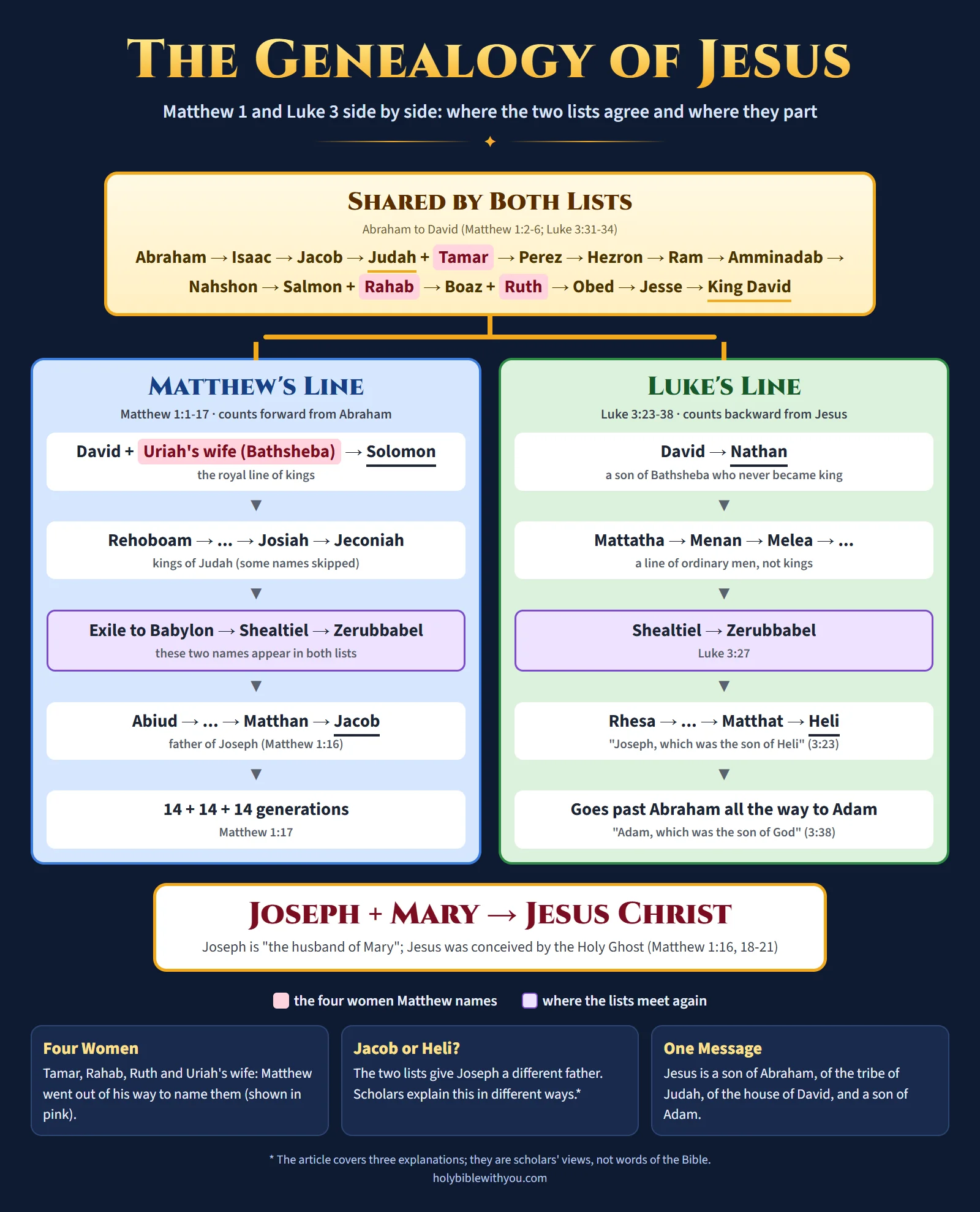
Matthew opens his Gospel with the list. Luke waits until after he’s told about Jesus’ birth, childhood, and baptism, and places it right before Jesus begins His public ministry. From Abraham to David, the two lists give almost the same names. After David, though, they take different paths. We’ll look at that difference in its own section below.
The chart below shows the key names in both genealogies, where they run together, and where they split apart.
What Does Matthew’s Genealogy of Jesus Say?
Matthew’s very first sentence tells you what the whole list is for:
“The book of the generation of Jesus Christ, the son of David, the son of Abraham.”
— Matthew 1:1 (KJV)
Many scholars believe Matthew wrote mainly for a Jewish audience (that’s a scholarly view). For Jewish readers, two ancestors mattered more than any others: Abraham and David. God had promised Abraham, “in thy seed shall all the nations of the earth be blessed” (Genesis 22:18). He had promised David, “thy throne shall be established for ever” (2 Samuel 7:16). In one opening sentence, Matthew is telling his readers that both of those promises come together in Jesus.
Then the list begins:
“Abraham begat Isaac; and Isaac begat Jacob; and Jacob begat Judas and his brethren;”
— Matthew 1:2 (KJV)
Jacob had twelve sons, but Matthew names only Judah (“Judas”) and lumps the rest together as “his brethren.” That’s because the kings were supposed to come from the tribe of Judah (Genesis 49:10). Right from the start, Matthew is showing that Jesus belongs to Judah.
From there the list runs: Judah → Perez → Hezron → Ram → Amminadab → Nahshon → Salmon → Boaz → Obed → Jesse → King David. From David to Solomon, and then the kings of Judah: Rehoboam, Abijah, Asa, Jehoshaphat, Jehoram, Uzziah, Jotham, Ahaz, Hezekiah, Manasseh, Amon, Josiah, Jeconiah. Then comes the exile to Babylon. After the exile: Shealtiel, Zerubbabel, then a string of names we know almost nothing about, and finally Jacob and his son Joseph (Matthew 1:3-16).
At the end, Matthew divides the whole list into three parts:
“So all the generations from Abraham to David are fourteen generations; and from David until the carrying away into Babylon are fourteen generations; and from the carrying away into Babylon unto Christ are fourteen generations.”
— Matthew 1:17 (KJV)
These three parts are three chapters of Israel’s history. Part one, Abraham to David: a family grows into a kingdom. Part two, David to the exile: the age of the kings, when the kingdom split and finally fell. Part three, the exile to Christ: no king, and a people reduced to almost nothing. David’s royal family lost its crown and became an ordinary family. Joseph was a carpenter (Matthew 13:55 calls Jesus “the carpenter’s son”). And yet, Matthew is saying, that’s exactly the ordinary family the promised King was born into.
Why Are Some Names Missing From Matthew’s List? What Do the “Fourteen Generations” Mean?
A careful reader will notice something. Matthew’s list includes this verse:
“And Asa begat Josaphat; and Josaphat begat Joram; and Joram begat Ozias;”
— Matthew 1:8 (KJV)
But the Old Testament book of Chronicles gives the same royal line like this:
“And Solomon’s son was Rehoboam, Abia his son, Asa his son, Jehoshaphat his son, Joram his son, Ahaziah his son, Joash his son, Amaziah his son, Azariah his son, Jotham his son,”
— 1 Chronicles 3:10-12 (KJV)
Chronicles, written after the exile, gives the full list of David’s royal descendants. After Joram it has three more kings: Ahaziah, Joash, and Amaziah. The next king, Azariah, also went by the name Uzziah (“Ozias” in Matthew); 2 Kings 15:1 calls him Azariah and 2 Chronicles 26:1 calls him Uzziah, and they’re talking about the same man. So Matthew left out three kings. Something similar happens in Matthew 1:11, which says “Josias begat Jechonias,” but according to the Old Testament, Josiah’s son was Jehoiakim, and Jehoiakim’s son was Jeconiah (1 Chronicles 3:15-16; 2 Kings 24:6). So Jeconiah was actually Josiah’s grandson.
This isn’t a mistake. Matthew is writing the way Jewish genealogies were written. In those lists, “son” and “begat” could mean “grandson” or simply “descendant.” Matthew’s own first sentence proves it: Jesus is “the son of David” and “the son of Abraham,” even though He lived about a thousand years after David. Matthew isn’t trying to list every single person; he’s tracing the main line. He arranged the list so that each of its three parts has fourteen names, which also makes it easy to memorize. (Note: if you count carefully, the third section reaches fourteen only if you count Jeconiah, whose name also closes the second section. Scholars explain this in different ways: some say Jeconiah is meant to be counted in both sections, others point to how ancient writers counted. These are scholars’ views.)
Why did Matthew pick the number fourteen? The Bible doesn’t say. (Scholars’ view, not a statement of the Bible: in Hebrew, letters double as numbers. The name David is spelled with three Hebrew letters whose values add up to 14 (4 + 6 + 4). Some scholars think Matthew chose fourteen as a quiet pointer to David. Others think it was simply a memory device.) Either way, Matthew’s point is clear: God was guiding history in an orderly way, and Christ came at exactly the right time.
Who Are the Four Women in the Genealogy of Jesus, and Why Are They There?
Jewish genealogies usually listed only men. But in Jesus’ genealogy, Matthew names four women besides Mary. Once you know their stories, you start to see why he included them.
1. Tamar: A Daughter-in-Law Who Was Wronged
“And Judas begat Phares and Zara of Thamar; and Phares begat Esrom; and Esrom begat Aram;”
— Matthew 1:3 (KJV)
Tamar’s story is in Genesis 38. She was married to Judah’s oldest son, who died. By the custom of that time, the dead man’s brother was supposed to marry her and raise up children in his brother’s name. The second son dodged that duty and also died. Judah promised her his third son, Shelah, but when Shelah grew up, Judah never kept his word. To get what she was owed, Tamar disguised herself as a prostitute and became pregnant by her father-in-law, Judah himself. When the truth came out, Judah admitted:
“And Judah acknowledged them, and said, She hath been more righteous than I; because that I gave her not to Shelah my son. And he knew her again no more.”
— Genesis 38:26 (KJV)
When Judah heard Tamar was pregnant, he ordered her to be burned. Then she produced the signet, cord, and staff he had left with her as a pledge (Genesis 38:18, 25). Judah recognized them as his and admitted he was the one in the wrong. It’s one of the most uncomfortable stories in the Bible, and nobody in it comes off looking good. Yet from that relationship came Perez, and from Perez came David, and eventually Jesus. Matthew doesn’t hide the fact that Jesus’ family tree had its share of family dysfunction, sin, and injustice.
2. Rahab: An Outsider From Jericho
“And Salmon begat Booz of Rachab; and Booz begat Obed of Ruth; and Obed begat Jesse; And Jesse begat David the king; and David the king begat Solomon of her that had been the wife of Urias;”
— Matthew 1:5-6 (KJV)
These two verses mention three women: Rahab, Ruth, and “her that had been the wife of Urias.” Let’s start with Rahab. She wasn’t an Israelite. She was a Canaanite woman from the city of Jericho, and the Bible is upfront about her past:
“And Joshua the son of Nun sent out of Shittim two men to spy secretly, saying, Go view the land, even Jericho. And they went, and came into an harlot’s house, named Rahab, and lodged there.”
— Joshua 2:1 (KJV)
Before Israel entered Canaan, Joshua sent two spies into Jericho. When the king of Jericho sent men to arrest them, Rahab hid them on her roof. She confessed that Israel’s God “is God in heaven above, and in earth beneath” (Joshua 2:11). When Jericho fell, Rahab and her whole family were spared, and she went on to live among the Israelites (Joshua 6:25). The New Testament praises her faith:
“By faith the harlot Rahab perished not with them that believed not, when she had received the spies with peace.”
— Hebrews 11:31 (KJV)
Hebrews 11 is often called the “hall of faith,” a list of people who lived by faith. Right there among giants like Abraham and Moses is Rahab. It wasn’t her past that defined her; it was her faith that made her one of God’s people. She became the mother of Boaz, which made her David’s great-great-grandmother. (Note: a long time passed between the fall of Jericho and the birth of David, yet this list has only four names in between: Salmon, Boaz, Obed, and Jesse. That’s why many commentators think some generations were skipped here as well, while others take the list exactly as written. These are commentators’ views.)
3. Ruth: A Daughter-in-Law From Moab
Ruth wasn’t an Israelite either. She came from the nation of Moab. During a famine, an Israelite woman named Naomi moved to Moab with her family, and one of her sons married Ruth. Then Naomi’s husband and both of her sons died. When Naomi decided to go home to Bethlehem, she urged her daughters-in-law to go back to their own families. Ruth’s answer is one of the most beautiful lines in the Bible:
“And Ruth said, Intreat me not to leave thee, or to return from following after thee: for whither thou goest, I will go; and where thou lodgest, I will lodge: thy people shall be my people, and thy God my God:”
— Ruth 1:16 (KJV)
Here’s a young widow leaving behind her country, her family, and her gods, and moving to a foreign land with her aging mother-in-law. With the words “thy God my God,” she put her faith in the God of Israel. In Bethlehem she gathered leftover grain in the fields of a man named Boaz to keep the two of them alive. Boaz noticed her character and, as a close relative with a family duty to redeem, he married her:
“So Boaz took Ruth, and she was his wife: and when he went in unto her, the LORD gave her conception, and she bare a son. And the women said unto Naomi, Blessed be the LORD, which hath not left thee this day without a kinsman, that his name may be famous in Israel. And he shall be unto thee a restorer of thy life, and a nourisher of thine old age: for thy daughter in law, which loveth thee, which is better to thee than seven sons, hath born him. And Naomi took the child, and laid it in her bosom, and became nurse unto it. And the women her neighbours gave it a name, saying, There is a son born to Naomi; and they called his name Obed: he is the father of Jesse, the father of David.”
— Ruth 4:13-17 (KJV)
Naomi, who had lost everything, now held a grandson in her arms. And the last line of the book of Ruth is the punchline: that baby would be King David’s grandfather. Israel’s greatest king had a Moabite great-grandmother. And since Matthew says Boaz’s mother was Rahab, that one household of Boaz and Ruth had two women from outside Israel in it.
4. “The Wife of Uriah”: David’s Sin and God’s Forgiveness
Notice that Matthew doesn’t call her Bathsheba. He calls her “her that had been the wife of Urias” (Matthew 1:6). That wording is deliberate. One evening, after David had become king, he saw a beautiful woman bathing from his rooftop:
“And David sent and enquired after the woman. And one said, Is not this Bath-sheba, the daughter of Eliam, the wife of Uriah the Hittite?”
— 2 Samuel 11:3 (KJV)
David knew she was another man’s wife, and he sent for her anyway. She became pregnant. To cover it up, David had her husband Uriah placed on the front line of a battle so he would be killed (2 Samuel 11). Uriah was a loyal soldier in David’s army, and a Hittite, a foreigner. By writing “the wife of Urias,” Matthew reminds us of that terrible sin. But the story doesn’t end there. When the prophet Nathan confronted David, David didn’t make excuses:
“And David said unto Nathan, I have sinned against the LORD. And Nathan said unto David, The LORD also hath put away thy sin; thou shalt not die.”
— 2 Samuel 12:13 (KJV)
David repented and God forgave him, though the consequences of that sin followed his family for the rest of his life. Later, Bathsheba gave birth to Solomon, who became king. You can read more in our articles on David’s story and King Solomon in the Bible.
What Do These Four Women’s Stories Tell Us Together?
Matthew didn’t name famous matriarchs like Sarah, Rebekah, or Rachel. Instead he named Tamar, Rahab, Ruth, and “the wife of Uriah.” Two threads run through their stories.
First: outsiders. Rahab was a Canaanite, Ruth a Moabite. Tamar entered Judah’s family in the land of Canaan, and Bathsheba’s husband Uriah was a Hittite. (The Bible doesn’t clearly state Tamar’s or Bathsheba’s own ethnic background, and scholars disagree on whether they were foreigners too.) The family line of Israel’s King and the world’s Savior includes people from other nations. God’s promise to Abraham, “in thee shall all families of the earth be blessed” (Genesis 12:3), is already showing up inside Jesus’ own family tree.
Second: sin, shame, and grace. These stories include injustice, prostitution, adultery, and murder. Most families would quietly leave that kind of thing out of the family history. Matthew deliberately points to it. Jesus wasn’t born into a line of only noble, holy people. He was born into a family full of sinners, weak people, and outsiders. And the angel had already told Joseph why He came: “he shall save his people from their sins” (Matthew 1:21). Jesus’ family tree is the first piece of evidence for that promise.
Joseph Wasn’t Jesus’ Biological Father, So Why Give Joseph’s Genealogy?
This is a question a lot of people ask. Matthew’s list repeats the same pattern over and over, “so-and-so begat so-and-so.” But at the very end, the pattern changes:
“And Jacob begat Joseph the husband of Mary, of whom was born Jesus, who is called Christ.”
— Matthew 1:16 (KJV)
Matthew does not say “Joseph begat Jesus.” He calls Joseph “the husband of Mary” and says Jesus was born “of whom,” meaning of Mary. That’s because Jesus wasn’t conceived through Joseph. Matthew explains this in the very next verses: Mary was engaged to Joseph, but before they came together she was found to be pregnant by the Holy Spirit (Matthew 1:18). When Joseph decided to break off the engagement quietly:
“But while he thought on these things, behold, the angel of the Lord appeared unto him in a dream, saying, Joseph, thou son of David, fear not to take unto thee Mary thy wife: for that which is conceived in her is of the Holy Ghost. And she shall bring forth a son, and thou shalt call his name JESUS: for he shall save his people from their sins.”
— Matthew 1:20-21 (KJV)
The angel addressed him as “Joseph, thou son of David.” So God’s own messenger confirmed that Joseph was a descendant of David. Joseph then took Mary home as his wife and named the baby Jesus (Matthew 1:24-25).
In Jewish custom, naming a child was the father’s role. By naming the baby, Joseph legally received Jesus as his own son. (This is a scholarly explanation.) You can compare it to adoption today. An adopted child gets the father’s last name, the right to inherit, and a full place in the family. In the same way, through Joseph, Jesus received the legal rights of David’s line. Jesus grew up in Nazareth with Joseph and Mary, and Luke says He “was subject unto them” (Luke 2:51). People called Him “Son of David” (Matthew 9:27). In other words, the people of His day accepted Him as a descendant of David.
What Does Luke’s Genealogy of Jesus Say?
Luke begins his list like this:
“And Jesus himself began to be about thirty years of age, being (as was supposed) the son of Joseph, which was the son of Heli,”
— Luke 3:23 (KJV)
Jesus had just been baptized in the Jordan River, and a voice from heaven had said, “Thou art my beloved Son; in thee I am well pleased” (Luke 3:22). Luke gives the genealogy right after that. Notice the phrase “as was supposed.” In people’s eyes, Jesus was Joseph’s son, but Luke had already told his readers that Jesus was conceived by the Holy Spirit (Luke 1:35). That’s why he chose his words so carefully.
Luke’s list runs backward from Jesus: Joseph, Heli, Matthat, … Zerubbabel, Shealtiel, … Nathan, David, … Judah, Jacob, Isaac, Abraham, … Noah, … Adam. Here’s how it ends:
“Which was the son of Enos, which was the son of Seth, which was the son of Adam, which was the son of God.”
— Luke 3:38 (KJV)
Matthew stopped at Abraham, because he wanted to show Jewish readers that Jesus fulfilled the promises made to Abraham and David. Luke kept going, past Abraham, all the way back to Adam, the first human being. Many scholars think Luke wrote mostly for non-Jewish readers (a scholarly view). His point: Jesus doesn’t belong to the Jewish people alone. He belongs to every descendant of Adam, which means every human being. Sin entered the world through the first Adam; Jesus came as the Savior of all people.
That last phrase, “Adam, which was the son of God,” matters too. Adam had no human father; God created him. Just before this list, God called Jesus “my beloved Son.” And right after it, Luke tells how the devil tempted Jesus in the wilderness, opening with “If thou be the Son of God” (Luke 4:3). The first “son of God,” Adam, failed when he was tempted. Jesus, the Son of God, overcame temptation. Many commentators believe Luke placed these three scenes side by side on purpose to draw that contrast (this is a commentators’ explanation).
Why Are the Genealogies in Matthew and Luke Different?
This is the question people ask most about the genealogy of Jesus. From Abraham to David, the two lists match. But after David, they follow two different sons:
- Matthew: David → Solomon → the kings of Judah → … → Jacob → Joseph
- Luke: David → Nathan → … → Heli → Joseph
Here’s the verse in Luke’s list:
“Which was the son of Melea, which was the son of Menan, which was the son of Mattatha, which was the son of Nathan, which was the son of David,”
— Luke 3:31 (KJV)
This Nathan is not Nathan the prophet. He was David’s son, one of four sons Bathsheba (“Bath-shua”) bore to David, and Solomon’s brother (1 Chronicles 3:5). So Matthew traces David’s line through Solomon and the royal kings, while Luke traces it through Nathan, a line of ordinary people who never wore a crown. That’s also why Joseph’s father has a different name in each list: “Jacob” in Matthew (Matthew 1:16) and “Heli” in Luke (Luke 3:23).
So if both are true, how can Joseph have two fathers? The Bible doesn’t answer that directly. What follows are explanations Christian scholars have offered over the centuries. These are opinions, not statements of the Bible.
Explanation 1: Luke gives Mary’s genealogy. In this view, Matthew gives Joseph’s line (the legal, royal line), and Luke gives Mary’s. Heli was Mary’s father, which made him Joseph’s father-in-law. Since Jewish genealogies didn’t usually list women, Luke put Mary’s husband Joseph in the list. Supporters point out that Luke tells the birth story from Mary’s side (the angel’s visit to Mary, Mary’s song, and lines like “Mary kept all these things, and pondered them in her heart,” Luke 2:19), so this would fit naturally. In this view, Jesus received the legal right to David’s throne through Joseph and was physically descended from David through Mary. They say this matches Paul’s words that Jesus “was made of the seed of David according to the flesh” (Romans 1:3). This is one of the most common explanations taught in churches.
Explanation 2: both are Joseph’s genealogies, one through his natural father and one through his legal father. This is a very old explanation. A Christian writer named Julius Africanus, who lived in the second and third centuries, proposed it, and the fourth-century historian Eusebius preserved it in his “Church History.” According to Africanus, Jacob and Heli were half-brothers: same mother, different fathers. Heli died without children. Following the custom we saw in Tamar’s story (when a man died childless, his brother married the widow to raise up a son in his name, Deuteronomy 25:5-6), Jacob married Heli’s widow. So Joseph was Jacob’s son by birth and Heli’s son by law. Africanus said he learned this from relatives of Jesus’ own family.
Explanation 3: Matthew gives the royal line, and Luke gives the natural line. Some scholars think Matthew traces “who had the legal right to the throne,” while Luke traces “who was actually born to whom.” When a royal line runs out of direct heirs, the right passes to the nearest relative. So the two lines may have crossed at some points and separated at others.
Why do both lists meet at Shealtiel? After splitting at David, the two lists come together again for a moment around the time of the Babylonian exile: both include Shealtiel (“Salathiel”) and his son Zerubbabel (“Zorobabel”). But they give Shealtiel different fathers. Matthew says “Jechonias begat Salathiel” (Matthew 1:12), while Luke says Salathiel “was the son of Neri” (Luke 3:27). To complicate things further, 1 Chronicles 3:17-19 lists Salathiel among Jeconiah’s descendants and names Zerubbabel as a son of Pedaiah. The Bible doesn’t explain these differences. (Scholars’ views, not statements of the Bible: many scholars think that here too, one man may have been a natural father and another a legal father. For example, since Jeconiah had no son who would reign as king, Shealtiel, a son of Neri from Nathan’s line, may have been counted as Jeconiah’s legal heir. Or, if Shealtiel died without children, his brother Pedaiah may have raised up a son in his name, following the custom from Tamar’s story. Still others think the Shealtiel and Zerubbabel in Luke are different men who happened to share the same names.)
None of these explanations can be proven from the Bible itself. But one thing is worth noticing. In the first century, the religious leaders who opposed Jesus threw plenty of accusations at Him, yet nowhere in the Gospels do they argue that He wasn’t descended from David. Ordinary people called Him the Son of David, and Paul wrote:
“Remember that Jesus Christ of the seed of David was raised from the dead according to my gospel:”
— 2 Timothy 2:8 (KJV)
Paul wrote this from prison to his young protégé Timothy, at a time when he knew his death was near (2 Timothy 4:6). In the middle of hardship, these were the two things Timothy needed to hold onto: Jesus is the descendant of David, and He rose from the dead. Whatever the differences between the two genealogies, they agree on the main point: Jesus is the Son of David, the fulfillment of God’s promises.
If Jeconiah Was Cursed, How Could Jesus Be Heir to David’s Throne?
Matthew’s list includes Jeconiah, one of the last kings of Judah:
“And Josias begat Jechonias and his brethren, about the time they were carried away to Babylon: And after they were brought to Babylon, Jechonias begat Salathiel; and Salathiel begat Zorobabel;”
— Matthew 1:11-12 (KJV)
Jeconiah reigned for only three months before the king of Babylon carried him off as a prisoner (2 Kings 24:8-15). (Language note: in the Old Testament he’s also called Jehoiachin and Coniah.) Because of his wickedness, God pronounced a judgment on him through the prophet Jeremiah:
“Thus saith the LORD, Write ye this man childless, a man that shall not prosper in his days: for no man of his seed shall prosper, sitting upon the throne of David, and ruling any more in Judah.”
— Jeremiah 22:30 (KJV)
Jeremiah said this as the kingdom of Judah was collapsing. “Childless” doesn’t mean Jeconiah would have no children; he did have sons (1 Chronicles 3:17-18). It means none of them would succeed him as king. And in fact, none of his sons ever ruled. So how could Jesus, through Joseph, who came from Jeconiah’s line, be the heir to David’s throne?
The Bible doesn’t answer this directly. Christian scholars usually offer two main explanations (these are scholars’ views):
- Jesus wasn’t Jeconiah’s biological descendant. Since Jesus wasn’t conceived through Joseph, the judgment on Jeconiah didn’t pass to Him by blood. Through Joseph He received the legal royal right, and through Mary (if Luke’s list is Mary’s line) He received David’s bloodline. In this view, the virgin birth itself is part of how God kept His promise.
- God later reversed the judgment. About Jeconiah (“Coniah”), God had said, “though Coniah… were the signet upon my right hand, yet would I pluck thee thence” (Jeremiah 22:24). But after the exile, God used the very same picture through the prophet Haggai about Jeconiah’s grandson Zerubbabel.
“In that day, saith the LORD of hosts, will I take thee, O Zerubbabel, my servant, the son of Shealtiel, saith the LORD, and will make thee as a signet: for I have chosen thee, saith the LORD of hosts.”
— Haggai 2:23 (KJV)
Zerubbabel was the governor who led the Jews home from Babylon, and under his leadership the temple in Jerusalem was rebuilt. God had pulled Jeconiah off like a signet ring; now He chose Zerubbabel, from the same family, to be His signet ring. Some scholars say this shows that God can pronounce judgment and also, in His grace, turn it around. Zerubbabel’s name appears in both Matthew’s and Luke’s genealogies (Matthew 1:12; Luke 3:27).
Which Promises Does the Genealogy of Jesus Fulfill?
The genealogy of Jesus isn’t just a list of names. It’s the road along which promises God made thousands of years earlier came true, one after another.
The promise to Abraham. When Abraham was willing to obey God even to the point of offering his son Isaac, God told him:
“And in thy seed shall all the nations of the earth be blessed; because thou hast obeyed my voice.”
— Genesis 22:18 (KJV)
God confirmed this promise on Mount Moriah after Abraham obeyed. “All the nations of the earth” means not only Israel but every people on the planet. Matthew’s genealogy starts with Abraham and includes women from other nations; Luke’s goes all the way back to Adam. Christians believe that through Jesus, Abraham’s descendant, that blessing has reached every nation. You can read Abraham’s whole story in our Abraham biography.
The promise to the tribe of Judah. Jacob said, “The sceptre shall not depart from Judah” (Genesis 49:10). Jesus was born into the tribe of Judah (Hebrews 7:14). We look at this in detail in the “Which tribe was Jesus from?” section of our article on the 12 tribes of Israel.
The promise to David. “Thy throne shall be established for ever” (2 Samuel 7:16). The Jewish people of Jesus’ day knew the Christ had to come from David’s family:
“Others said, This is the Christ. But some said, Shall Christ come out of Galilee? Hath not the scripture said, That Christ cometh of the seed of David, and out of the town of Bethlehem, where David was?”
— John 7:41-42 (KJV)
During a festival in Jerusalem, people who heard Jesus teach were arguing about Him. Some said He was the Christ. Others objected that the Christ couldn’t come from Galilee, because the Scriptures said He would come from David’s family and from Bethlehem. What they didn’t realize was that Jesus really had been born into David’s family, in Bethlehem (Luke 2:4-7). The genealogies in Matthew and Luke answer their question.
The very first promise. The Bible’s first hint of a Savior comes in the Garden of Eden. After Adam and Eve sinned, God said to the serpent:
“And I will put enmity between thee and the woman, and between thy seed and her seed; it shall bruise thy head, and thou shalt bruise his heel.”
— Genesis 3:15 (KJV)
One of the woman’s descendants would crush the serpent’s head, though he would be wounded in the struggle. Many Christian commentators see this verse as the first promise of Jesus (a commentators’ interpretation). By tracing Jesus all the way back to Adam, Luke’s genealogy takes us right back to that first promise. For the full story of the first couple, read our article on Adam and Eve.
Where Does the Story of Jesus’ Family Tree End? What the Bible Says Up to the Second Coming
Both genealogies stop with Jesus. No name comes after His. That’s significant. God promised David that his throne would last “for ever.” A king who reigns forever doesn’t need an heir. The family tree is complete in Him. But that raises a question: when did Jesus sit on David’s throne? During His life on earth, He never lived in a palace, never wore a crown, and never commanded an army. To answer that, we have to follow the Bible’s story from Jesus’ birth all the way to His Second Coming.
Step 1: The Old Testament’s promise of a kingdom with no end. Centuries after David, the prophet Isaiah wrote about a child who would be born:
“For unto us a child is born, unto us a son is given: and the government shall be upon his shoulder: and his name shall be called Wonderful, Counsellor, The mighty God, The everlasting Father, The Prince of Peace. Of the increase of his government and peace there shall be no end, upon the throne of David, and upon his kingdom, to order it, and to establish it with judgment and with justice from henceforth even for ever. The zeal of the LORD of hosts will perform this.”
— Isaiah 9:6-7 (KJV)
Isaiah spoke these words when the kingdom of Judah was trembling in fear of its enemies. You probably know the first line from Christmas cards and Handel’s “Messiah.” This child would reign “upon the throne of David… for ever,” and His government would have “no end.” When the angel Gabriel told Mary, “of his kingdom there shall be no end” (Luke 1:33), he was echoing this prophecy.
Step 2: From the manger to the cross, a hidden King. Jesus wasn’t born in a palace. On the night He was born, He was laid in a manger (Luke 2:7). Some time later, wise men from the east arrived asking, “Where is he that is born King of the Jews?” (Matthew 2:2), and when they found Him, it was in an ordinary house (Matthew 2:11). Years later He was called “king” again, this time on a cross:
“And set up over his head his accusation written, THIS IS JESUS THE KING OF THE JEWS.”
— Matthew 27:37 (KJV)
Roman soldiers posted the crime of a crucified man above his head. Jesus’ “crime” was that He claimed to be the King of the Jews. The words were written to mock Him, but they were true. The Son of David was wearing a crown of thorns, and His throne was a cross. (About Jesus’ age: Luke 3:23 says He was “about thirty” when His ministry began. The common figure of thirty-three at His death is a traditional estimate; the Bible doesn’t give an exact number.)
Step 3: The resurrection and the throne. After Jesus rose from the dead, on the day of Pentecost, Peter stood before thousands of people in Jerusalem and spoke about God’s promise to David:
“Men and brethren, let me freely speak unto you of the patriarch David, that he is both dead and buried, and his sepulchre is with us unto this day. Therefore being a prophet, and knowing that God had sworn with an oath to him, that of the fruit of his loins, according to the flesh, he would raise up Christ to sit on his throne; He seeing this before spake of the resurrection of Christ, that his soul was not left in hell, neither his flesh did see corruption.”
— Acts 2:29-31 (KJV)
Peter’s argument goes like this: David died, and his tomb is right here in Jerusalem, so he’s still in it. That means God’s oath, “Of the fruit of thy body will I set upon thy throne” (Psalm 132:11), wasn’t ultimately about David himself. It was about Jesus, David’s descendant, who died and rose again. For Peter, Jesus’ resurrection and ascension into heaven marked the beginning of His reign on David’s throne. That’s why he closed his sermon with these words: “God hath made that same Jesus, whom ye have crucified, both Lord and Christ” (Acts 2:36).
Step 4: He is coming back. When Jesus was taken up into heaven before His disciples’ eyes, they stood there staring at the sky. Then two angels said to them:
“Which also said, Ye men of Galilee, why stand ye gazing up into heaven? this same Jesus, which is taken up from you into heaven, shall so come in like manner as ye have seen him go into heaven.”
— Acts 1:11 (KJV)
The first time, Jesus came quietly, in a small town, in an ordinary family, and most people never noticed. His second coming won’t be like that. Jesus Himself described it:
“When the Son of man shall come in his glory, and all the holy angels with him, then shall he sit upon the throne of his glory:”
— Matthew 25:31 (KJV)
Jesus said this on the Mount of Olives, just days before the cross, while teaching His disciples about the end of the age. He went on to say that all the nations would be gathered before Him and that He would separate them as a shepherd separates sheep from goats (Matthew 25:32-46). The One who was mockingly labeled “King of the Jews” on a cross will be seen by everyone as King, seated on “the throne of his glory.”
Step 5: The Son of David on the Bible’s last pages. In the visions John saw in the book of Revelation, there’s a moment when Jesus’ kingdom is fully established:
“And the seventh angel sounded; and there were great voices in heaven, saying, The kingdoms of this world are become the kingdoms of our Lord, and of his Christ; and he shall reign for ever and ever.”
— Revelation 11:15 (KJV)
This announcement rings out when the last of the seven trumpets sounds. “He shall reign for ever and ever” is the fulfillment of “for ever” in God’s promise to David (2 Samuel 7:16), “even for ever” in Isaiah 9:7, and “no end” in Luke 1:33. A few chapters later, John sees Jesus coming on a white horse, and on His robe is written “KING OF KINGS, AND LORD OF LORDS” (Revelation 19:16).
In the last chapter of the Bible, Jesus describes Himself in His own words:
“I Jesus have sent mine angel to testify unto you these things in the churches. I am the root and the offspring of David, and the bright and morning star.”
— Revelation 22:16 (KJV)
These are among the last words of Jesus recorded in the Bible. He calls Himself both “the root” and “the offspring” of David. “Offspring” means He was born into David’s family, exactly what Matthew’s and Luke’s genealogies show. “Root” means He is David’s source, the One who existed before David. A tree grows from its root. As a man, Jesus came from David; as God, He is where David came from. (This is how many commentators explain these two words.) The “morning star” is the star that announces the night is ending and dawn is coming. A star once led the wise men to Him. At the end of the Bible, He tells us He is that light.
The final step: the promise to Abraham completely fulfilled. Matthew’s genealogy began with Abraham, to whom God said, “in thy seed shall all the nations of the earth be blessed.” In Revelation, John saw that promise fully come true:
“After this I beheld, and, lo, a great multitude, which no man could number, of all nations, and kindreds, and people, and tongues, stood before the throne, and before the Lamb, clothed with white robes, and palms in their hands;”
— Revelation 7:9 (KJV)
John saw this crowd right after hearing the number of those sealed from the twelve tribes of Israel (Revelation 7:4-8). This multitude comes from “all nations” and “tongues,” every country and every language on earth. The God who made room for outsiders like Rahab and Ruth in Jesus’ family tree will one day gather people from every nation before the throne of His King. The family story that started with Abraham is finished there.
How Christians differ on the Second Coming. All Christians believe Jesus is coming back and that His kingdom will have no end. But they hold different views about how and when that kingdom appears. (These are theological views, not statements of the Bible, and we’re not taking sides.)
- A thousand-year reign on earth after His return (premillennialism): Some Christians believe that after His Second Coming, Jesus will reign on earth for a literal thousand years on David’s throne. They take Revelation 20:4, “they lived and reigned with Christ a thousand years,” literally.
- A reign from heaven now (amillennialism): Others believe that since His resurrection and ascension, Jesus is already reigning on David’s throne at God’s right hand (Acts 2:30-36), and that the “thousand years” is a symbolic picture of this present age. At His Second Coming, they say, His reign will be fully visible to everyone.
- His return after the gospel spreads (postmillennialism): Still others believe Christ’s kingdom will grow gradually as the gospel spreads throughout the world, that this long era is the “thousand years,” and that Jesus will return after it.
Whatever their differences, all Christians agree on the heart of what Jesus’ genealogy is saying: Jesus, the Son of David, is King; He is coming back; and His kingdom will never end. A story that began with a list of names in Matthew 1 ends with “I am the root and the offspring of David” in Revelation 22.
What Does the Genealogy of Jesus Teach Us?
- God keeps His word. It took about two thousand years for the promise to Abraham to come to its fulfillment, with exiles, wars, and fallen kingdoms along the way. Yet God protected that promise, generation after generation. When it feels like God’s promises are taking forever in your own life, He hasn’t forgotten.
- God uses sinners. Judah, Tamar, Rahab, David, and King Manasseh are all in Jesus’ family line. Manasseh was the most wicked of Judah’s kings, but in the end he humbled himself and repented (2 Chronicles 33:1-13). No matter how bad your past is, it’s not a barrier to God’s grace.
- There’s room in God’s family for outsiders. Rahab and Ruth came from other nations. Through faith they became part of God’s people and earned a place in the Savior’s family tree.
- Ordinary lives are part of God’s plan too. The names after the exile, like Abiud, Eliakim, Azor, and Zadok, appear nowhere else in the Bible. They were ordinary people who never did anything famous. Yet their names are recorded forever in the family tree of Christ.
- Jesus came for everyone. Matthew’s genealogy shows Jesus as the son of Abraham and David; Luke’s shows Him as the son of Adam. He doesn’t belong to one race, one class, or one family. He’s the Savior of all people.
Related Articles
- The 12 Tribes of Israel: Names, Meanings, Bible Verses, and Where They Are Today
- Abraham Biography: His Life, Faith, Family, and God’s Promises
- David’s Story: From a Shepherd Boy to the King of Israel
- King Solomon in the Bible
- Adam and Eve: Their Story, Sin, and Life
- More English Bible articles
Bible Passages About the Genealogy of Jesus
- Matthew’s genealogy — Matthew 1:1-17
- Jesus’ birth and the angel’s message to Joseph — Matthew 1:18-25
- Luke’s genealogy — Luke 3:23-38
- Jesus’ baptism and temptation — Luke 3:21-22; 4:1-13
- The genealogy of Adam — Genesis 5
- Priests without a genealogy record — Ezra 2:61-63
- Tamar and Judah — Genesis 38
- Rahab — Joshua 2; 6:22-25; Hebrews 11:31
- Ruth — Ruth 1–4
- David and Bathsheba — 2 Samuel 11–12
- David’s sons (Nathan, Solomon) — 1 Chronicles 3:1-9
- The royal line of David — 1 Chronicles 3:10-24
- Azariah (Uzziah) — 2 Kings 15:1-7; 2 Chronicles 26:1-23
- Jeconiah and Jeremiah’s judgment — 2 Kings 24:6-17; Jeremiah 22:24-30
- Zerubbabel — Haggai 2:20-23
- The cross, resurrection, Second Coming, and David’s throne — Isaiah 9:6-7; Psalm 132:11; Matthew 25:31-46; 27:37; Acts 1:9-11; 2:29-36; Revelation 7:9; 11:15; 19:11-16; 20:4-6; 22:16
- The promises — Genesis 3:15; 12:3; 22:18; 49:10; 2 Samuel 7:12-16; John 7:42; Romans 1:3; 2 Timothy 2:8
Historical Source Used in This Article
- Eusebius, “Church History,” Book 1, Chapter 7: the letter of Julius Africanus to Aristides on the difference between the genealogies in Matthew and Luke — New Advent
Disclaimers
On language: we’ve written this article in plain, everyday English that anyone can follow, even without a church background.
On the story and opinions: there are no fictional stories in this article. The Bible’s stories are told the way the Bible records them. Where the Bible doesn’t give a direct answer (the differences between Matthew’s and Luke’s genealogies, the “fourteen generations,” the judgment on Jeconiah, the Second Coming, and the thousand-year reign), we’ve shared the explanations of scholars and commentators and labeled them clearly as such where they appear. We’re not ruling on which of those explanations is correct. Comparisons like DNA kits, family-history websites, and adoption are only illustrations to help explain the ideas.
On the verses: every Bible quotation in this article is from the King James Version (KJV), a public-domain English translation. Under each verse, we’ve explained the situation it was spoken in, in plain words, for readers who may not know the Bible well. To understand any verse fully, read the whole chapter it comes from in your own Bible. This article is not a complete or final explanation of the subject, and it isn’t arguing for or against any particular church tradition. Treat it as a study aid only.