Introduction
Emily Carter grew up on a farm outside Ames, Iowa. At twenty-two she landed her first real job at a big accounting firm in Manhattan. Everything was new: the subway, the noise, the office slang, the after-work drinks where everybody seemed to know the unwritten rules except her. Within a year her boss noticed how good she was and handed her bigger accounts. That’s when the pressure started. A senior partner asked her to “clean up” a client’s numbers before an audit. A couple of coworkers who resented her quick promotion started watching for any mistake they could report. Emily didn’t make a speech about it. She simply kept doing honest work, kept the numbers straight, and kept the habit her mother had taught her: a few minutes of prayer every morning before she left her apartment.
About 2,600 years ago, a teenager named Daniel faced a far more extreme version of that same pressure. He was taken from his home in Jerusalem as a prisoner of war and carried off to Babylon, the superpower of his day. The Babylonians gave him a new name, taught him a new language, and put the king’s own food on his plate. Daniel stayed loyal to his God anyway. He interpreted a king’s terrifying dream, read the mysterious writing on the wall, and survived a night in a den of lions. He served at the top of government under several kings, and his enemies couldn’t find a single thing to accuse him of.
In this article we’ll go through the life of Daniel in the Bible from beginning to end: who he was, what his name means, why he refused the king’s food (and what people mean by the “Daniel fast”), Nebuchadnezzar’s dream of the great statue, Shadrach, Meshach, and Abed-nego in the fiery furnace, the writing on the wall, the lions’ den, Daniel’s prayer, his visions, and what Jesus said about him. When we say “the Bible says,” we’ll show you the verse. When we share history or scholars’ opinions, we’ll tell you right there that they’re not Scripture.
Questions in this article:
- Who was Daniel in the Bible, and what does his name mean?
- How did Daniel end up in Babylon?
- Why did Daniel refuse the king’s food? What is the Daniel fast?
- Nebuchadnezzar’s dream: what did the statue of gold, silver, bronze, iron, and clay mean?
- Shadrach, Meshach, and Abed-nego: what happened in the fiery furnace?
- What happened to Nebuchadnezzar when he became proud?
- Belshazzar’s feast: what did the writing on the wall mean?
- Daniel and the lions’ den: what happened?
- Daniel’s prayer: how did he pray, and why was his answer delayed?
- What visions did Daniel see?
- What did Jesus say about Daniel?
- How long did Daniel live, and where did he die?
- Book of Daniel summary by chapter
- What does Daniel’s life teach us?
Who Was Daniel in the Bible, and What Does His Name Mean?
Daniel was a young man from the kingdom of Judah who was taken captive to Babylon when King Nebuchadnezzar conquered Jerusalem. He spent the rest of his life serving in the courts of foreign kings. The Old Testament book that carries his name has twelve chapters. The first six tell stories from the lives of Daniel and his friends. The last six record visions God showed Daniel about the future.
The Bible tells us what kind of young men the king was looking for:
“And the king spake unto Ashpenaz the master of his eunuchs, that he should bring certain of the children of Israel, and of the king’s seed, and of the princes; Children in whom was no blemish, but well favoured, and skilful in all wisdom, and cunning in knowledge, and understanding science, and such as had ability in them to stand in the king’s palace, and whom they might teach the learning and the tongue of the Chaldeans.”
— Daniel 1:3-4 (KJV)
King Nebuchadnezzar told his chief official, Ashpenaz, to pick out the best of the young captives from Judah: young men from the royal family and the nobility, healthy, good-looking, and sharp. They would be trained in the language and learning of the Chaldeans (the Babylonians) so they could serve in the king’s palace. In plain words, the king wanted to take the brightest young talent from a defeated nation and turn them into loyal Babylonian civil servants. Daniel was one of them.
“Now among these were of the children of Judah, Daniel, Hananiah, Mishael, and Azariah: Unto whom the prince of the eunuchs gave names: for he gave unto Daniel the name of Belteshazzar; and to Hananiah, of Shadrach; and to Mishael, of Meshach; and to Azariah, of Abed-nego.”
— Daniel 1:6-7 (KJV)
Four of these young men were from Judah: Daniel, Hananiah, Mishael, and Azariah. The Babylonian official gave each of them a new name. Daniel became Belteshazzar. Hananiah became Shadrach, Mishael became Meshach, and Azariah became Abed-nego. So if you’ve ever searched for “Shadrach, Meshach, and Abednego real names,” there they are: Hananiah, Mishael, and Azariah. They were Daniel’s closest friends.
Changing someone’s name wasn’t a small thing. Their Hebrew names honored the God of Israel. Their new names pointed to Babylonian culture and gods. The goal was to make them forget where they came from. Their names changed, but their hearts didn’t, and that shows up all through the story.
What does the name Daniel mean?
(Language note, not a Bible verse:) In Hebrew, the name is Daniyyel. “Dan” means “judge” and “el” means “God,” so the name Daniel means “God is my judge.” His Babylonian name, Belteshazzar, is harder to pin down. Scholars have offered meanings such as “Lady, protect the king” or “protect his life.” Nebuchadnezzar himself said the name was given “according to the name of my god” (Daniel 4:8). One man, two names: one pointing to the God of Israel, the other to the gods of Babylon. The rest of this article shows which name Daniel lived up to.
Who were Daniel’s father and mother? Did he have a wife?
The Bible doesn’t name Daniel’s parents, and it never mentions a wife or children. All it tells us is that the young men chosen were from the royal family or the nobility (Daniel 1:3). (Historical note, not in the Bible:) The first-century Jewish historian Josephus wrote in his Antiquities of the Jews (book 10) that some of these young men were relatives of King Zedekiah of Judah. The Bible doesn’t say that, so we can’t be sure.
Was Daniel a eunuch?
This is a common question, because Daniel 1:3 says he was placed under “the master of his eunuchs.” (Differing views:) Some interpreters believe Daniel and his friends were made eunuchs, which was a common practice for young men serving in ancient royal courts. They point to Isaiah 39:7, where the prophet warned King Hezekiah that some of his descendants would become eunuchs in the palace of the king of Babylon. Others note that the Hebrew word translated “eunuch” (saris) was also used more generally for a court official, and some officials with this title were married. The Bible doesn’t say directly, and we’re not ruling on which view is correct.
Daniel in the book of Ezekiel
While Daniel was in Babylon, another prophet named Ezekiel was living among the Jewish captives there. Daniel’s name shows up in his book:
“Though these three men, Noah, Daniel, and Job, were in it, they should deliver but their own souls by their righteousness, saith the Lord GOD.”
— Ezekiel 14:14 (KJV)
God was telling Ezekiel how deep Jerusalem’s sin had become. Even if three of the most righteous men who ever lived were there, Noah, Daniel, and Job, their goodness could save only themselves, not the city. It’s remarkable to see Daniel’s name next to Noah and Job. (Differing views:) Many readers believe this is our Daniel. Some scholars think it may refer to a different ancient righteous figure called Danel, known from old Canaanite stories. We’re not ruling on which view is correct.
How Did Daniel End Up in Babylon?
The book of Daniel opens with the historical setting:
“In the third year of the reign of Jehoiakim king of Judah came Nebuchadnezzar king of Babylon unto Jerusalem, and besieged it. And the Lord gave Jehoiakim king of Judah into his hand, with part of the vessels of the house of God: which he carried into the land of Shinar to the house of his god; and he brought the vessels into the treasure house of his god.”
— Daniel 1:1-2 (KJV)
Nebuchadnezzar, king of Babylon, marched on Jerusalem and laid siege to it. King Jehoiakim of Judah surrendered, and Nebuchadnezzar carried off some of the sacred vessels from God’s temple and put them in the treasure house of his own god in Shinar (an old name for the land of Babylon). On the surface, it looked like Babylon’s god had won. But notice the key phrase: “the Lord gave Jehoiakim king of Judah into his hand.” This didn’t happen because Nebuchadnezzar was stronger than God. God allowed it, because His people had turned away from Him to idols. That truth runs through the whole book of Daniel: the real authority over the kingdoms of the world belongs to God.
(Historical note, not in the Bible:) Most historians date this to about 605 BC; some connect it with the deportation of 597 BC instead. Nebuchadnezzar ruled Babylon from about 605 to 562 BC. He came back against Jerusalem in 597 BC and again in 586 BC, when he finally destroyed the city and the temple. The ruins of Babylon lie in modern Iraq, south of Baghdad. Jeremiah 25:1 counts this same year as Jehoiakim’s “fourth year.” Many scholars explain the difference by the way Babylonians counted a king’s years of reign.
God had already told His people how long this exile would last:
“For thus saith the LORD, That after seventy years be accomplished at Babylon I will visit you, and perform my good word toward you, in causing you to return to this place.”
— Jeremiah 29:10 (KJV)
The prophet Jeremiah stayed in Jerusalem and wrote a letter to the captives in Babylon. In it, God promised that when Babylon’s seventy years were over, He would bring His people home. That promise became important in Daniel’s life. Decades later, an old Daniel would read this very verse and fall on his knees in prayer.
It’s worth remembering that Daniel didn’t choose to go to Babylon. As a young man he lost his home, his family, and his country, and had to build a life in an enemy nation. If you’re facing a move you didn’t ask for and wondering whether God is coming with you, read our article We Have to Move to a Place We’ve Never Even Seen — Is God Really Going With Us?
(Historical note, not in the Bible:) The Bible doesn’t give Daniel’s age when he was taken. It just calls these young men “children,” meaning youths. Jewish tradition and some commentators estimate he was somewhere around 14 to 17. That’s an estimate only.
Why Did Daniel Refuse the King’s Food? What Is the Daniel Fast?
The king ordered that the young men be trained for three years and fed from his own table, with his food and his wine (Daniel 1:5). That sounds like a privilege. But Daniel made a decision:
“But Daniel purposed in his heart that he would not defile himself with the portion of the king’s meat, nor with the wine which he drank: therefore he requested of the prince of the eunuchs that he might not defile himself.”
— Daniel 1:8 (KJV)
“Meat” in the King James Version often just means food. Daniel “purposed in his heart” that he wouldn’t defile himself with the king’s food and wine. The decision was made inside first. Then, instead of picking a fight, he respectfully asked permission. For a young captive in a foreign palace, saying no to the king’s menu was risky. His courage came from a settled decision to obey God.
The Bible doesn’t spell out exactly why the king’s food would have defiled him. (Commentators’ explanations:) Some think the menu included meat that the Law of Moses called unclean. Others think the meat and wine had first been offered to Babylonian gods. Others suggest that eating from the king’s table was a sign of total dependence on and loyalty to the king, and Daniel wanted to keep his loyalty to God clear. Whatever the exact reason, Daniel wanted to stay faithful. (For more on the food laws in the Old Testament, see our article What Foods Were Forbidden in the Bible? Leviticus 11 Explained.)
“Then said Daniel to Melzar, whom the prince of the eunuchs had set over Daniel, Hananiah, Mishael, and Azariah, Prove thy servants, I beseech thee, ten days; and let them give us pulse to eat, and water to drink. Then let our countenances be looked upon before thee, and the countenance of the children that eat of the portion of the king’s meat: and as thou seest, deal with thy servants.”
— Daniel 1:11-13 (KJV)
The chief official was nervous. If these young men looked weaker than the others, he said, the king would have his head (Daniel 1:10). So Daniel went to the guard in charge of them, called Melzar in the KJV, and proposed a simple test. For ten days, give us only “pulse” (vegetables, or food grown from seeds) and water. Then compare us with the young men eating the king’s food, and decide what to do. Daniel found a way to stay faithful without getting anyone else in trouble.
“And at the end of ten days their countenances appeared fairer and fatter in flesh than all the children which did eat the portion of the king’s meat. Thus Melzar took away the portion of their meat, and the wine that they should drink; and gave them pulse.”
— Daniel 1:15-16 (KJV)
After ten days, the four of them looked healthier and better nourished than everyone eating the royal food. So the guard let them keep eating vegetables. God honored a small decision made for Him.
“As for these four children, God gave them knowledge and skill in all learning and wisdom: and Daniel had understanding in all visions and dreams.”
— Daniel 1:17 (KJV)
Their wisdom wasn’t simply their own achievement. The verse says plainly, “God gave them knowledge and skill.” Daniel also received a special gift: understanding visions and dreams. That gift would soon put him in front of the king.
“And the king communed with them; and among them all was found none like Daniel, Hananiah, Mishael, and Azariah: therefore stood they before the king. And in all matters of wisdom and understanding, that the king enquired of them, he found them ten times better than all the magicians and astrologers that were in all his realm. And Daniel continued even unto the first year of king Cyrus.”
— Daniel 1:19-21 (KJV)
When the three years of training were over, the king interviewed them himself and found them “ten times better” than all the wise men in his kingdom. Notice the last sentence: Daniel “continued even unto the first year of king Cyrus.” In other words, Daniel served from the rise of the Babylonian Empire until it fell and the Persian king Cyrus took over, roughly seventy years in royal service.
What is the “Daniel fast”?
You’ll hear about the “Daniel fast” in a lot of churches today, and it’s one of the most searched topics about Daniel. The Bible doesn’t command a “Daniel fast” by name. The idea comes from two passages. The first is the ten days of vegetables and water we just read (Daniel 1:12). The second is a fast Daniel kept as an old man:
“In those days I Daniel was mourning three full weeks. I ate no pleasant bread, neither came flesh nor wine in my mouth, neither did I anoint myself at all, till three whole weeks were fulfilled.”
— Daniel 10:2-3 (KJV)
This happened during the reign of the Persian king Cyrus. Daniel was grieving over the future of his people and seeking understanding from God, so for three weeks he gave up “pleasant bread” (rich, tasty food), meat, and wine. He didn’t even use the scented oils people of that time used to care for their skin. He didn’t stop eating altogether, but he set aside comfort and pleasure to humble himself before God.
(Modern practice, not a Bible command:) Based on these two passages, many Christians today do a “Daniel fast” for 10 or 21 days. They typically give up meat, sweets, caffeine, and processed foods, and eat vegetables, fruits, whole grains, and water while spending extra time in prayer. It can be a meaningful spiritual practice, but the Bible doesn’t require it of everyone. The heart of Daniel’s fast wasn’t the menu. It was a humble heart before God. If you have health conditions, talk to your doctor before you fast.
Nebuchadnezzar’s Dream: What Did the Statue of Gold, Silver, Bronze, Iron, and Clay Mean?
Chapter 2 begins with a crisis:
“And in the second year of the reign of Nebuchadnezzar Nebuchadnezzar dreamed dreams, wherewith his spirit was troubled, and his sleep brake from him.”
— Daniel 2:1 (KJV)
The most powerful king in the world had a dream that shook him so badly he couldn’t sleep. He called in his wise men and astrologers and made a strange demand: tell me what I dreamed, and then tell me what it means. If you can’t, I’ll have you cut in pieces (Daniel 2:5). He wanted proof that they weren’t just making things up.
“The Chaldeans answered before the king, and said, There is not a man upon the earth that can shew the king’s matter: therefore there is no king, lord, nor ruler, that asked such things at any magician, or astrologer, or Chaldean. And it is a rare thing that the king requireth, and there is none other that can shew it before the king, except the gods, whose dwelling is not with flesh.”
— Daniel 2:10-11 (KJV)
Babylon’s experts threw up their hands. No human being on earth could do what the king was asking, they said. Only the gods could, and the gods don’t live among people. Without realizing it, they were telling the truth: only God could reveal this dream. The king was furious and ordered all the wise men of Babylon to be executed. That order included Daniel and his friends.
“Then Daniel went to his house, and made the thing known to Hananiah, Mishael, and Azariah, his companions: That they would desire mercies of the God of heaven concerning this secret; that Daniel and his fellows should not perish with the rest of the wise men of Babylon.”
— Daniel 2:17-18 (KJV)
Daniel didn’t panic. He went to the king and asked for a little time (Daniel 2:16). Then he went home, told his three friends what was happening, and asked them to pray with him for mercy from “the God of heaven.” When his life was on the line, Daniel’s first move was prayer, and he didn’t pray alone. He called his most trusted friends to pray with him.
“Then was the secret revealed unto Daniel in a night vision. Then Daniel blessed the God of heaven. Daniel answered and said, Blessed be the name of God for ever and ever: for wisdom and might are his:”
— Daniel 2:19-20 (KJV)
That same night, God showed Daniel the dream and its meaning in a vision. And notice what Daniel did first. He didn’t run to the palace. He praised God. It’s easy to forget to say thank you once the answer comes. Daniel didn’t forget.
“And he changeth the times and the seasons: he removeth kings, and setteth up kings: he giveth wisdom unto the wise, and knowledge to them that know understanding: He revealeth the deep and secret things: he knoweth what is in the darkness, and the light dwelleth with him.”
— Daniel 2:21-22 (KJV)
Daniel’s prayer of praise sums up the whole book of Daniel. God “removeth kings, and setteth up kings.” Even a king as mighty as Nebuchadnezzar sits on his throne only because God allows it. God knows the secrets that no human being can uncover.
“Daniel answered in the presence of the king, and said, The secret which the king hath demanded cannot the wise men, the astrologers, the magicians, the soothsayers, shew unto the king; But there is a God in heaven that revealeth secrets, and maketh known to the king Nebuchadnezzar what shall be in the latter days. Thy dream, and the visions of thy head upon thy bed, are these;”
— Daniel 2:27-28 (KJV)
Standing before the king, Daniel had the perfect chance to make himself look impressive. He didn’t take it. No wise man could tell you this, he said, “But there is a God in heaven that revealeth secrets.” He pointed the king away from himself and toward God. Then he described the dream.
“Thou, O king, sawest, and behold a great image. This great image, whose brightness was excellent, stood before thee; and the form thereof was terrible. This image’s head was of fine gold, his breast and his arms of silver, his belly and his thighs of brass, His legs of iron, his feet part of iron and part of clay.”
— Daniel 2:31-33 (KJV)
The king had seen a huge, dazzling, frightening statue. From top to bottom, it was made of different materials: a head of gold, chest and arms of silver, belly and thighs of bronze (“brass” in the KJV), legs of iron, and feet that were a mix of iron and clay. As you move down, the metals become less valuable but stronger, until you reach feet that are dangerously weak where iron and clay are mixed.
“Thou sawest till that a stone was cut out without hands, which smote the image upon his feet that were of iron and clay, and brake them to pieces. Then was the iron, the clay, the brass, the silver, and the gold, broken to pieces together, and became like the chaff of the summer threshingfloors; and the wind carried them away, that no place was found for them: and the stone that smote the image became a great mountain, and filled the whole earth.”
— Daniel 2:34-35 (KJV)
Then a stone “cut out without hands,” meaning no human being carved it, struck the statue on its weak feet. The whole statue shattered and blew away like chaff on a threshing floor, the light husks that the wind carries off at harvest time. But the stone grew into a great mountain that filled the whole earth.
“And wheresoever the children of men dwell, the beasts of the field and the fowls of the heaven hath he given into thine hand, and hath made thee ruler over them all. Thou art this head of gold.”
— Daniel 2:38 (KJV)
Daniel began the interpretation. “Thou art this head of gold”: the gold head was Nebuchadnezzar, that is, the kingdom of Babylon. And even that power had been given to him by God. After him, Daniel said, would come another kingdom inferior to his, then a third, then a fourth kingdom as strong as iron (Daniel 2:39-43). Finally, he explained the stone:
“And in the days of these kings shall the God of heaven set up a kingdom, which shall never be destroyed: and the kingdom shall not be left to other people, but it shall break in pieces and consume all these kingdoms, and it shall stand for ever.”
— Daniel 2:44 (KJV)
That’s the heart of the dream. Every kingdom built by human beings, whether gold or iron, will fall one day. But the kingdom the God of heaven sets up “shall never be destroyed.” No human hands built it, which is why the stone was “cut out without hands.”
(Commentators’ explanations:) The Bible clearly says the head of gold is Babylon. The other three kingdoms aren’t named in this chapter. Many Christian commentators identify the silver as Medo-Persia, the bronze as Greece, the iron as Rome, and the stone as Jesus Christ and the kingdom of God He established. They point to Daniel 8:20-21, where Media, Persia, and Greece are named outright. Other scholars count the four kingdoms as Babylon, Media, Persia, and Greece. We’re not ruling on which interpretation is correct. But everyone agrees on the main message: in the end, God’s kingdom is the one that lasts.
“Then the king Nebuchadnezzar fell upon his face, and worshipped Daniel, and commanded that they should offer an oblation and sweet odours unto him. The king answered unto Daniel, and said, Of a truth it is, that your God is a God of gods, and a Lord of kings, and a revealer of secrets, seeing thou couldst reveal this secret. Then the king made Daniel a great man, and gave him many great gifts, and made him ruler over the whole province of Babylon, and chief of the governors over all the wise men of Babylon.”
— Daniel 2:46-48 (KJV)
Hearing his own dream described exactly, the king fell on his face before Daniel. He confessed that Daniel’s God is “a God of gods, and a Lord of kings, and a revealer of secrets.” He made Daniel ruler over the province of Babylon and head of all its wise men. At Daniel’s request, the king also promoted his three friends (Daniel 2:49). Overnight, a young captive became one of the most powerful officials in the empire.
(Comparison, for reflection:) Centuries earlier, the same thing happened to Joseph. As a slave and a prisoner in Egypt, he interpreted Pharaoh’s dreams and became second-in-command of the country. Both men told a pagan king that it’s God who gives the meaning of dreams. You can read Joseph’s story in our article Joseph’s Life: The Complete Biblical Story of His Trials, Faith, and Forgiveness.
Shadrach, Meshach, and Abed-nego: What Happened in the Fiery Furnace?
In chapter 3, Nebuchadnezzar built something enormous:
“Nebuchadnezzar the king made an image of gold, whose height was threescore cubits, and the breadth thereof six cubits: he set it up in the plain of Dura, in the province of Babylon.”
— Daniel 3:1 (KJV)
The king set up a golden statue on the plain of Dura. (Measurement note:) A cubit was about 18 inches, so “threescore” (sixty) cubits is roughly 90 feet tall, about the height of a nine-story building. In chapter 2, only the statue’s head was gold. Now Nebuchadnezzar made a statue that was gold all over. (Commentators’ view:) Many commentators think he was defying God’s message that his kingdom would one day give way to others.
“Then an herald cried aloud, To you it is commanded, O people, nations, and languages, That at what time ye hear the sound of the cornet, flute, harp, sackbut, psaltery, dulcimer, and all kinds of musick, ye fall down and worship the golden image that Nebuchadnezzar the king hath set up: And whoso falleth not down and worshippeth shall the same hour be cast into the midst of a burning fiery furnace.”
— Daniel 3:4-6 (KJV)
All the officials of the empire were summoned to the dedication. When the music played, everyone was to bow down and worship the statue. Anyone who refused would be thrown into a blazing furnace on the spot. The music started, and thousands hit the ground. Three young men stayed standing: Shadrach, Meshach, and Abed-nego. They knew God’s command: “Thou shalt not make unto thee any graven image… Thou shalt not bow down thyself to them, nor serve them” (Exodus 20:4-5). (To understand why God took idolatry so seriously, see our article Who Was Molech? The Dark History of Child Sacrifice in the Bible.)
Some jealous officials reported them. The king flew into a rage, called them in, and gave them one more chance. Bow down now and you’ll be fine. If not, into the furnace you go, “and who is that God that shall deliver you out of my hands?” (Daniel 3:15). Their answer is one of the boldest statements in the Bible:
“Shadrach, Meshach, and Abed-nego, answered and said to the king, O Nebuchadnezzar, we are not careful to answer thee in this matter. If it be so, our God whom we serve is able to deliver us from the burning fiery furnace, and he will deliver us out of thine hand, O king. But if not, be it known unto thee, O king, that we will not serve thy gods, nor worship the golden image which thou hast set up.”
— Daniel 3:16-18 (KJV)
“We are not careful to answer thee” means “we don’t need to defend ourselves to you.” Their answer has three parts. First, our God is able to save us. Second, He will save us from your hand. Third, “But if not,” we still won’t worship your gods. Those three words, “But if not,” are what real faith looks like. Faith that only serves God when He does what we want isn’t really faith. Real faith says: whether He rescues us or not, He is God, and we’ll stay loyal to Him.
The king was livid. He ordered the furnace heated seven times hotter than usual. The three men were tied up, fully clothed, and thrown in. The fire was so intense that the soldiers who threw them in were killed by the heat (Daniel 3:19-23). Then the king saw something that made him jump to his feet:
“Then Nebuchadnezzar the king was astonied, and rose up in haste, and spake, and said unto his counsellors, Did not we cast three men bound into the midst of the fire? They answered and said unto the king, True, O king. He answered and said, Lo, I see four men loose, walking in the midst of the fire, and they have no hurt; and the form of the fourth is like the Son of God.”
— Daniel 3:24-25 (KJV)
They had thrown in three men, tied up. Now the king saw four men, untied, walking around in the fire, unharmed. And the fourth, he said, looked “like the Son of God.” The king called them out. Not a hair on their heads was singed, their clothes weren’t scorched, and they didn’t even smell like smoke (Daniel 3:27).
(Language note and commentators’ views:) In the original Aramaic, the king’s words can be translated “like a son of the gods,” and that’s how many modern translations render it. A pagan king would naturally speak of “the gods.” In the next verse, the king himself says God “hath sent his angel.” Many Christian commentators believe the fourth figure was an angel; others believe it was an appearance of Christ before His birth as a man. Whichever view you hold, one thing is clear: the three men were not alone in the fire. God didn’t keep them out of the furnace. He was with them in it.
“Then Nebuchadnezzar spake, and said, Blessed be the God of Shadrach, Meshach, and Abed-nego, who hath sent his angel, and delivered his servants that trusted in him, and have changed the king’s word, and yielded their bodies, that they might not serve nor worship any god, except their own God.”
— Daniel 3:28 (KJV)
Moments earlier, the king had sneered, “who is that God that shall deliver you?” Now he was praising that very God. What moved him was the faith of these three men, who “trusted in him” and “yielded their bodies” rather than worship any other god. The king issued a decree that no one could speak against their God, and he promoted them again (Daniel 3:29-30).
Where was Daniel during the fiery furnace?
Daniel’s name never appears in chapter 3, and the Bible doesn’t say where he was. (Commentators’ guesses:) Some suggest he was away on the king’s business, or that as a high official he wasn’t required to attend that ceremony. Those are guesses only. Looking at Daniel’s whole life, though, it’s hard to imagine him bowing to that statue.
What Happened to Nebuchadnezzar When He Became Proud?
Chapter 4 is unusual: it’s told in Nebuchadnezzar’s own words. He had another dream, this time about a huge tree that reached the sky, sheltering animals and birds. A messenger from heaven ordered the tree cut down, leaving only the stump in the ground. Daniel explained that the tree was the king himself. Because of his pride, he would be driven away from people and live like an animal until he acknowledged that the Most High God rules over the kingdoms of men (Daniel 4:19-26). Then Daniel gave the king some advice:
“Wherefore, O king, let my counsel be acceptable unto thee, and break off thy sins by righteousness, and thine iniquities by shewing mercy to the poor; if it may be a lengthening of thy tranquility.”
— Daniel 4:27 (KJV)
After delivering bad news, Daniel didn’t gloat. He pleaded with the king: turn away from your sins by doing what’s right, show mercy to the poor, and maybe your peace and prosperity will last longer. Daniel cared enough about a foreign king to tell him the truth and offer him a way out. But the king didn’t listen.
“The king spake, and said, Is not this great Babylon, that I have built for the house of the kingdom by the might of my power, and for the honour of my majesty? While the word was in the king’s mouth, there fell a voice from heaven, saying, O king Nebuchadnezzar, to thee it is spoken; The kingdom is departed from thee.”
— Daniel 4:30-31 (KJV)
A year later (Daniel 4:29), the king was walking on the roof of his palace, looking out over the city, and he said: “Is not this great Babylon, that I have built… by the might of my power, and for the honour of my majesty?” Count the words: I, my, my. God isn’t anywhere in that sentence. The words were still in his mouth when a voice from heaven announced his judgment.
(Historical note, not in the Bible:) History confirms that Nebuchadnezzar carried out huge building projects in Babylon. Many of the bricks found there are stamped with his name, and the famous blue-tiled Ishtar Gate was built during his reign.
“The same hour was the thing fulfilled upon Nebuchadnezzar: and he was driven from men, and did eat grass as oxen, and his body was wet with the dew of heaven, till his hairs were grown like eagles feathers, and his nails like birds’ claws.”
— Daniel 4:33 (KJV)
That very hour, the judgment came. The great king lost his mind and lived outdoors like an animal, eating grass like an ox, soaked with dew, his hair and nails grown long and wild. The man who thought he was almost a god was brought down lower than a man. (Commentators’ note:) Some compare his condition to a rare mental disorder in which a person believes he is an animal. The Bible doesn’t describe it as a medical diagnosis but as God’s judgment.
“And at the end of the days I Nebuchadnezzar lifted up mine eyes unto heaven, and mine understanding returned unto me, and I blessed the most High, and I praised and honoured him that liveth for ever, whose dominion is an everlasting dominion, and his kingdom is from generation to generation:”
— Daniel 4:34 (KJV)
When the appointed time was over, Nebuchadnezzar “lifted up mine eyes unto heaven.” The man who once looked proudly at his city now looked humbly up to God, and his sanity came back. God even gave him back his kingdom (Daniel 4:36).
“Now I Nebuchadnezzar praise and extol and honour the King of heaven, all whose works are truth, and his ways judgment: and those that walk in pride he is able to abase.”
— Daniel 4:37 (KJV)
Nebuchadnezzar’s story ends with this line: “those that walk in pride he is able to abase.” The king who terrified the world learned that lesson the hard way. (Commentators’ views:) Commentators disagree about whether Nebuchadnezzar truly came to faith in the God of Israel or simply added Him to his list of gods to honor. The Bible doesn’t settle that question.
(Comparison:) The king of Nineveh also stepped down from his throne, put on sackcloth, and humbled himself before God after hearing Jonah’s warning. Both stories show that when even the proudest rulers humble themselves before God, He shows mercy. You can read that story in our article Jonah in the Bible.
Belshazzar’s Feast: What Did the Writing on the Wall Mean?
Chapter 5 takes place many years later. Nebuchadnezzar is dead, and Belshazzar is now king in Babylon.
“Belshazzar the king made a great feast to a thousand of his lords, and drank wine before the thousand. Belshazzar, whiles he tasted the wine, commanded to bring the golden and silver vessels which his father Nebuchadnezzar had taken out of the temple which was in Jerusalem; that the king, and his princes, his wives, and his concubines, might drink therein.”
— Daniel 5:1-2 (KJV)
Belshazzar threw a huge party for a thousand of his nobles. Once the wine was flowing, he ordered the gold and silver cups taken from the temple in Jerusalem to be brought out so everyone could drink from them. Vessels set apart for the worship of God were passed around a drinking party while the guests praised their gods of gold and silver (Daniel 5:4). This wasn’t just a party. It was a public insult to the God of Israel.
(Historical note, not in the Bible:) For a long time, Belshazzar’s name wasn’t found anywhere outside the Bible, and historians knew Nabonidus as Babylon’s last king. Later, ancient clay inscriptions were discovered showing that Belshazzar was Nabonidus’s eldest son, and that he ran the government in the capital while his father was away for years. That may explain why Belshazzar offered Daniel the position of “third ruler in the kingdom” (Daniel 5:29): Nabonidus was first and Belshazzar was second. As for the Bible calling Nebuchadnezzar Belshazzar’s “father,” scholars point out that the word could also mean grandfather, ancestor, or predecessor on the throne.
“In the same hour came forth fingers of a man’s hand, and wrote over against the candlestick upon the plaister of the wall of the king’s palace: and the king saw the part of the hand that wrote. Then the king’s countenance was changed, and his thoughts troubled him, so that the joints of his loins were loosed, and his knees smote one against another.”
— Daniel 5:5-6 (KJV)
Right then, the fingers of a human hand appeared and began writing on the plaster wall, where the lamplight fell. In an instant the party turned to terror. The king went pale, his legs gave way, and his knees knocked together. None of Babylon’s wise men could read the writing. Then the queen remembered Daniel, the man who had interpreted dreams for Nebuchadnezzar (Daniel 5:10-12). By now Daniel was old, and the new king seems to have forgotten him. They sent for him.
The king promised Daniel rich rewards. Daniel said, “Let thy gifts be to thyself, and give thy rewards to another” (Daniel 5:17). Before reading the writing, he reminded the king of his guilt:
“And thou his son, O Belshazzar, hast not humbled thine heart, though thou knewest all this; But hast lifted up thyself against the Lord of heaven; and they have brought the vessels of his house before thee, and thou, and thy lords, thy wives, and thy concubines, have drunk wine in them; and thou hast praised the gods of silver, and gold, of brass, iron, wood, and stone, which see not, nor hear, nor know: and the God in whose hand thy breath is, and whose are all thy ways, hast thou not glorified:”
— Daniel 5:22-23 (KJV)
Daniel reminded Belshazzar how God had humbled Nebuchadnezzar for his pride. Belshazzar knew that story, and still he hadn’t humbled his heart: “though thou knewest all this.” Sinning out of ignorance is one thing. Defying God when you know better is another. He praised idols that can’t see or hear, but the God who held his very breath in His hand, he never honored.
“And this is the writing that was written, MENE, MENE, TEKEL, UPHARSIN. This is the interpretation of the thing: MENE; God hath numbered thy kingdom, and finished it. TEKEL; Thou art weighed in the balances, and art found wanting. PERES; Thy kingdom is divided, and given to the Medes and Persians.”
— Daniel 5:25-28 (KJV)
The writing said: MENE, MENE, TEKEL, UPHARSIN. Daniel explained it. MENE means “numbered”: God has counted the days of your kingdom and brought it to an end. TEKEL means “weighed”: you’ve been weighed on God’s scales and found too light. PERES means “divided”: your kingdom is split up and handed to the Medes and Persians. That’s where the English expression “the writing on the wall” comes from, meaning a clear sign that disaster is coming.
(Language note, not a Bible verse:) These words are Aramaic. Scholars point out that they’re also names of weights or money of that time: the mina, the shekel, and the half-mina. The “U” in “UPHARSIN” means “and,” and the word “Peres” also sounds like “Persia.” Babylon’s wise men may have been able to sound out the words, but no one could say what they meant until God showed Daniel.
“In that night was Belshazzar the king of the Chaldeans slain. And Darius the Median took the kingdom, being about threescore and two years old.”
— Daniel 5:30-31 (KJV)
“In that night.” The judgment came before the party was over. Belshazzar was killed, and the mighty Babylonian Empire fell in a single night. Darius the Mede took over the kingdom at the age of sixty-two. Just as God had shown Nebuchadnezzar in his dream, the head of gold gave way to the silver.
(Historical note, not in the Bible:) According to history, in 539 BC the army of the Persian king Cyrus took Babylon without a major battle. The Greek historian Herodotus wrote that the soldiers diverted the Euphrates River and entered the city through the riverbed while the city was celebrating a festival. Who “Darius the Median” was hasn’t been clearly identified in records outside the Bible. Scholars suggest he may have been Gubaru, a governor under Cyrus, or another name for Cyrus himself, or another ruler. We’re not ruling on which view is correct.
Daniel and the Lions’ Den: What Happened?
This is the best-known story in the book. The new king, Darius, divided his kingdom into 120 provinces with a governor over each, and put three top administrators over them. Daniel was one of the three (Daniel 6:1-2).
“Then this Daniel was preferred above the presidents and princes, because an excellent spirit was in him; and the king thought to set him over the whole realm.”
— Daniel 6:3 (KJV)
A new empire had taken over, but Daniel’s value didn’t drop. A new king might have fired an old official from the previous government. Instead, because “an excellent spirit was in him,” Darius planned to put Daniel in charge of the whole kingdom. The other officials didn’t like that one bit.
“Then the presidents and princes sought to find occasion against Daniel concerning the kingdom; but they could find none occasion nor fault; forasmuch as he was faithful, neither was there any error or fault found in him. Then said these men, We shall not find any occasion against this Daniel, except we find it against him concerning the law of his God.”
— Daniel 6:4-5 (KJV)
The jealous officials went through Daniel’s work looking for something to use against him: fraud, bribes, sloppiness, anything. They came up empty. “He was faithful, neither was there any error or fault found in him.” His enemies became witnesses to his integrity. Finally they concluded that the only way to get him was through his devotion to his God. You can’t get a better reference than that.
“All the presidents of the kingdom, the governors, and the princes, the counsellors, and the captains, have consulted together to establish a royal statute, and to make a firm decree, that whosoever shall ask a petition of any God or man for thirty days, save of thee, O king, he shall be cast into the den of lions.”
— Daniel 6:7 (KJV)
They went to the king with flattery and a proposed law: for thirty days, anyone who prayed to any god or man except the king would be thrown into the lions’ den. They claimed “all the presidents” had agreed, but that wasn’t true. Daniel, one of the three top administrators, was never asked.
“Now, O king, establish the decree, and sign the writing, that it be not changed, according to the law of the Medes and Persians, which altereth not.”
— Daniel 6:8 (KJV)
Under “the law of the Medes and Persians,” once the king signed a decree, not even the king could change it. That shows how carefully the trap was set. The king signed without thinking it through.
“Now when Daniel knew that the writing was signed, he went into his house; and his windows being open in his chamber toward Jerusalem, he kneeled upon his knees three times a day, and prayed, and gave thanks before his God, as he did aforetime.”
— Daniel 6:10 (KJV)
Daniel knew about the new law. He went home to his upstairs room, where the windows faced Jerusalem, knelt down, and prayed three times a day, “as he did aforetime.” He didn’t stage a public protest and start praying in a new, defiant way. He also didn’t shut the windows and hide. He simply kept doing what he’d done for years. His prayer life wasn’t built in a day, so a law couldn’t tear it down in a day. And notice that his prayer included giving thanks. On the day his life was threatened, Daniel was still thanking God.
(Bible background:) Praying toward Jerusalem goes back to King Solomon’s prayer at the dedication of the temple. Solomon asked God to hear His people if, as captives “in the land of their enemies,” they would “pray unto thee toward their land… the city which thou hast chosen, and the house which I have built for thy name” (1 Kings 8:48). Daniel was holding on to that promise. (For more on Solomon, see our article King Solomon in the Bible.)
His enemies caught him praying and reported him. Only then did the king realize what he’d done. He tried until sunset to find a way to save Daniel, but he couldn’t overturn his own law (Daniel 6:14-15).
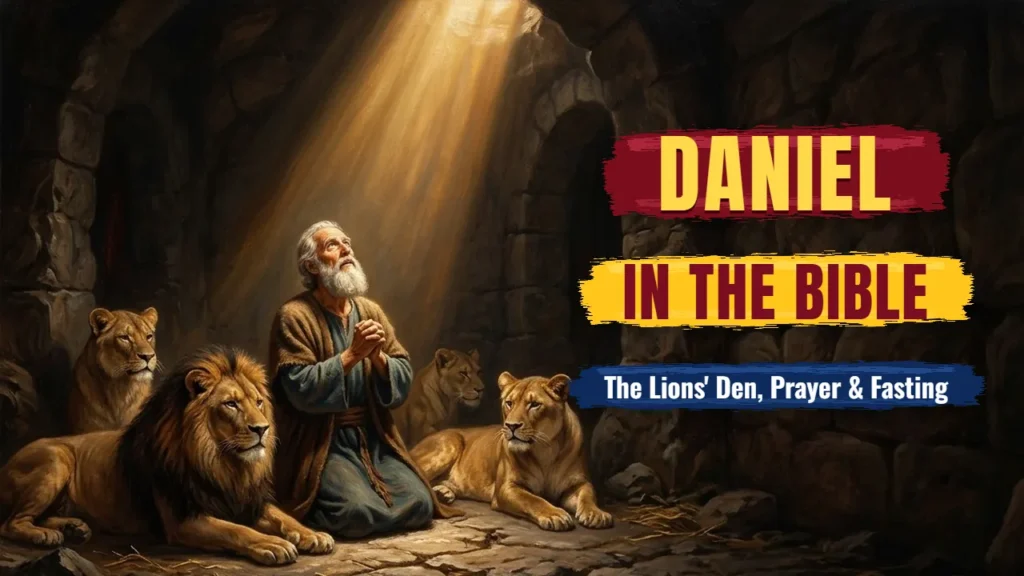
“Then the king commanded, and they brought Daniel, and cast him into the den of lions. Now the king spake and said unto Daniel, Thy God whom thou servest continually, he will deliver thee.”
— Daniel 6:16 (KJV)
Daniel was thrown into the lions’ den. A stone was rolled over the opening and sealed with the king’s signet so no one could tamper with it (Daniel 6:17). Listen to what the king said: “Thy God whom thou servest continually, he will deliver thee.” Even the king had noticed that Daniel served God “continually.” That night the king wouldn’t eat and couldn’t sleep (Daniel 6:18).
“Then the king arose very early in the morning, and went in haste unto the den of lions. And when he came to the den, he cried with a lamentable voice unto Daniel: and the king spake and said to Daniel, O Daniel, servant of the living God, is thy God, whom thou servest continually, able to deliver thee from the lions? Then said Daniel unto the king, O king, live for ever. My God hath sent his angel, and hath shut the lions mouths, that they have not hurt me: forasmuch as before him innocency was found in me; and also before thee, O king, have I done no hurt.”
— Daniel 6:19-22 (KJV)
At first light, the king hurried to the den and called out in an anguished voice. From inside, Daniel answered calmly: “My God hath sent his angel, and hath shut the lions mouths.” He didn’t lash out at the king. He spoke respectfully, “O king, live for ever,” and said he was innocent before God and had done nothing wrong to the king either.
“Then was the king exceeding glad for him, and commanded that they should take Daniel up out of the den. So Daniel was taken up out of the den, and no manner of hurt was found upon him, because he believed in his God.”
— Daniel 6:23 (KJV)
Daniel came out without a scratch. Why? “Because he believed in his God.” It wasn’t Daniel’s strength that saved him. It was his trust in God, and God’s answer to that trust.
“And the king commanded, and they brought those men which had accused Daniel, and they cast them into the den of lions, them, their children, and their wives; and the lions had the mastery of them, and brake all their bones in pieces or ever they came at the bottom of the den.”
— Daniel 6:24 (KJV)
The king had Daniel’s accusers thrown into the same den, and the lions overpowered them before they even hit the bottom. So those lions weren’t tame or full. The fact that they didn’t touch Daniel all night was a true miracle. (Note:) Punishing the accusers’ wives and children too was a harsh Persian royal practice. This was the king’s order, not God’s command. The Law of Moses itself says “the children” shall not “be put to death for the fathers” (Deuteronomy 24:16).
“I make a decree, That in every dominion of my kingdom men tremble and fear before the God of Daniel: for he is the living God, and stedfast for ever, and his kingdom that which shall not be destroyed, and his dominion shall be even unto the end. He delivereth and rescueth, and he worketh signs and wonders in heaven and in earth, who hath delivered Daniel from the power of the lions.”
— Daniel 6:26-27 (KJV)
The king who had signed a law demanding that everyone pray only to him now issued a new decree: everyone in his kingdom must fear the God of Daniel. “He is the living God,” and “his kingdom that which shall not be destroyed.” The same truth revealed in Nebuchadnezzar’s dream now came out of a Persian king’s mouth. Because one man stayed faithful, a whole empire heard about the living God.
(Historical note:) Daniel was a youth when he arrived in Babylon. The lions’ den took place about 66 years later, so commentators estimate Daniel was around 80 years old. Children’s Bibles often draw him as a young man, but by the Bible’s own timeline, he was an old man. If you’re going through the most frightening season of your life, read our article I’m Going Through the Scariest Time of My Life — Is God Really With Me?
Daniel’s Prayer: How Did He Pray, and Why Was His Answer Delayed?
Prayer shows up all through Daniel’s life: praying with his friends for the dream to be revealed (2:17-18), praising God when the answer came (2:20-23), kneeling three times a day (6:10), and fasting for three weeks (10:2-3). The longest and deepest of his prayers is in chapter 9.
“In the first year of his reign I Daniel understood by books the number of the years, whereof the word of the LORD came to Jeremiah the prophet, that he would accomplish seventy years in the desolations of Jerusalem. And I set my face unto the Lord God, to seek by prayer and supplications, with fasting, and sackcloth, and ashes:”
— Daniel 9:2-3 (KJV)
This was in the first year of Darius, right after Babylon fell. The aging Daniel was reading “by books,” meaning the scroll of the prophet Jeremiah, and came across the promise that Jerusalem’s desolation would last seventy years (the Jeremiah 29:10 promise we saw earlier). Counting the years, he realized the seventy years were nearly up. He didn’t think, “God promised it, so there’s no need to pray.” God’s promise is exactly what drove him to pray. He fasted, put on sackcloth, and sat in ashes as he poured out his heart to God. Notice too that Daniel, a great prophet himself, was carefully studying the writings of another prophet.
“And I prayed unto the LORD my God, and made my confession, and said, O Lord, the great and dreadful God, keeping the covenant and mercy to them that love him, and to them that keep his commandments; We have sinned, and have committed iniquity, and have done wickedly, and have rebelled, even by departing from thy precepts and from thy judgments:”
— Daniel 9:4-5 (KJV)
Daniel’s prayer opens with two things. First, who God is: great, awesome (“dreadful” in old English), faithful to His covenant and His mercy. Then confession. Notice he didn’t say “they have sinned.” He said “We have sinned.” The Bible doesn’t record a single wrongdoing in Daniel’s life, and yet he owned his people’s sin as his own before God.
“O my God, incline thine ear, and hear; open thine eyes, and behold our desolations, and the city which is called by thy name: for we do not present our supplications before thee for our righteousnesses, but for thy great mercies. O Lord, hear; O Lord, forgive; O Lord, hearken and do; defer not, for thine own sake, O my God: for thy city and thy people are called by thy name.”
— Daniel 9:18-19 (KJV)
The closing words of the prayer are full of longing. “We do not present our supplications before thee for our righteousnesses, but for thy great mercies.” Daniel didn’t point to his own goodness. He leaned entirely on God’s mercy and God’s name. “O Lord, hear; O Lord, forgive.” Short words, straight from the heart. If you’re carrying a mistake and wondering whether God will forgive you, you can come to Him the same way Daniel did, on the basis of His mercy. (See our article I Made a Mistake: Will God Forgive Me?)
“And whiles I was speaking, and praying, and confessing my sin and the sin of my people Israel, and presenting my supplication before the LORD my God for the holy mountain of my God; Yea, whiles I was speaking in prayer, even the man Gabriel, whom I had seen in the vision at the beginning, being caused to fly swiftly, touched me about the time of the evening oblation.”
— Daniel 9:20-21 (KJV)
While Daniel was still praying, the angel Gabriel came to him. Look at the timing: “about the time of the evening oblation,” the hour of the evening sacrifice. The temple in Jerusalem had been in ruins for nearly fifty years, and the sacrifices had stopped. But Daniel still kept that hour as his time of prayer.
“At the beginning of thy supplications the commandment came forth, and I am come to shew thee; for thou art greatly beloved: therefore understand the matter, and consider the vision.”
— Daniel 9:23 (KJV)
Gabriel’s words are deeply comforting. “At the beginning of thy supplications,” God had already sent the answer. And he told Daniel, “thou art greatly beloved.” In God’s eyes, Daniel was precious. Gabriel then gave Daniel the vision of the “seventy weeks” (Daniel 9:24-27), which we’ll look at in the visions section below.
When the answer is delayed: Daniel 10
In chapter 10, Daniel fasted and prayed for three weeks. After twenty-one days, an angel came and said:
“And he said unto me, O Daniel, a man greatly beloved, understand the words that I speak unto thee, and stand upright: for unto thee am I now sent. And when he had spoken this word unto me, I stood trembling. Then said he unto me, Fear not, Daniel: for from the first day that thou didst set thine heart to understand, and to chasten thyself before thy God, thy words were heard, and I am come for thy words.”
— Daniel 10:11-12 (KJV)
Daniel’s prayer was heard “from the first day.” But the answer took three weeks to arrive. Why?
“But the prince of the kingdom of Persia withstood me one and twenty days: but, lo, Michael, one of the chief princes, came to help me; and I remained there with the kings of Persia.”
— Daniel 10:13 (KJV)
The angel explained that “the prince of the kingdom of Persia” had opposed him for twenty-one days, until Michael, “one of the chief princes” (an archangel), came to help him. (Commentators’ explanation:) Most commentators understand “the prince of the kingdom of Persia” not as a human king but as an evil spiritual power working behind that empire. The Bible gives very few details about these unseen battles, so we shouldn’t build big theories on them. But we can take real comfort from this passage: a delayed answer doesn’t mean God didn’t hear. If you’ve been praying for years without an answer, read our article I’ve Asked God for Nine Years and Still No Answer — How Much Longer Am I Supposed to Believe?
Daniel’s private prayer life brings to mind something Jesus said:
“But thou, when thou prayest, enter into thy closet, and when thou hast shut thy door, pray to thy Father which is in secret; and thy Father which seeth in secret shall reward thee openly.”
— Matthew 6:6 (KJV)
In the Sermon on the Mount, Jesus warned against people who pray on street corners to be seen. Prayer isn’t a performance for people. It’s for God. “Closet” here means an inner room. Daniel, too, prayed in his own room. His enemies only found out because they were specifically spying on him. Steady, private, faithful prayer was the source of Daniel’s strength.
What Visions Did Daniel See?
Chapters 7 through 12 of the book of Daniel record the visions God gave him. They’re full of symbols and numbers, and Christians have many different views on the details. So in this section we’ll focus mainly on what the Bible says clearly.
“In the first year of Belshazzar king of Babylon Daniel had a dream and visions of his head upon his bed: then he wrote the dream, and told the sum of the matters.”
— Daniel 7:1 (KJV)
Chapter 7 goes back in time to the first year of Belshazzar, before the feast in chapter 5. (The book of Daniel doesn’t tell everything in strict chronological order.) In this dream Daniel saw four terrifying beasts rise out of the sea: one like a lion, one like a bear, one like a leopard, and a fourth, dreadful beast with iron teeth (Daniel 7:2-8). The vision itself explains that the four beasts are four kings or kingdoms (Daniel 7:17). Many commentators see them as the same sequence of kingdoms as the statue in chapter 2. Then Daniel saw “the Ancient of days,” God Himself, seated on a throne for judgment (Daniel 7:9-10). And then he saw this:
“I saw in the night visions, and, behold, one like the Son of man came with the clouds of heaven, and came to the Ancient of days, and they brought him near before him. And there was given him dominion, and glory, and a kingdom, that all people, nations, and languages, should serve him: his dominion is an everlasting dominion, which shall not pass away, and his kingdom that which shall not be destroyed.”
— Daniel 7:13-14 (KJV)
After the beastly kingdoms, Daniel saw “one like the Son of man” coming with the clouds of heaven. God, the Ancient of days, gave Him everlasting dominion and a kingdom. People of every nation and language would serve Him, and His kingdom would never be destroyed. This is one of the most important visions in the Bible, because “the Son of man” is the very title Jesus used for Himself. We’ll come back to that below.
In chapter 8, Daniel saw a ram and a goat in a vision. This time the angel explained them by name:
“The ram which thou sawest having two horns are the kings of Media and Persia. And the rough goat is the king of Grecia: and the great horn that is between his eyes is the first king.”
— Daniel 8:20-21 (KJV)
The two-horned ram is the kingdom of Media and Persia. The shaggy goat that charges in and overthrows it is Greece, and its great horn is the first king. (Historical note, not in the Bible:) About two hundred years after Daniel saw this vision, Alexander the Great of Greece (who reigned 336-323 BC) conquered the Persian Empire with astonishing speed. When he died young, his empire split into four parts. The vision says the great horn was broken and four horns came up in its place (Daniel 8:8, 22). Many commentators identify the great horn as Alexander and the later “little horn” in this chapter as Antiochus Epiphanes, a Greek king who brutally persecuted the Jews.
What are the “seventy weeks” of Daniel 9?
After Daniel’s prayer in chapter 9, Gabriel told him that “Seventy weeks are determined upon thy people and upon thy holy city.” From “the going forth of the commandment to restore and to build Jerusalem unto the Messiah the Prince” would be a set period, and after that, “shall Messiah be cut off, but not for himself” (Daniel 9:24-26). (Commentators’ explanations:) Many Christians read each “week” as seven years and believe this prophecy points to the coming of Jesus Christ and His death on the cross. Even among them, there are different views about the final “week”: some say it was fulfilled in Christ’s time, others say it’s still to come at the end of the age. Other scholars believe the prophecy refers to events in the time of the Greek king Antiochus. This is one of the hardest passages in the Bible, and we’re not ruling on which calculation is correct.
The dead will rise: Daniel 12
The last chapter of Daniel contains one of the clearest promises of resurrection in the Old Testament:
“And many of them that sleep in the dust of the earth shall awake, some to everlasting life, and some to shame and everlasting contempt. And they that be wise shall shine as the brightness of the firmament; and they that turn many to righteousness as the stars for ever and ever.”
— Daniel 12:2-3 (KJV)
Those who “sleep in the dust,” meaning the dead, will one day wake up: some to everlasting life, some to everlasting shame. Death isn’t the final word. Those who lived wisely for God, and those who led others to do what’s right, will shine like the stars forever. To learn more about what the Bible says happens after death, read our article Body, Soul, and Spirit: What Happens When You Die?
What Did Jesus Say About Daniel?
The book of Daniel echoes all through the New Testament. Jesus Himself mentioned Daniel by name and called him a prophet:
“When ye therefore shall see the abomination of desolation, spoken of by Daniel the prophet, stand in the holy place, (whoso readeth, let him understand:)”
— Matthew 24:15 (KJV)
As Jesus left the temple in Jerusalem, He told His disciples it would be destroyed. Describing the hard times ahead, He pointed to a sign “spoken of by Daniel the prophet”: “the abomination of desolation” standing in the holy place (see Daniel 9:27; 11:31; 12:11). Notice that Jesus calls Daniel “the prophet.” (Commentators’ views:) Some believe this was fulfilled when the Roman army destroyed the temple in AD 70, others believe it’s still to be fulfilled at the end of the age, and others believe both.
Jesus’s words at His trial also come straight from Daniel’s vision:
“But he held his peace, and answered nothing. Again the high priest asked him, and said unto him, Art thou the Christ, the Son of the Blessed? And Jesus said, I am: and ye shall see the Son of man sitting on the right hand of power, and coming in the clouds of heaven.”
— Mark 14:61-62 (KJV)
After Jesus was arrested and brought before the Jewish council, the high priest asked Him directly whether He was the Christ. Jesus answered, “I am,” and said they would see “the Son of man… coming in the clouds of heaven.” The high priest tore his clothes (Mark 14:63). Everyone in the room understood that Jesus was claiming to be the “Son of man” from Daniel 7:13-14, the one who comes with the clouds and receives an everlasting kingdom. The New Testament teaches that Daniel’s vision is fulfilled in Jesus.
The book of Hebrews remembers Daniel and his friends in its list of heroes of faith:
“Who through faith subdued kingdoms, wrought righteousness, obtained promises, stopped the mouths of lions, Quenched the violence of fire, escaped the edge of the sword, out of weakness were made strong, waxed valiant in fight, turned to flight the armies of the aliens.”
— Hebrews 11:33-34 (KJV)
Hebrews 11 is the great “faith chapter” that celebrates men and women of faith from the Old Testament. The names aren’t listed here, but “stopped the mouths of lions” points to Daniel, and “Quenched the violence of fire” points to Shadrach, Meshach, and Abed-nego. They didn’t win because they were strong. They won “through faith.”
How Long Did Daniel Live, and Where Did He Die?
The last date the book of Daniel gives for Daniel is this:
“In the third year of Cyrus king of Persia a thing was revealed unto Daniel, whose name was called Belteshazzar; and the thing was true, but the time appointed was long: and he understood the thing, and had understanding of the vision.”
— Daniel 10:1 (KJV)
In the third year of Cyrus, Daniel was still alive and still receiving visions from God. (Historical note:) Historians place this around 536 BC. If Daniel was a teenager when he was taken to Babylon in 605 BC, he would have been around 85 by then. In Cyrus’s first year, a decree went out allowing the Jews to return to their land (Ezra 1:1-3). The Bible never says Daniel went back to Jerusalem. Whether because of his age or some other reason, he seems to have stayed in the region of Babylon.
The book of Daniel ends with a personal, comforting word from God to Daniel:
“But go thou thy way till the end be: for thou shalt rest, and stand in thy lot at the end of the days.”
— Daniel 12:13 (KJV)
Daniel didn’t understand everything in his visions. He admitted, “I heard, but I understood not” (Daniel 12:8). God didn’t explain it all. Instead He said: go your way to the end. You will rest, meaning you will die. But at the end of the days you will rise and “stand in thy lot,” meaning you’ll receive the inheritance set aside for you. Daniel spent his whole life far from home, and God’s final promise to him was that he had a permanent place waiting.
The Bible doesn’t say when or where Daniel died. (Traditions, not proven:) Several places claim to have Daniel’s tomb. The best known is the “Tomb of Daniel” in the city of Shush in Iran, the site of ancient Susa (Shushan). Sites in Kirkuk, Iraq, and Samarkand, Uzbekistan, also claim to be his burial place. None of these has been proven.
Book of Daniel Summary by Chapter
If you’d like the whole book at a glance, here’s a chapter-by-chapter summary of the book of Daniel:
- Chapter 1: Exile and the king’s food. Nebuchadnezzar besieges Jerusalem. Daniel, Hananiah, Mishael, and Azariah are taken to Babylon and given new names. Daniel asks for a ten-day test instead of the king’s food. God gives the four young men wisdom (Daniel 1:1-21).
- Chapter 2: Nebuchadnezzar’s dream. The king dreams of a statue with a head of gold and feet of iron and clay. God reveals the dream and its meaning to Daniel. God’s kingdom will stand forever. Daniel is promoted (Daniel 2:1-49).
- Chapter 3: The golden image and the fiery furnace. Shadrach, Meshach, and Abed-nego refuse to bow to the statue and are thrown into the furnace. A fourth figure appears in the fire. They come out without even the smell of smoke (Daniel 3:1-30).
- Chapter 4: A proud king humbled. Nebuchadnezzar dreams of a great tree. Because of his pride, he loses his mind and lives like an animal. He later praises God and gets his kingdom back (Daniel 4:1-37).
- Chapter 5: The writing on the wall. Belshazzar drinks from the temple vessels. A hand writes “MENE, MENE, TEKEL, UPHARSIN” on the wall. That same night Babylon falls (Daniel 5:1-31).
- Chapter 6: The lions’ den. Daniel keeps praying three times a day despite the king’s decree. He’s thrown into the lions’ den, and God shuts the lions’ mouths (Daniel 6:1-28).
- Chapter 7: Four beasts and the Son of man. Daniel sees four beasts representing four kingdoms, and one like the Son of man coming with the clouds to receive an everlasting kingdom (Daniel 7:1-28).
- Chapter 8: The ram and the goat. A vision about the kingdoms of Media-Persia and Greece (Daniel 8:1-27).
- Chapter 9: Daniel’s prayer and the seventy weeks. After reading Jeremiah’s prophecy, Daniel prays and confesses his people’s sins. Gabriel gives the prophecy of the seventy weeks (Daniel 9:1-27).
- Chapters 10-12: The final vision. After a three-week fast, an angel comes to Daniel. He tells of future kings and wars, the suffering of God’s people, Michael, and the resurrection of the dead. The book ends with “go thou thy way till the end be” (Daniel 10:1-12:13).
(Language note, not in the Bible:) The book of Daniel was written in two languages. Daniel 1:1 to the middle of 2:4, and chapters 8-12, are in Hebrew. From 2:4 through the end of chapter 7, it’s in Aramaic, the common language of the Babylonian and Persian empires.
(Differing views, not in the Bible:) Opinions differ on when the book of Daniel was written. Jewish and Christian tradition holds that Daniel wrote it in the sixth century BC, and many point to Jesus calling him “Daniel the prophet.” Many modern scholars believe the book reached its final form later, around 165 BC, during the persecution under the Greek king Antiochus. We’re not ruling on which view is correct.
(Note:) Catholic and Orthodox Bibles include some additional sections of Daniel in Greek: the Prayer of Azariah and the Song of the Three Holy Children in the furnace, the story of Susanna, and the story of Bel and the Dragon. These aren’t in the Hebrew Bible, so Protestant Bibles, including the King James Version’s Old Testament, don’t include them in Daniel.
What Does Daniel’s Life Teach Us?
- Make the decision before the test. “Daniel purposed in his heart that he would not defile himself” (Daniel 1:8). If we wait until the pressure hits to decide, we’ll probably cave. When we settle ahead of time that we’ll stay faithful to God, we can stand when the test comes.
- You can stay faithful far from home. Daniel’s name changed, his language changed, his country changed. His God didn’t. For anyone moving away for school or a job, Daniel is a powerful example.
- Integrity is a powerful witness. His enemies searched his work and found no “error or fault” (Daniel 6:4). Honest work, honest books, and honest words say more about our God than a sermon ever could.
- Make prayer a habit, not an emergency. Daniel prayed three times a day “as he did aforetime” (Daniel 6:10). If we spend time with God every ordinary day, we’ll be ready to stand on the hard days.
- Good friends are a gift from God. When his life was on the line, Daniel gathered his three friends to pray (Daniel 2:17-18). Keep friends close who pray with you and point you toward God.
- “But if not.” Real faith stays loyal to God not only when He does what we ask, but also when He doesn’t (Daniel 3:18).
- Pride comes before a fall. “Those that walk in pride he is able to abase” (Daniel 4:37). Our education, career, money, and reputation are all gifts from God. Instead of saying “I” and “my,” give Him the glory.
- Give God the credit. Standing before the king, Daniel said, “there is a God in heaven that revealeth secrets” (Daniel 2:28). We shouldn’t use the gifts God gives us to build our own name, but to make His name great.
- The world’s kingdoms fall, but God’s kingdom stands. Babylon fell, Persia fell, Greece fell. But the kingdom the God of heaven sets up “shall never be destroyed” (Daniel 2:44). Our future doesn’t depend on any government.
- It all points to Jesus. Jesus said He is the “Son of man” coming with the clouds from Daniel’s vision (Mark 14:62). Daniel came out of the lions’ den alive. Jesus came out of the tomb, having conquered death itself.
Related Articles
- Jonah in the Bible: The Story of the Whale, Nineveh, and the Sign of Jonah
- Elijah in the Bible: The Prophet’s Story, Miracles, Prayer, and Chariot of Fire
- Joseph’s Life: The Complete Biblical Story of His Trials, Faith, and Forgiveness
- King Solomon in the Bible: How the Wisest King Lost His Way
- The 12 Tribes of Israel: Names, Meanings, Bible Verses, and Where They Are Today
- I’ve Asked God for Nine Years and Still No Answer — How Much Longer Am I Supposed to Believe?
- More English Bible articles
Bible Passages About the Life of Daniel
- Exile to Babylon, new names, the king’s food — Daniel 1; Jeremiah 25:1-11; 29:10; Isaiah 39:7
- Nebuchadnezzar’s dream, the statue, God’s kingdom — Daniel 2
- The golden image and the fiery furnace — Daniel 3; Exodus 20:4-5; Hebrews 11:34
- Nebuchadnezzar’s pride and humbling — Daniel 4
- Belshazzar’s feast and the writing on the wall — Daniel 5
- The lions’ den — Daniel 6; 1 Kings 8:46-49; Deuteronomy 24:16; Hebrews 11:33
- Four beasts and the Son of man — Daniel 7; Mark 14:61-62
- The ram and the goat — Daniel 8
- Daniel’s prayer and the seventy weeks — Daniel 9
- The three-week fast, the final vision, the resurrection — Daniel 10–12
- Daniel in the book of Ezekiel — Ezekiel 14:14, 20; 28:3
- Jesus on Daniel and on prayer — Matthew 24:15; Matthew 6:6
- The return from exile — Ezra 1:1-4
Historical Sources Used in This Article
- Meaning of Daniel’s name (“God is my judge”), Belteshazzar (Beltu-šar-uṣur), tomb traditions — Wikipedia: Daniel (biblical figure)
- Structure of the book, Hebrew and Aramaic sections, views on when it was written — Wikipedia: Book of Daniel
- Nebuchadnezzar’s reign, the 605 BC deportation, building projects in Babylon — Wikipedia: Nebuchadnezzar II
- Belshazzar as the son of Nabonidus — Wikipedia: Belshazzar
- The fall of Babylon in 539 BC and Herodotus’s account — Wikipedia: Fall of Babylon
- Views on the identity of Darius the Mede — Wikipedia: Darius the Mede
- Meanings of “Mene, Mene, Tekel, Upharsin” — Wikipedia: Belshazzar’s feast
- The Tomb of Daniel in Shush — Wikipedia: Tomb of Daniel
- The modern Daniel Fast — Wikipedia: Daniel Fast
- The Greek additions to Daniel — Wikipedia: Additions to Daniel
- Jewish traditions about Daniel, the 597 BC dating of the exile — Jewish Virtual Library: Daniel
Disclaimers
On language: we’ve written this article in plain, everyday English that anyone can follow, even without a church background.
On the story and opinions: there are no fictional stories in this article. Daniel’s story is told the way the Bible records it. The story of Emily in the introduction is only an illustration to help explain the idea; Emily is not a real person. Where the Bible doesn’t give a direct answer (Daniel’s age, his parents, whether he was a eunuch, his tomb, the meaning of Belteshazzar, why the king’s food was defiling, the four kingdoms of the statue, the fourth figure in the furnace, where Daniel was in chapter 3, Nebuchadnezzar’s illness, Belshazzar and Nabonidus, the identity of Darius the Mede, the meanings of “Mene, Tekel,” the prince of Persia, the seventy weeks, the fulfillment of the “abomination of desolation,” when the book was written, the modern “Daniel fast,” the comparisons with Joseph and Jonah, and historical dates and measurements), we’ve shared the explanations of scholars and commentators and historical information, and labeled them clearly as such where they appear. We’re not ruling on which of those explanations is correct. What we say about fasting is not medical advice; if you have health conditions, please talk to a doctor.
On the verses: every Bible quotation in this article is from the King James Version (KJV), a public-domain English translation. Under each verse, we’ve explained the situation it was spoken in, in plain words, for readers who may not know the Bible well. To understand any verse fully, read the whole chapter it comes from in your own Bible. This article is not a complete or final explanation of the subject, and it isn’t arguing for or against any particular church tradition. Treat it as a study aid only.